Materials estimating guide
How Much Paint Do I Need? (Australia, Litres per m²)
How much paint do I need? Measure walls in m², double for two coats, divide by the can's 12–16 m² per litre, round up to 4 L or 10 L cans. Room tables inside.
Published 2026-09-19 · Updated 2026-09-19 · BuildMeasure Editorial Team
Next step
Turn your measurements into a material estimate
Enter the recorded dimensions in the calculator. It shows the calculated amount, wastage allowance, and a supplier-ready suggested order.
Use the Wall and Ceiling Paint CalculatorHow much paint do I need? The short answer
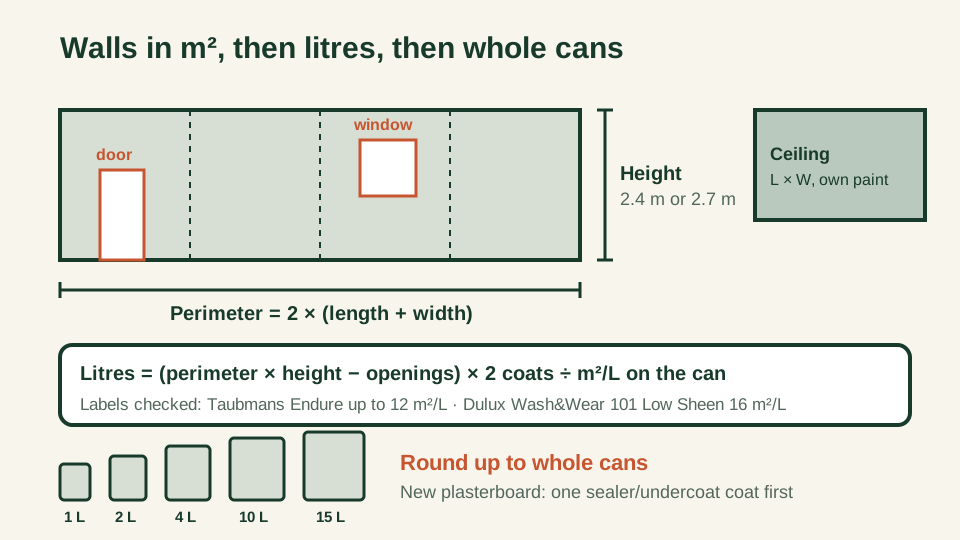
To work out how many litres of paint you need, measure the walls in square metres, deduct doors and windows you are not painting, multiply by two coats, then divide by the spread rate on the can — 12 to 16 m² per litre on the Australian labels checked here. Round up to whole cans.
The spread rate is the number that changes the answer most. Taubmans lists Endure interior wall paint at up to 12 m² per litre, while the Dulux Wash&Wear 101 Low Sheen data sheet gives a theoretical spread rate of 16 m² per litre and specifies two coats. Dulux's own online paint calculator also assumes two topcoats at 16 m² per litre. Read the figure on the can you are actually buying: the same wall needs a third more paint at 12 m²/L than at 16 m²/L (16 ÷ 12 = 1.33).
Per square metre of wall, two coats use 2 ÷ 12 = 0.167 litres at 12 m²/L, or 2 ÷ 16 = 0.125 litres at 16 m²/L. Australian interior paint is sold in 1 L, 2 L, 4 L, 10 L and 15 L cans (Dulux Wash&Wear also comes in 500 mL), so the final step is always rounding the litres up to a combination of whole cans.
- Walls: perimeter × ceiling height, minus openings you are not painting.
- Ceilings: length × width of the room, worked out separately because they are usually a different product.
- Two coats is the manufacturers' standard; strong colour changes can need a third.
- New plasterboard or bare plaster needs one sealer/undercoat coat before the topcoats.
Step by step: measure the room in metres
Measure the length and width of the floor and the wall height from floor to ceiling. Many Australian homes have 2.4 m ceilings; newer homes are often 2.7 m, which adds 12.5% more wall area for the same floor plan (2.7 ÷ 2.4 = 1.125).
Perimeter = 2 × (length + width). Gross wall area = perimeter × height. Deduct each door and window you are not painting: a typical 2040 × 820 mm internal door is 2.04 × 0.82 = 1.67 m², and a 1200 × 1200 mm window is 1.44 m². Leave openings in the total if you are painting the frames and reveals in the same colour.
- Room length, width and ceiling height measured in metres.
- Perimeter = 2 × (length + width); gross wall area = perimeter × height.
- Doors and windows deducted only where they are outside the paint scope.
- Net wall area × number of coats (two for most topcoats).
- Divided by the m² per litre printed on your can or data sheet.
- Ceiling measured separately as length × width with its own spread rate.
- Sealer/undercoat added as one coat for new plasterboard or bare plaster.
- Litres rounded up to whole 1, 2, 4, 10 or 15 L cans.
Typical room sizes to litres of paint
The table assumes a 2.4 m ceiling and deducts one 2040 × 820 mm door (1.67 m²) and one 1200 × 1200 mm window (1.44 m²) from every room, 3.11 m² in total. Wall litres are for two coats at the two label spread rates checked above. The ceiling column uses 16 m² per litre, the figure Taubmans lists for Ceiling White and Dulux's calculator uses for ceiling paint.
Method for the first row: perimeter 2 × (3 + 3) = 12 m; gross area 12 × 2.4 = 28.8 m²; net area 28.8 − 3.11 = 25.69 m²; two coats 25.69 × 2 = 51.38 m²; at 12 m²/L that is 51.38 ÷ 12 = 4.28 L, and at 16 m²/L it is 51.38 ÷ 16 = 3.21 L. Ceiling: 3 × 3 = 9 m² × 2 coats ÷ 16 = 1.13 L.
| Room (floor) | Net wall area | Wall litres at 12 m²/L | Cans to buy at 12 m²/L | Wall litres at 16 m²/L | Ceiling litres at 16 m²/L |
|---|---|---|---|---|---|
| 3 × 3 m | 25.69 m² | 4.28 L | 1 × 4 L + 1 × 1 L | 3.21 L | 1.13 L |
| 3 × 4 m | 30.49 m² | 5.08 L | 1 × 4 L + 1 × 2 L | 3.81 L | 1.50 L |
| 4 × 4 m | 35.29 m² | 5.88 L | 1 × 4 L + 1 × 2 L | 4.41 L | 2.00 L |
| 4 × 5 m | 40.09 m² | 6.68 L | 1 × 4 L + 1 × 2 L + 1 × 1 L | 5.01 L | 2.50 L |
| 5 × 6 m | 49.69 m² | 8.28 L | 2 × 4 L + 1 × 1 L | 6.21 L | 3.75 L |
Litres = net wall area × 2 coats ÷ spread rate, rounded to two decimals. Cans are the smallest whole-can total that covers the litres; a single 10 L can is a sensible alternative from about 8 L upward. At 16 m²/L one 4 L can covers the walls of the 3 × 3 m and 3 × 4 m rooms. Use your own can's spread rate and room heights.
Ceilings, sealer and undercoat
Measure the ceiling as the floor area (length × width) and plan it with its own paint. Taubmans Ceiling White is listed at up to 16 m² per litre in 2 L, 4 L and 10 L sizes, so a 3 × 4 m ceiling at two coats needs 12 × 2 ÷ 16 = 1.5 L — one 2 L can.
New surfaces need preparation before the two topcoats. Dulux's Wash&Wear Low Sheen instructions call for one coat of Dulux 1Step Prep water-based primer, sealer and undercoat on unpainted plasterboard, and a sealer binder on set plaster. Dulux's calculator treats preparation products as a single coat; its page quotes 12 m² per litre in the calculation note and about 14 m² per litre in its general guide, so plan at the lower 12 m²/L unless your primer's label says otherwise.
The Wash&Wear 101 data sheet also notes that some colours may need more than two coats, especially over a contrasting colour. If you are going from a dark wall to a light one, or using a deep base colour, budget for a third coat or a tinted undercoat.
Worked example: a 4 × 3.5 m bedroom with 2.7 m ceilings, checked by hand
The room is 4 m long, 3.5 m wide and 2.7 m high, with new plasterboard, one 2040 × 820 mm door and one 1800 × 1200 mm window.
Walls: perimeter = 2 × (4 + 3.5) = 15 m. Gross area = 15 × 2.7 = 40.5 m². Openings = (2.04 × 0.82) + (1.8 × 1.2) = 1.67 + 2.16 = 3.83 m². Net wall area = 40.5 − 3.83 = 36.67 m².
Topcoat: two coats = 36.67 × 2 = 73.34 m². At 12 m²/L: 73.34 ÷ 12 = 6.11 L, so 1 × 4 L + 1 × 2 L (6 L) is just short — buy 1 × 4 L + 1 × 2 L + 1 × 1 L = 7 L, or one 10 L can if you want touch-up paint. At 16 m²/L: 73.34 ÷ 16 = 4.58 L, so 1 × 4 L + 1 × 1 L = 5 L.
Ceiling: 4 × 3.5 = 14 m² × 2 coats = 28 m² ÷ 16 = 1.75 L, so one 2 L can of ceiling paint.
Sealer/undercoat on the new plasterboard (one coat, walls and ceiling): 36.67 + 14 = 50.67 m² ÷ 12 = 4.22 L, so 1 × 4 L + 1 × 1 L. Check that the product you choose is suitable for ceilings as well as walls.
Common questions
These answers use the same method as the table: net wall area × coats ÷ the spread rate on the can.
- How many litres of paint for a 3x3 room? — About 3.2 L at 16 m²/L or 4.3 L at 12 m²/L for two coats on the walls (2.4 m ceiling, one door and one window deducted). That is one 4 L can with a 16 m²/L paint, or 4 L + 1 L with a 12 m²/L paint. The ceiling adds about 1.1 L.
- How many litres of paint per m²? — Two coats use 0.125 L per m² at 16 m²/L and 0.167 L per m² at 12 m²/L. One coat is half that.
- How many litres of paint for a room? — A typical 3 × 4 m bedroom with 2.4 m ceilings needs about 3.8–5.1 L for the walls (two coats) plus about 1.5 L for the ceiling. Larger rooms are in the table above.
- Why do the Dulux and other paint calculators give different answers? — They apply the same arithmetic but assume different spread rates. Dulux states its calculator uses two topcoats at 16 m²/L; if your can says 12 m²/L, the real requirement is a third higher.
- Is a 4 L can enough for a bedroom? — Only for a small room with a high-coverage paint. At 12 m²/L a 4 L can covers 4 × 12 ÷ 2 = 24 m² of wall at two coats, which is less than the walls of a 3 × 3 m room.
Common mistakes
Most over- and under-buying comes from a few repeatable errors.
- Using floor area instead of wall area — walls are perimeter × height, roughly three times the floor area in a typical bedroom.
- Forgetting the second coat, or treating the can's 'up to' spread rate as guaranteed on porous or textured surfaces.
- Adding the ceiling into the wall total when it will be painted in a different product and colour.
- Skipping the sealer/undercoat on new plasterboard, so the first topcoat soaks in unevenly.
- Assuming 2.4 m walls in a home with 2.7 m ceilings — that alone is 12.5% more paint.
- Rounding litres down. A 4.28 L result means more than one 4 L can.
Sources and limits
Check the project-specific details
- Dulux Australia — Paint Calculator — States the calculator assumes two coats of topcoat at 16 m² per litre and one coat of preparation product (quoted as 12 m² per litre in the calculation note and about 14 m² per litre in the general guide), and that coverage varies by surface and product.
- Dulux Wash & Wear 101 Low Sheen — Data Sheet AUDU06253 — Manufacturer data sheet giving a theoretical spread rate of 16 m²/L, two coats (some colours may need more over a contrasting colour) and 15, 10, 4, 2, 1 and 0.5 L pack sizes.
- Dulux Wash&Wear Low Sheen — product page — Lists 500 mL to 15 L sizes, two-coat application, and one coat of Dulux 1Step Prep primer, sealer and undercoat on unpainted plasterboard (sealer binder on set plaster).
- Taubmans Endure Interior — product page — Lists spread rate up to 12 m² per litre and 1, 2, 4, 10 and 15 L sizes — the lower label figure used in the tables.
- Taubmans Ceiling White — product page — Lists coverage up to 16 m² per litre in 2, 4 and 10 L sizes — the basis for the ceiling column.
Review status: Formulas and worked examples checked by hand; measurement practice pending human trade review.
This guide supports planning only. It does not specify structural design, code compliance, or a supplier quotation.