Materials estimating guide
How Many 20 kg Bags of Concrete Do You Need? (Australia)
Work out how many 20 kg bags of premixed concrete you need in Australia: 108 bags per cubic metre, bag counts by volume, post-hole tables, and a worked example.
Published 2026-07-20 · Updated 2026-07-20 · BuildMeasure Editorial Team
Next step
Turn your measurements into a material estimate
Enter the recorded dimensions in the calculator. It shows the calculated amount, wastage allowance, and a supplier-ready suggested order.
Use the Concrete Volume CalculatorThe short answer: about 108 × 20 kg bags per cubic metre
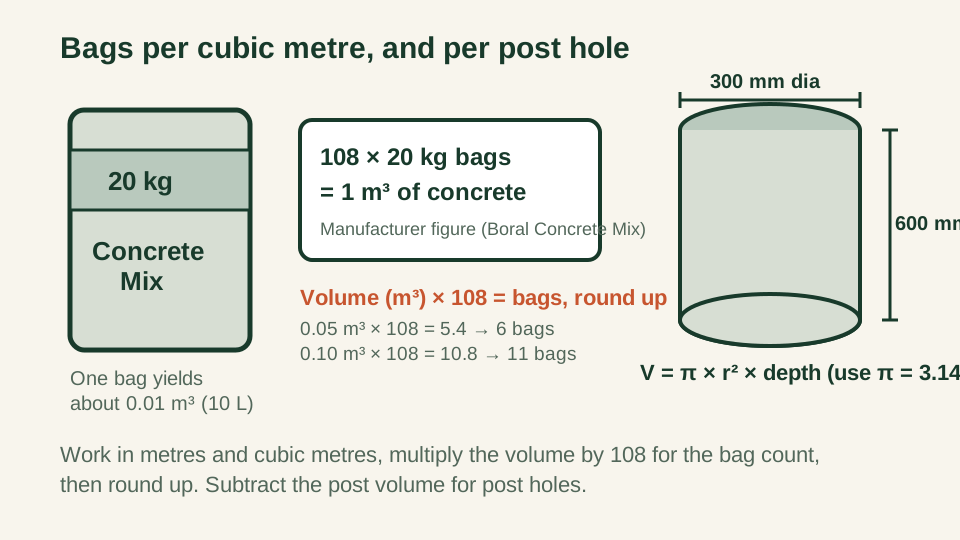
In Australia, premixed concrete is sold in 20 kg bags. Boral's Concrete Mix product data sheet states that one 20 kg bag covers roughly 1.1 m² to a depth of about 10 mm, and that 108 × 20 kg bags equal one cubic metre of mixed concrete. That works out to a yield of a little under 0.01 m³ (about 10 litres) per bag.
So the fast estimate is: work out the volume of your pour in cubic metres, multiply by 108, and round up to whole bags. For a rough 0.05 m³ footing that is 0.05 × 108 = 5.4, so you buy 6 bags. Always round up — a part bag still means buying a whole one.
Bagged concrete makes sense for small, spread-out, or hard-to-reach jobs: post holes, garden edges, a single footing, a small path, or repairs where a full ready-mix truck would be wasteful or cannot reach. Once a pour climbs past roughly 0.5–1 m³, mixing dozens of bags by hand becomes slow and inconsistent, and ordering ready-mix by the cubic metre is usually easier and more uniform.
- Bagged 20 kg mix: small pours, post holes, patching, tight access, staged work.
- Ready-mix by the m³: larger slabs and driveways, or any pour where consistency and speed matter.
- The changeover point is a judgement call, but somewhere around 0.5–1 m³ hand-mixing bags stops being practical.
Bags by volume: multiply cubic metres by 108
Once you know the volume of concrete you need in cubic metres, the bag count is simply volume × 108, rounded up. The table below uses Boral's stated 108 bags per cubic metre. Different brands quote slightly different yields (Boral's Post Hole Concrete, for example, lists about 0.011 m³ per bag while still using 108 bags per cubic metre), so check the bag you actually buy and round up.
| Volume needed | Bags (volume × 108) | Buy (rounded up) |
|---|---|---|
| 0.02 m³ | 2.16 | 3 bags |
| 0.05 m³ | 5.40 | 6 bags |
| 0.10 m³ | 10.80 | 11 bags |
| 0.50 m³ | 54.00 | 54 bags |
| 1.00 m³ | 108.00 | 108 bags |
Based on Boral Concrete Mix: 108 × 20 kg bags = 1 m³. Round every fractional result up to the next whole bag.
Post holes: turn hole size into a bag count
A post hole is a cylinder, so its volume is V = π × r² × depth. Boral's Post Hole Concrete data sheet gives exactly this method: calculate the hole volume in cubic metres using V = πr²h (with π taken as 3.142), subtract the volume of the post, then multiply the result by 108 to get the number of 20 kg bags.
The table below lists common round-hole sizes and the gross hole volume (before you subtract the post). Because the post takes up some of the hole, treating the hole as solid gives a small safety margin. Work in millimetres for the measurements, then convert to metres for the formula (300 mm = 0.3 m, radius 0.15 m).
| Hole diameter × depth | Radius | Volume | Bags (× 108, rounded up) |
|---|---|---|---|
| 200 mm × 600 mm | 0.10 m | 0.019 m³ | 3 bags |
| 300 mm × 600 mm | 0.15 m | 0.042 m³ | 5 bags |
| 300 mm × 900 mm | 0.15 m | 0.064 m³ | 7 bags |
| 450 mm × 900 mm | 0.225 m | 0.143 m³ | 16 bags |
Volumes treat the hole as solid concrete. Subtracting the post volume reduces the bag count slightly; the extra is a useful margin.
Worked example: a 300 mm × 600 mm post hole, checked by hand
Say you are setting a 100 mm × 100 mm timber post in a hole 300 mm in diameter and 600 mm deep, and you want the concrete-only quantity.
First the hole volume. Radius r = 300 ÷ 2 = 150 mm = 0.15 m, and depth h = 600 mm = 0.6 m. V = π × r² × h = 3.142 × (0.15 × 0.15) × 0.6 = 3.142 × 0.0225 × 0.6 = 0.0424 m³.
Next the post volume: 0.1 m × 0.1 m × 0.6 m = 0.006 m³. Concrete needed = 0.0424 − 0.006 = 0.0364 m³.
Finally the bags: 0.0364 × 108 = 3.9, so round up to 4 × 20 kg bags. If you skip the post subtraction and treat the hole as solid, 0.0424 × 108 = 4.6, which still rounds to 5 bags — so buying 5 gives you a spare.
- Pour volume worked out in cubic metres (length × width × depth, all in metres).
- Post holes calculated as cylinders with V = πr²h using π = 3.142.
- Post volume subtracted where you want concrete-only quantities.
- Volume multiplied by 108 (or your bag's stated bags-per-m³) for the bag count.
- Every fractional bag rounded up to the next whole 20 kg bag.
- A spare bag or two allowed for spillage, over-dig, and slump.
Common mistakes
Most bag-count errors come from unit slips and from forgetting that thickness is a real third dimension, not an afterthought.
- Mixing millimetres and metres in the same formula — convert everything to metres before multiplying.
- Forgetting depth: a path is length × width × thickness, and thinning by 10 mm changes the volume, not just the surface.
- Rounding bag counts down. A result of 5.4 bags means 6 bags, never 5.
- Assuming every brand yields exactly the same — check the bag's own bags-per-m³ or litres-per-bag figure.
- Buying zero margin. Over-dig, spillage, and a wetter mix all eat into yield, so keep a spare bag on site.
Same project
Related measurement guides
Sources and limits
Check the project-specific details
- Boral Concrete Mix — Product Data Sheet — States one 20 kg bag covers about 1.1 m² at ~10 mm and that 108 × 20 kg bags equal one cubic metre of mixed concrete — the basis for the ×108 bag counts.
- Boral Post Hole Concrete — Product Data Sheet — Sets out the post-hole method V = πr²h (use π = 3.142), a per-bag yield of about 0.011 m³, and 108 × 20 kg bags per cubic metre.
Review status: Formulas and conversions covered by automated tests; measurement practice pending human trade review.
This guide supports planning only. It does not specify structural design, code compliance, or a supplier quotation.