Measurement basics guide
How to Measure Decking in Australia (Lineal Metres)
Measure an Australian deck in lineal metres: divide deck width by board width plus gap for rows, multiply by length, add waste. With board sizes and a worked example.
Published 2026-07-20 · Updated 2026-07-20 · BuildMeasure Editorial Team
Next step
Turn your measurements into a material estimate
Enter the recorded dimensions in the calculator. It shows the calculated amount, wastage allowance, and a supplier-ready suggested order.
Use the Decking CalculatorAustralian decking is bought by the lineal metre
In Australia, decking boards are priced and sold per lineal metre (lm) — the total end-to-end length of board, regardless of how wide the board is. So the job of measuring a deck is really the job of working out how many metres of board it takes to cover the surface.
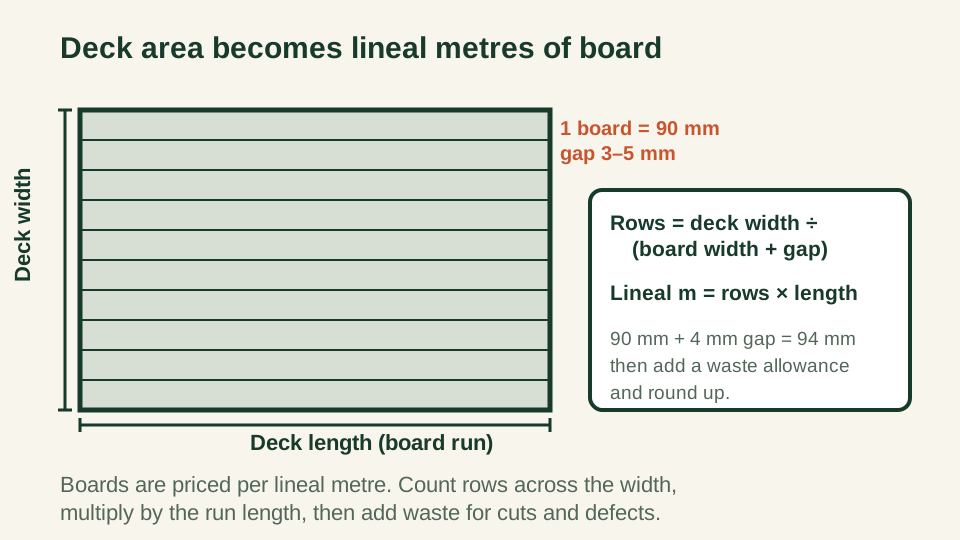
The method is: divide the deck width (measured across the direction the boards run) by the board width plus the gap between boards to get the number of rows; multiply the number of rows by the deck length (the direction the boards run) to get lineal metres; then add a waste allowance and round up.
Common solid-timber board profiles are 90 × 19 mm and 140 × 22 mm. Merbau and spotted gum are popular hardwoods, usually around 19 mm thick; treated pine is commonly 22 mm thick and comes in profiles such as 90 × 22 mm and 140 × 22 mm. Boards ship in set stock lengths — 5.4 m is a common one — as well as random lengths sold by the lineal metre.
- Width = across the boards; length = along the boards (the run direction).
- Narrower boards (90 mm) mean more rows and more lineal metres than wide boards (140 mm) for the same deck.
- A gap of roughly 3–5 mm between boards is normal to allow drainage and timber movement; the exact gap is a setting-out choice.
The method, step by step
Boards sit side by side with a small gap, so each row effectively occupies (board width + gap). For 90 mm boards with a 4 mm gap that is 94 mm, or 0.094 m, per row.
Rows = deck width ÷ (board width + gap), always rounded up because a part row still needs a full board. Lineal metres = rows × deck length. Then add waste for cutting, board defects, and any diagonal or feature boards.
- Deck width and length measured in metres, at the widest and longest points.
- Board width and planned gap chosen (e.g. 90 mm + 4 mm = 94 mm per row).
- Rows = width ÷ (board width + gap), rounded up to a whole row.
- Lineal metres = rows × length.
- Waste allowance added (commonly around 10%, more for angled or picture-frame layouts).
- Result rounded up, and cross-checked against the stock lengths you can buy.
Deck size to lineal metres (90 mm boards, 4 mm gap)
The table below uses 90 × 19 mm boards with a 4 mm gap (94 mm per row) and a 10% waste allowance. Read deck size as width × length. For wider 140 mm boards you would divide by roughly 144 mm per row instead, giving fewer rows and fewer lineal metres for the same deck.
| Deck (width × length) | Rows (÷ 94 mm) | Lineal m (no waste) | Lineal m (+10%) |
|---|---|---|---|
| 3.0 m × 3.0 m | 32 | 96 | 106 lm |
| 3.0 m × 4.0 m | 32 | 128 | 141 lm |
| 4.0 m × 4.0 m | 43 | 172 | 190 lm |
| 4.0 m × 5.0 m | 43 | 215 | 237 lm |
| 5.0 m × 5.0 m | 54 | 270 | 297 lm |
| 6.0 m × 4.0 m | 64 | 256 | 282 lm |
Rows rounded up. Lineal metres rounded up to the whole metre after adding 10% waste. Wider boards need fewer rows.
Worked example: a 4.2 m × 5.0 m deck, checked by hand
Take a deck 4.2 m wide (across the boards) and 5.0 m long (the board run), using 90 × 19 mm boards with a 4 mm gap and a 10% waste allowance.
Per row = board width + gap = 90 + 4 = 94 mm = 0.094 m. Rows = 4.2 ÷ 0.094 = 44.7, rounded up to 45 rows.
Lineal metres before waste = 45 rows × 5.0 m = 225 lm. Add 10% waste: 225 × 1.10 = 247.5, rounded up to 248 lm.
If you buy set 5.4 m lengths, each 5.0 m row takes one board (with a 0.4 m offcut), so 45 rows is 45 boards; rounding up to 46 boards covers the cutting and defect waste. Either way, 248 lineal metres is the quantity to order.
Common mistakes
Decking estimates go wrong when the board direction is confused, when the gap is ignored, or when quantities are treated as square metres instead of lineal metres.
- Measuring width along the boards instead of across them — width is the dimension you divide by board width.
- Ignoring the gap: dividing the deck width by the bare board width alone overstates the rows — and the lineal metres — so always divide by board width plus the planned gap.
- Ordering in square metres. Australian boards are sold per lineal metre; convert your area into rows and lengths.
- Zero waste allowance — cuts, splits, and end-matching all consume board, so keep roughly 10% (more for diagonal patterns).
- Forgetting stock lengths: a 5.6 m run cannot come from a single 5.4 m board without a join, which changes the board count.
A note on structure
This guide covers how much decking board to buy — counts, rows, and lineal metres. It does not cover joist and bearer sizing, spans, footings, or fixings, which are structural decisions. Those should follow the relevant Australian Standards and, for anything load-bearing, the advice of a qualified builder or engineer.
Same project
Related measurement guides
Sources and limits
Check the project-specific details
- Softwoods — Merbau Decking 90 × 19 mm — Australian supplier listing 90 × 19 mm merbau decking priced per lineal metre in random lengths, also available in 140 mm width — basis for the board-width figures.
- PY Timber Warehouse — Treated Pine Decking 90 × 22 mm × 5.4 m — Australian supplier confirming a 90 × 22 mm treated-pine decking profile (AS/NZS 1604) in a 5.4 m stock length, used for the board thickness and stock-length references.
Review status: Formulas and conversions covered by automated tests; measurement practice pending human trade review.
This guide supports planning only. It does not specify structural design, code compliance, or a supplier quotation.