Landscaping estimating guide
How Much Mulch Do I Need? (Australia, m³ and Bags)
How much mulch do I need? Multiply bed area by depth: at 75 mm, 1 m³ covers about 13 m² and each m² takes 1.5 × 50 L bags. Bulk versus bag cost maths included.
Published 2026-09-19 · Updated 2026-09-19 · BuildMeasure Editorial Team
Next step
Turn your measurements into a material estimate
Enter the recorded dimensions in the calculator. It shows the calculated amount, wastage allowance, and a supplier-ready suggested order.
Use the Mulch Calculator (bags vs bulk)How much mulch do I need? The short answer
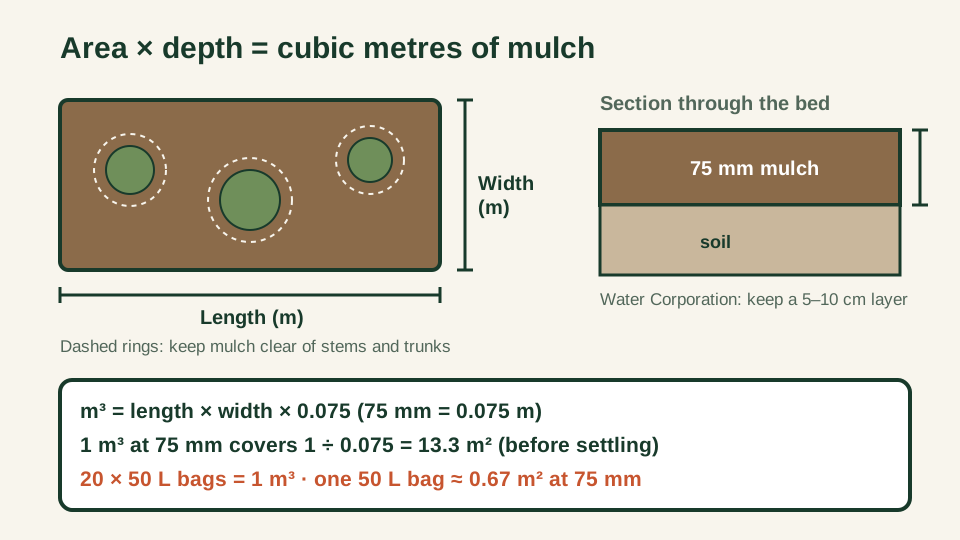
To work out how much mulch you need, multiply the bed area in m² by the mulch depth in metres. At 75 mm, each square metre takes 0.075 m³ — 75 litres, or one and a half 50 L bags — and one cubic metre covers about 13.3 m² before it settles. Add around 10% for settling.
Depth is the main decision. Water Corporation's waterwise advice is an even 5–10 cm layer of coarse mulch, kept clear of the base of plants and trees and topped up every few months. Sustainable Gardening Australia suggests 6–8 cm for large-particle mulch and says chunky mulches can go to 60–75 mm without blocking rain and irrigation. Product labels sit in the same band: Richgro advises 50–75 mm for its pine bark, ANL recommends 50–75 mm for Midnight Mulch and 75–100 mm for its Eucy Mulch.
75 mm is therefore a sensible middle figure for most garden beds; go to 50 mm for a top-up and towards 100 mm on a new bed where weeds are the main problem.
Mulch per square metre by depth
Litres per m² equals the depth in millimetres, because 1 m² × 1 mm = 1 litre. That makes bag counts easy: divide the litres by the bag size. The m² per m³ column is 1 ÷ depth in metres.
| Depth | Litres per m² | 50 L bags per m² | 60 L bags per m² | m² covered by 1 m³ |
|---|---|---|---|---|
| 50 mm | 50 L | 1.0 | 0.83 | 20.0 m² |
| 75 mm | 75 L | 1.5 | 1.25 | 13.3 m² |
| 100 mm | 100 L | 2.0 | 1.67 | 10.0 m² |
Theoretical figures for a loose layer. Mulch settles, so real coverage is lower — ANL quotes about 10–12 m² per m³ at 75 mm for Midnight Mulch against 13.3 m² in theory.
Why bag labels and bulk coverage figures disagree
Coverage printed on a bag is usually an 'up to' figure for a thin layer. Richgro states its 40 L pine bark bag covers up to 1.5 m² and its 70 L bag up to 2.5 m². Work backwards and that is 0.040 ÷ 1.5 = 0.027 m and 0.070 ÷ 2.5 = 0.028 m — a layer only about 27–28 mm deep, well under the 50–75 mm the same page recommends. At 75 mm a 40 L bag covers 0.040 ÷ 0.075 = 0.53 m².
Bulk figures run the other way. ANL's 10–12 m² per m³ at 75 mm is lower than the 13.3 m² theoretical figure because the mulch compacts as it is spread and watered in. Plan with depth × area and add about 10% for settling rather than relying on a label's coverage claim.
Bed size to cubic metres and 50 L bags at 75 mm
Measure rectangular beds as length × width. Split L-shaped beds into rectangles and add them. For a circle, or a ring around a tree, use π × radius² (a 1 m radius ring is 3.14 m²). Then multiply by 0.075 for a 75 mm layer.
| Bed area | m³ at 75 mm | m³ with 10% for settling | 50 L bags (no allowance, rounded up) |
|---|---|---|---|
| 5 m² | 0.375 m³ | 0.41 m³ | 8 bags |
| 10 m² | 0.75 m³ | 0.83 m³ | 15 bags |
| 20 m² | 1.50 m³ | 1.65 m³ | 30 bags |
| 30 m² | 2.25 m³ | 2.48 m³ | 45 bags |
| 50 m² | 3.75 m³ | 4.13 m³ | 75 bags |
m³ = area × 0.075. Bags = m³ × 1,000 ÷ 50, rounded up. Twenty 50 L bags make one cubic metre. Add 10% to the bag count too if you want the settling allowance.
Bulk or bags? Worked with published prices
ANL (Australian Native Landscapes), which delivers across Sydney and NSW, lists Midnight Mulch at $90.00 per m³ in bulk and $12.00 for a 60 L bag, with all prices including GST (published prices checked 19 Sep 2026; prices change — get a written quote).
One cubic metre is 1,000 ÷ 60 = 16.67 bags, so the bagged product works out to 16.67 × $12.00 = $200.00 per m³ — and because you can only buy whole bags, 1 m³ in bags is really 17 × $12.00 = $204.00. Bulk saves about $200.00 − $90.00 = $110.00 per m³ before delivery.
So the break-even is simple: bulk wins once the saving outweighs the delivery charge. Divide the delivery fee you are quoted by $110 to get the break-even volume at these prices. Bags still suit small beds, tight access with no place to tip, and staged jobs. If you are paying someone to spread it, labour is a separate quote.
Worked example: an L-shaped bed and a tree ring, checked by hand
The bed is an L made of two rectangles: 6.0 × 1.5 m and 3.0 × 1.2 m. Area = 9.0 + 3.6 = 12.6 m². At 75 mm: 12.6 × 0.075 = 0.945 m³. Add 10% for settling: 0.945 × 1.1 = 1.04 m³.
In 50 L bags: 1.04 m³ = 1,040 L ÷ 50 = 20.8, so 21 bags. In 60 L bags: 1,040 ÷ 60 = 17.3, so 18 bags. In bulk: a 1 m³ load spread over 12.6 m² is 1 ÷ 12.6 = 0.079 m, about 79 mm loose — enough for a 75 mm finished layer with a small margin, so 1 m³ is the order if your yard sells whole cubic metres.
The tree ring has a 1 m radius: π × 1² = 3.14 m² × 0.075 = 0.236 m³ = 236 L ÷ 50 = 4.7, so 5 × 50 L bags. Keep the mulch pulled back from the trunk rather than heaped against it.
Common questions
Answers use depth × area; swap in your own depth and bag size.
- How many bags of mulch per m²? — At 75 mm, 1.5 × 50 L bags (or 1.25 × 60 L bags). At 50 mm, one 50 L bag; at 100 mm, two.
- How much mulch per square metre? — The depth in millimetres equals the litres per m²: 75 mm deep is 75 L, or 0.075 m³, per m².
- What does a cubic metre of mulch cover? — 20 m² at 50 mm, 13.3 m² at 75 mm and 10 m² at 100 mm in theory; expect a little less after settling (ANL quotes 10–12 m² at 75 mm).
- How much does a 50 litre bag of mulch cover? — 1 m² at 50 mm, 0.67 m² at 75 mm and 0.5 m² at 100 mm.
- What does mulching cost in Sydney? — Supply is area × depth × the price per m³ (or per bag) plus delivery; one Sydney supplier's published bulk price is $90.00 per m³ including GST for its Midnight Mulch. Spreading labour, if you pay for it, is quoted separately.
Common mistakes
Mulch estimates go wrong on units, depth and the bag label.
- Multiplying by 75 instead of 0.075 — convert millimetres to metres before multiplying by square metres.
- Trusting a bag's 'covers up to' figure, which often assumes a layer under 30 mm.
- Forgetting settling: fresh mulch compacts after watering and rain, so order about 10% extra.
- Piling mulch against stems and trunks, which holds moisture against the bark and invites rot.
- Comparing a per-bag price with a per-m³ price without converting: one m³ is twenty 50 L bags or 16.67 × 60 L bags.
Same project
Related measurement guides
Sources and limits
Check the project-specific details
- Water Corporation (WA) — Creating a waterwise verge — Advises an even 5–10 cm layer of coarse mulch, kept clear of the base of new plants and trees, checked every few months and topped up to maintain 5–10 cm.
- Sustainable Gardening Australia — Which garden mulch is best — Suggests large-particle mulch at 6–8 cm and says chunky mulches can be used up to 60–75 mm deep without blocking rain and irrigation.
- ANL — Midnight Mulch — Recommends 50–75 mm depth, states one cubic metre covers about 10–12 m² at 75 mm, and lists $90.00 per m³ bulk and $12.00 per 60 L bag, prices including GST (published prices checked 19 Sep 2026).
- ANL — Eucy Mulch 60 L — States a 60 L bag covers about 1 m² at 50 mm, 1 m³ covers about 10 m² at 100 mm or 20 m² at 50 mm, and suggests 75–100 mm depth.
- Richgro — Natural Pinebark Mulch — Lists 40, 50 and 70 L bags, advises a 50–75 mm layer, and states a 40 L bag covers up to 1.5 m² and a 70 L bag up to 2.5 m² — the thin-layer label figures analysed above.
Review status: Formulas and worked examples checked by hand; measurement practice pending human trade review.
This guide supports planning only. It does not specify structural design, code compliance, or a supplier quotation.