Materials estimating guide
How Much Road Base Do I Need? (Australia, m³ to Tonnes)
How much road base do I need? Multiply area by compacted depth, add about 20% for compaction, then multiply by your yard's density (about 1.9 t/m³) for tonnes.
Published 2026-09-19 · Updated 2026-09-19 · BuildMeasure Editorial Team
Next step
Turn your measurements into a material estimate
Enter the recorded dimensions in the calculator. It shows the calculated amount, wastage allowance, and a supplier-ready suggested order.
Use the Gravel Calculator (m³ and tonnes)How much road base do I need? The short answer
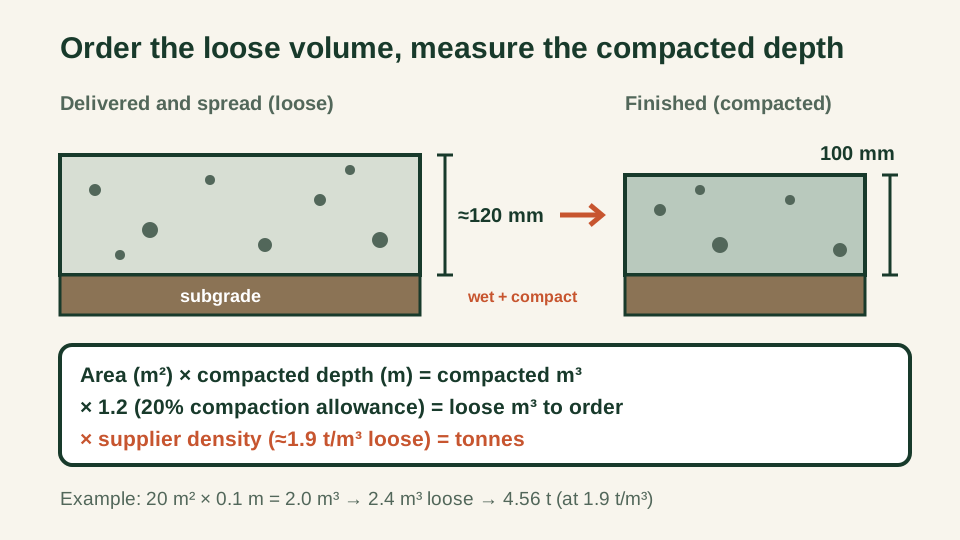
To work out how much road base you need, multiply the area in m² by the compacted depth in metres, add about 20% for compaction, then multiply by your supplier's density for tonnes. At 1.9 t/m³, 10 m² at 100 mm is 1.0 m³ compacted, 1.2 m³ loose and 2.28 tonnes.
Road base is a mix of crushed rock and fines that locks together when it is wetted and compacted. Boral describes it as a compacted mixture of crushed rock and fines that forms a stable foundation beneath roads, pavements, concrete slabs and driveways. Product names vary by state and quarry — crushed rock, DGB20, recycled road base and others — and so does the weight of a cubic metre, which is why the density should come from the yard you are buying from.
Landscape yards usually sell road base by the tonne. Lower Mountains Landscape Supplies publishes 1.9 tonnes per cubic metre for uncompacted road base and 2.2 for compacted road base, and a Summit Quarries driveway example (5.4 m³ quoted as 10.264 tonnes) works out to the same 1.9 t/m³.
Why you order about 20% more than the finished volume
The depth you measure on a plan is the finished, compacted depth. Road base arrives loose and shrinks when it is rolled or plate-compacted, so you need more loose material than the compacted volume. Burrum Landscapes states that 1 m³ of loose road base compacts to about 0.8–0.85 m³, which means ordering 1 ÷ 0.85 = 1.18 to 1 ÷ 0.8 = 1.25 times the compacted volume. Summit Quarries allows for 20% compaction. This guide uses × 1.2 as a planning figure.
A cross-check: compacted volume × the compacted density gives nearly the same weight. 1.0 m³ compacted × 2.2 t/m³ = 2.2 tonnes, against 1.0 × 1.2 × 1.9 = 2.28 tonnes by the loose route. The small gap is a useful safety margin.
Always confirm whether a quoted depth is loose or compacted. Summit's 6 × 6 m driveway example uses 36 m² × 150 mm = 5.4 m³ and prices 10.264 tonnes, noting that the 150 mm depth allows for 20% compaction by vehicles — so that 150 mm is a loose depth that settles to about 120 mm. If you need 150 mm after compaction, the same driveway needs 5.4 × 1.2 × 1.9 = 12.31 tonnes.
Typical depths from supplier guidance
These are the depths Australian suppliers publish as general guidance. They are not a pavement or slab design: reactive clay, poor drainage, slopes and heavy vehicles can all need more, and a slab's base layer should follow the engineer's drawings or your builder's specification.
- Paths, pavers and light foot traffic: 75–100 mm compacted (Burrum Landscapes).
- Residential driveways: 100–150 mm compacted (Burrum); at least 100 mm compacted (Nepean Landscape Supplies).
- Heavy vehicle access: 150–200 mm compacted (Burrum).
- Under concrete slabs: 75–100 mm compacted (Burrum) — follow the slab design where there is one.
- Lay and compact in layers: no more than 100 mm at a time (Burrum); layers typically 75–150 mm (Nepean). Summit gives 100–250 mm as its overall range.
Area × depth → m³ → tonnes
The table works each job through the same three steps: area × compacted depth = compacted m³; × 1.2 = loose m³ to order; × 1.9 t/m³ = tonnes. Replace 1.9 with your supplier's figure — a lighter recycled product or a heavier one changes the tonnes in direct proportion.
| Job (example) | Area | Compacted depth | Compacted m³ | Loose m³ to order (× 1.2) | Tonnes (× 1.9) |
|---|---|---|---|---|---|
| Garden path | 10 m² | 75 mm | 0.75 m³ | 0.90 m³ | 1.71 t |
| Paver patio base | 20 m² | 100 mm | 2.00 m³ | 2.40 m³ | 4.56 t |
| Base under a shed slab | 30 m² | 75 mm | 2.25 m³ | 2.70 m³ | 5.13 t |
| Single driveway, 3 × 6 m | 18 m² | 150 mm | 2.70 m³ | 3.24 m³ | 6.16 t |
| Double driveway, 6 × 6 m | 36 m² | 150 mm | 5.40 m³ | 6.48 m³ | 12.31 t |
| Long driveway, 3 × 20 m | 60 m² | 150 mm | 9.00 m³ | 10.80 m³ | 20.52 t |
Tonnes rounded to two decimals. Round the order up to the increment your yard sells in. Depths are examples, not a design.
How much area does 1 tonne of road base cover?
Work backwards: 1 tonne ÷ 1.9 t/m³ = 0.526 m³ loose; ÷ 1.2 for compaction = 0.439 m³ compacted; ÷ the compacted depth gives the area. At 100 mm that is 0.439 ÷ 0.1 = 4.39 m². Using Lower Mountains' compacted figure instead, 1 ÷ 2.2 = 0.455 m³, which covers 4.55 m² at 100 mm — the two routes agree closely.
Burrum Landscapes quotes a more generous 5–7 m² per tonne at 100 mm compacted. A spread that wide comes from different product densities and compaction assumptions, so treat any per-tonne coverage figure as belonging to one product and ask your yard for its own.
| Compacted depth | m² per tonne (1.9 t/m³ loose + 20%) | m² per tonne (2.2 t/m³ compacted) |
|---|---|---|
| 75 mm | 5.85 m² | 6.06 m² |
| 100 mm | 4.39 m² | 4.55 m² |
| 150 mm | 2.92 m² | 3.03 m² |
m² per tonne = (1 ÷ density ÷ compaction factor) ÷ depth in metres. The compacted-density column uses no separate compaction factor.
Worked example: road base under a 5.0 × 3.6 m paver patio, checked by hand
The patio is 5.0 m × 3.6 m. Many installers run the base a little past the edge restraint; this example extends it 200 mm on every side (confirm the margin with your paver supplier), so the base footprint is (5.0 + 0.4) × (3.6 + 0.4) = 5.4 × 4.0 = 21.6 m².
Compacted depth 100 mm = 0.1 m. Compacted volume = 21.6 × 0.1 = 2.16 m³. Add 20% for compaction: 2.16 × 1.2 = 2.59 m³ loose. At 1.9 t/m³: 2.592 × 1.9 = 4.92 tonnes.
Cross-check with the compacted density: 2.16 × 2.2 = 4.75 tonnes. Both land just under 5 tonnes, so order 5 tonnes. At 100 mm the base can be compacted in one layer; the bedding sand for the pavers is a separate, thinner layer and a separate order.
In the Gravel Calculator, enter the 21.6 m² area as dimensions, 100 mm depth, a 20% allowance and a density of 1,900 kg/m³ (or your supplier's figure) to reproduce this result.
Getting it home: trailer loads and tipper deliveries
Road base fills a trailer by weight long before it fills it by volume: one cubic metre of loose road base weighs about 1.9 tonnes. Check the rated mass on your trailer's compliance plate and your vehicle's towing capacity before you load, and let the yard's loader know the limit.
Example: if your trailer can legally carry a 600 kg payload, each trip moves 0.6 tonnes, and the 4.92 tonne patio base above would take 4.92 ÷ 0.6 = 8.2 — so 9 trips. For anything beyond a small path, a tipper delivery is usually the practical choice; Lower Mountains Landscape Supplies lists trucks up to a 31.5 tonne truck and dog for quarry loads. Ask about minimum delivery loads and where the truck can tip.
Common questions
All answers use a 20% compaction allowance and 1.9 t/m³ loose density — swap in your supplier's figures.
- How much road base under pavers? — Suppliers suggest 75–100 mm compacted for paths and pavers. At 100 mm, each m² needs 0.1 × 1.2 = 0.12 m³ loose, or about 0.23 tonnes; 20 m² of patio needs about 4.56 tonnes.
- How much road base under concrete? — Burrum gives 75–100 mm compacted as general guidance, but the slab design governs. At 75 mm, a 30 m² slab needs 2.25 m³ compacted, 2.70 m³ loose and about 5.13 tonnes.
- How much road base per square metre? — At 100 mm compacted: 0.1 m³ compacted, 0.12 m³ loose, 0.228 tonnes (228 kg). At 150 mm: 0.18 m³ loose and 0.342 tonnes.
- How much area does 1 ton of road base cover? — About 4.4 m² at 100 mm compacted with the figures above, 5.85 m² at 75 mm and 2.92 m² at 150 mm. Supplier figures range higher for lighter products.
- Road base for a driveway — how much? — A 3 × 6 m single driveway at 150 mm compacted is 2.70 m³ compacted, 3.24 m³ loose and about 6.16 tonnes.
Common mistakes
Road base orders usually go wrong on depth, compaction or density.
- Ordering the compacted volume with no compaction allowance, then finishing short.
- Mixing loose and compacted depths — ask which one a quote or a spec means.
- Typing 10 (cm) into a millimetre field, which gives a tenth of the material.
- Using someone else's density figure: recycled road base, crushed rock and blends weigh different amounts per m³.
- Spreading and compacting it in one thick lift instead of layers of about 100 mm.
- Overloading a box trailer — one cubic metre of loose road base weighs about 1.9 tonnes.
Same project
Related measurement guides
Sources and limits
Check the project-specific details
- Boral — Crushed Rock & Roadbase — Defines road base as a compacted mixture of crushed rock and fines forming a foundation beneath roads, pavements, slabs and driveways, supplied as specified, cement-treated, unspecified and recycled products.
- Lower Mountains Landscape Supplies — FAQs — Publishes conversion factors of 1.9 t/m³ for uncompacted road base and 2.2 t/m³ for compacted road base, states road base is ordered in tonnes, and lists trucks up to a 31.5 t truck and dog.
- Summit Construction Materials — Road Base — Gives a 100–250 mm laying range and a 6 × 6 m, 150 mm driveway example (36 m², 5.4 m³, 10.264 t) that allows for 20% compaction by vehicles — about 1.9 t/m³.
- Burrum Landscape Supplies — Road Base: what it is and how to order — States 1 m³ loose compacts to about 0.8–0.85 m³, 1 tonne covers about 5–7 m² at 100 mm, compacted depths by use (75–100 mm light use and under slabs, 100–150 mm driveways, 150–200 mm heavy vehicles) and layers of no more than 100 mm.
- Nepean Landscape Supplies — Driveway and pathway base materials — Recommends at least 100 mm of compacted base for driveways, layers typically 75–150 mm, wetted and compacted with a plate compactor or roller.
Review status: Formulas and worked examples checked by hand; measurement practice pending human trade review.
This guide supports planning only. It does not specify structural design, code compliance, or a supplier quotation.