Materials estimating guide
How Much Gravel Do I Need? Feet to Tonnes (Canada)
How much gravel do you need in Canada? Measure in feet, convert ft² × inches to cubic metres, then multiply by your supplier's tonnes per m³. Tables included.
Published 2026-09-19 · Updated 2026-09-19 · BuildMeasure Editorial Team
Next step
Turn your measurements into a material estimate
Enter the recorded dimensions in the calculator. It shows the calculated amount, wastage allowance, and a supplier-ready suggested order.
Use the Gravel CalculatorHow much gravel do I need? The Canadian answer
How much gravel you need in Canada: measure the area in feet and the depth in inches, convert to cubic metres (square feet × inches ÷ 12 × 0.0283168), add a compaction allowance for compactable base, then multiply by your supplier's tonnes per cubic metre. Pits and yards sell by the metric tonne, and some by the cubic yard.
Canadian gravel jobs sit in two unit systems. Driveways, pads and paths are usually measured with a tape in feet and inches, but aggregate is weighed and invoiced in metric tonnes (1,000 kg) — and some landscape yards still price bulk stone by the cubic yard. This guide gives the conversion chain for both, plus supplier-published weights for the common Ontario materials.
- Measure: length and width in feet, depth in inches.
- Convert: cubic feet → cubic metres (× 0.0283168) or cubic yards (÷ 27).
- Weigh: cubic metres × the supplier's tonnes per m³ (or cubic yards × tonnes per yd³).
- Round up to the supplier's sale increment or truckload.
The conversion chain: ft² × inches → m³ → tonnes
Because the inch is defined as exactly 25.4 mm, the foot is exactly 0.3048 m and a cubic foot is 0.0283168 m³. So: cubic feet = area (ft²) × depth (in) ÷ 12; cubic metres = cubic feet × 0.0283168. Folding the ÷ 12 in gives a one-step shortcut: m³ ≈ ft² × inches × 0.00236.
If your yard sells by the cubic yard instead, cubic yards = cubic feet ÷ 27, and 1 yd³ = 0.7646 m³. Weight always needs a density for the exact material: tonnes = m³ × tonnes per m³. Many Canadian suppliers publish tonnes per cubic yard; divide that figure by 0.7646 to get tonnes per cubic metre.
Keep tonnes and tons apart. A metric tonne is 1,000 kg; a US short ton is about 907 kg. A US guide that says '10 tons' means about 9.1 tonnes.
How many tonnes in a cubic metre of gravel?
It depends on the stone, its grading and whether it is loose or compacted. The figures below are what three Ontario suppliers publish per cubic yard, converted to per cubic metre by dividing by 0.764555. Use the figure your own pit or yard gives for the product you are buying.
| Material | Supplier figure | Converted (÷ 0.764555) | Supplier notes |
|---|---|---|---|
| 3/4 in clear stone | 1.3 t per yd³ (Peterborough Landscape Supply) | ≈ 1.70 t/m³ | Screened and washed, no fillers; drainage stone |
| 3/8 in pea gravel | ≈ 1.32 t per yd³ (Dragonfly Landscape Supply) | ≈ 1.73 t/m³ | Rounded; not recommended as a driveway base because it does not compact |
| Granular A (crusher run) | ≈ 1.45 t per yd³ (Dragonfly Landscape Supply) | ≈ 1.90 t/m³ | Compactable base; supplier recommends adding 20% for compaction |
Loose, as-sold weights published by the suppliers named. Densities vary by quarry and moisture — confirm with your supplier before ordering.
Granular A, clear stone and pea gravel: what the names mean
Granular A is an Ontario specification name, not a brand. It comes from OPSS 1010, the Ontario Provincial Standard Specification for base, subbase and backfill aggregates; the City of Toronto's amendment to OPSS.MUNI 1010 defines Granular A as a set of requirements for dense graded aggregates. Dense graded means it contains a range of sizes down to fines, which is why it compacts into a firm base — and why a compaction allowance applies when you order it. Suppliers also call it crusher run or road base.
Clear stone is the opposite: screened and washed stone with the fines removed, so water drains through it — Peterborough Landscape Supply lists 3/4 in clear stone for weeping tiles, under concrete, driveways and French drains. Pea gravel is small rounded stone; Dragonfly Landscape Supply notes it is not recommended as a driveway base because it does not compact.
Names change across provinces and pits (for example 3/4-inch crush or A-gravel), and a product with a similar name can have a different grading. Ask for the product's specification and its weight per cubic yard or cubic metre.
Area and depth to cubic metres and tonnes
Measured in feet and inches, converted with × 0.0283168 for cubic metres and ÷ 27 for cubic yards. The last two columns apply the converted supplier densities above: clear stone as loose volume, and Granular A with the supplier's 20% compaction allowance added before weighing.
| Area × depth | Cubic feet | Cubic metres | Cubic yards | Clear stone at 1.70 t/m³ | Granular A at 1.90 t/m³ + 20% |
|---|---|---|---|---|---|
| 10 × 10 ft × 3 in | 25.00 | 0.708 | 0.926 | 1.20 t | 1.61 t |
| 10 × 20 ft × 4 in | 66.67 | 1.888 | 2.469 | 3.21 t | 4.30 t |
| 12 × 24 ft × 6 in | 144.00 | 4.078 | 5.333 | 6.93 t | 9.30 t |
| 10 × 50 ft × 4 in | 166.67 | 4.719 | 6.173 | 8.02 t | 10.76 t |
| 12 × 40 ft × 6 in | 240.00 | 6.796 | 8.889 | 11.55 t | 15.49 t |
| 20 × 40 ft × 8 in | 533.33 | 15.102 | 19.753 | 25.67 t | 34.43 t |
Granular A column = m³ × 1.20 × 1.90. Clear stone column has no allowance added; add your own for spreading loss. Round the result up to your supplier's sale increment.
How much gravel for a driveway?
Depth is the input that matters most, and it is a plan or supplier decision, not a formula. As supplier guidance, Toronto supplier We Deliver Gravel says most suppliers and contractors specify 6 to 8 inches (150 to 200 mm) of compacted Granular A for a single or double car driveway carrying regular passenger vehicles, compacted in lifts of no more than 4 inches.
Frost, soft subgrade, heavier vehicles and municipal requirements can all change that build-up, so confirm the depth with your contractor or municipality before ordering. If the driveway has a separate top layer, calculate it as its own line — it is a different material with a different weight.
Because Granular A is ordered loose and compacted in place, add the supplier's compaction allowance before converting to tonnes. Dragonfly Landscape Supply recommends adding 20% for Granular A.
Worked example: a 12 × 40 ft driveway with 6 inches of Granular A
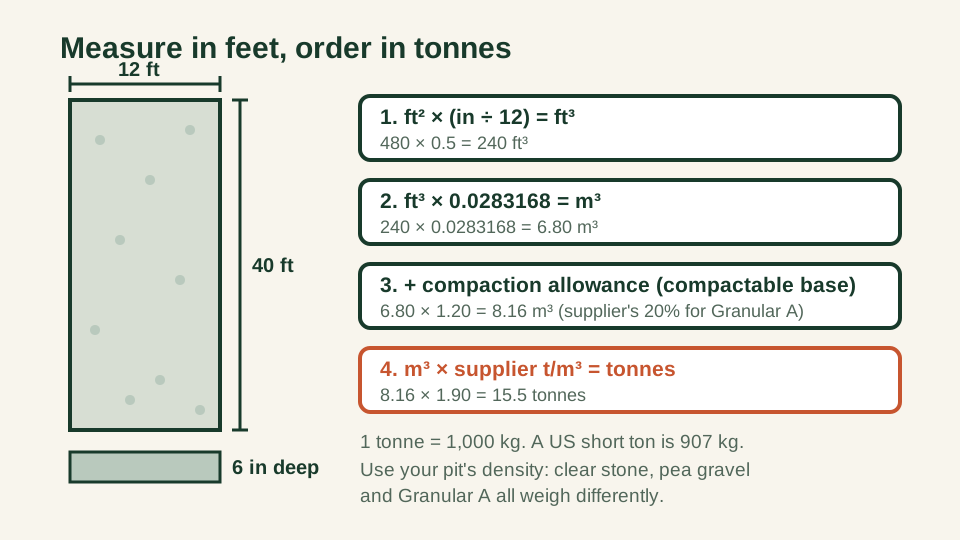
Area: 12 × 40 = 480 ft². Depth: 6 in ÷ 12 = 0.5 ft.
Cubic feet: 480 × 0.5 = 240 ft³. Cubic metres: 240 × 0.0283168 = 6.796 m³. (Shortcut check: 480 × 6 × 0.00236 = 6.797 m³.)
Compaction allowance: 6.796 × 1.20 = 8.155 m³ of loose material.
Tonnes: 8.155 × 1.90 = 15.49, so order about 15.5 tonnes, rounded up to the supplier's increment or truckload.
Cross-check by the cubic yard, using the supplier's own per-yard figure: 240 ÷ 27 = 8.889 yd³; × 1.20 = 10.667 yd³; × 1.45 t per yd³ = 15.47 tonnes. The 0.02-tonne difference comes from rounding 1.8965 to 1.90 t/m³ — both round to 15.5 tonnes. If the yard sells by the cubic yard, order 10.67 yd³ rounded up to its increment.
In US short tons, 15.5 tonnes is 15,500 ÷ 907.18 = 17.1 tons — useful only if you are comparing against an American quote or calculator.
- Length and width measured in feet; irregular areas split into rectangles.
- Depth taken from the plan or supplier guidance, in inches.
- Cubic metres = ft² × in ÷ 12 × 0.0283168 (or cubic yards = ft³ ÷ 27).
- Compaction allowance added for compactable base such as Granular A.
- Tonnes = m³ × the supplier's tonnes per m³ for the exact product.
- Rounded up to the supplier's sale increment; tonnes, not tons.
Common questions
Short answers to the ways Canadians search for gravel quantities.
- How much gravel do I need? — Area (ft²) × depth (in) ÷ 12 × 0.0283168 = cubic metres; × your supplier's tonnes per m³ = tonnes. A 10 × 20 ft area at 4 in is 1.888 m³, about 3.21 tonnes of clear stone at 1.70 t/m³.
- How many tonnes in a cubic metre of gravel? — It depends on the material: converted from Ontario supplier figures, about 1.70 t/m³ for 3/4 in clear stone, 1.73 for pea gravel and 1.90 for Granular A (before its compaction allowance).
- How much gravel for a driveway? — A 12 × 40 ft driveway with 6 in of compacted Granular A needs about 15.5 tonnes including a 20% compaction allowance. Depth is set by your plan; supplier guidance in Toronto is 6 to 8 in of compacted Granular A for car driveways.
- Is there a gravel calculator for Canada? — The Gravel Calculator accepts feet or metres, returns cubic metres and metric tonnes from the density you enter, and adds an optional CAD cost with GST/HST.
- Gravel calculator in tons or tonnes? — Canadian pits sell metric tonnes (1,000 kg). A US short ton is about 907 kg, so tonnes × 1.102 = short tons.
- Cubic yard calculator for gravel? — Cubic yards = ft² × in ÷ 12 ÷ 27. Some Ontario yards sell by the yard and publish tonnes per yard (for example 1.3 t per yd³ for 3/4 in clear stone).
Mistakes that leave you short (or with a spare pile)
Most gravel ordering errors are unit slips rather than bad arithmetic.
- Leaving depth in inches: 480 ft² × 6 treated as cubic feet is 12 times too much. Divide inches by 12 first.
- Mixing cubic yards and cubic metres — a cubic yard is about 24% smaller than a cubic metre.
- Reading a US 'tons' figure as metric tonnes, or the reverse.
- Using a clear-stone weight for Granular A, or a generic density for any product — ask the pit for its figure.
- Forgetting the compaction allowance on dense graded base, then running short on the last lift.
Same project
Related measurement guides
Sources and limits
Check the project-specific details
- Dragonfly Landscape Supply — Granular A (Crusher Run) — Ontario supplier listing Granular A at an approximate weight of 1.45 tonnes per cubic yard, describing it as a compactable blend for driveways and patios, and recommending adding 20% for compaction.
- Dragonfly Landscape Supply — 3/8" Pea Gravel — Lists 3/8 in pea gravel at approximately 1.32 tonnes per cubic yard and notes it is not recommended as a driveway base because it does not compact.
- Peterborough Landscape Supply — 3/4" Clear Stone — States there are 1.3 tonnes in a cubic yard of 3/4 in clear stone, that it is screened and washed with no fillers, and that it is sold by the cubic yard with a per-tonne equivalent shown.
- We Deliver Gravel — Granular A driveway base (Toronto) — Supplier guidance of 6 to 8 inches (150 to 200 mm) of compacted Granular A for a single or double car driveway, compacted in lifts of no more than 4 inches.
- City of Toronto — TS 1010 amendment to OPSS.MUNI 1010 (PDF) — Amendment to the Ontario Provincial Standard Specification for base, subbase and backfill aggregates; defines Granular A as a set of requirements for dense graded aggregates.
- NIST — SI units: length — States the inch is exactly 25.4 mm and shows the yard as 0.9144 m — the basis for 1 ft³ = 0.0283168 m³ and 1 yd³ = 0.764555 m³.
Review status: Formulas and worked examples checked by hand; measurement practice pending human trade review.
This guide supports planning only. It does not specify structural design, code compliance, or a supplier quotation.