Materials estimating guide
How to Order Ready-Mix Concrete in Canada (Feet to m³)
Canadian sites are measured in feet and inches but ready-mix is ordered in cubic metres. Convert with 1 ft³ = 0.0283168 m³, add waste, round up, and check the minimum.
Published 2026-07-20 · Updated 2026-07-20 · BuildMeasure Editorial Team
Next step
Turn your measurements into a material estimate
Enter the recorded dimensions in the calculator. It shows the calculated amount, wastage allowance, and a supplier-ready suggested order.
Use the Concrete Slab CalculatorCanada measures in feet, but orders concrete in cubic metres
Canadian construction lives in two unit systems at once. Formwork, lumber, and site dimensions are almost always in feet and inches, but ready-mix concrete is quoted, batched, and delivered in cubic metres (m³). Ordering therefore means measuring in feet, then converting to cubic metres.
The reliable route is: work out the slab volume in cubic feet, convert to cubic metres with an exact factor, add a waste allowance, then round up to a sensible ordering quantity — and check it clears the supplier's minimum load. Canadian ready-mix suppliers price per cubic metre and typically set a minimum load size around 1 m³, with extra charges on small loads.
- Measure the slab in feet and inches, as the forms are built.
- Convert to cubic metres for the order — that is the unit the plant works in.
- Round up and confirm the supplier's minimum load before you book the pour.
The exact conversions
Because the foot and yard are defined exactly in metres (1 ft = 0.3048 m, 1 yd = 0.9144 m), the volume conversions are exact too. Use these:
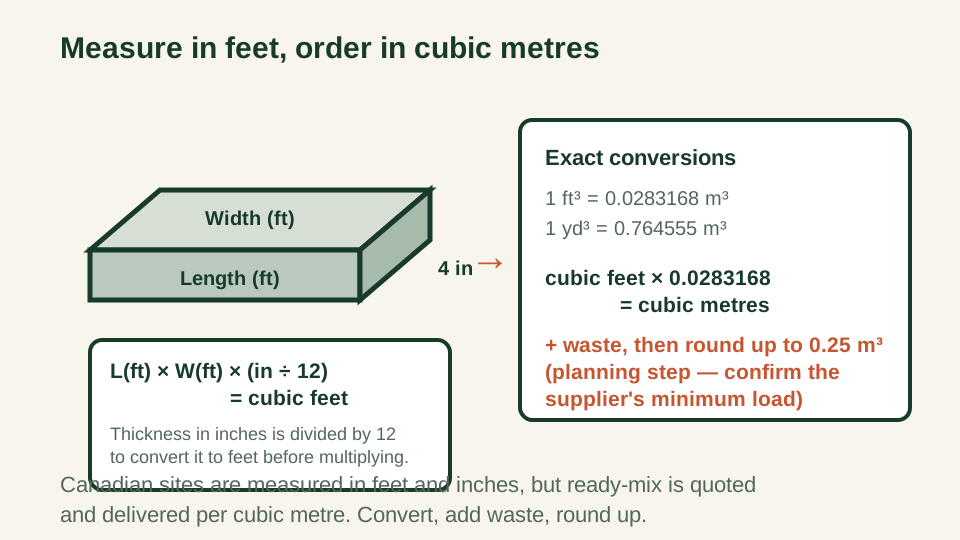
1 ft³ = 0.0283168 m³, and 1 yd³ = 0.764555 m³. To go from a slab measured in feet: multiply length (ft) × width (ft) × thickness (in ÷ 12) to get cubic feet, then multiply by 0.0283168 to get cubic metres.
The thickness step matters: a slab thickness is given in inches, so divide by 12 to turn it into feet before multiplying, otherwise the volume is out by a factor of twelve.
| From | To | Multiply by |
|---|---|---|
| Cubic feet (ft³) | Cubic metres (m³) | 0.0283168 |
| Cubic yards (yd³) | Cubic metres (m³) | 0.764555 |
| Cubic metres (m³) | Cubic feet (ft³) | 35.3147 |
| Cubic metres (m³) | Cubic yards (yd³) | 1.30795 |
Derived from the exact definitions 1 ft = 0.3048 m and 1 yd = 0.9144 m. The reverse factors are the reciprocals.
Slab sizes in feet to cubic metres
The table gives the exact concrete volume (before waste) for common slab sizes at 4 in and 6 in thickness. Cubic feet = length × width × (thickness ÷ 12); cubic metres = cubic feet × 0.0283168. These are exact volumes — you still add waste and round up before ordering.
| Slab (ft) | 4 in: ft³ → m³ | 6 in: ft³ → m³ |
|---|---|---|
| 10 × 10 | 33.33 ft³ → 0.944 m³ | 50.00 ft³ → 1.416 m³ |
| 10 × 12 | 40.00 ft³ → 1.133 m³ | 60.00 ft³ → 1.699 m³ |
| 12 × 12 | 48.00 ft³ → 1.359 m³ | 72.00 ft³ → 2.039 m³ |
| 12 × 16 | 64.00 ft³ → 1.812 m³ | 96.00 ft³ → 2.718 m³ |
| 20 × 20 | 133.33 ft³ → 3.776 m³ | 200.00 ft³ → 5.663 m³ |
| 24 × 24 | 192.00 ft³ → 5.437 m³ | 288.00 ft³ → 8.155 m³ |
Exact volumes using × 0.0283168. Add a waste allowance and round up to your ordering increment before booking.
Waste and rounding up
The converted figure is the exact volume. Real pours need more: spillage, uneven subgrade, form spread, and a bit left in the truck all mean you should add a waste allowance — commonly around 10% for a slab — before you order.
As a planning convention, this calculator then rounds the waste-adjusted figure up to the nearest 0.25 m³. Treat that quarter-metre step as a tidy planning increment rather than a universal supplier rule: Canadian plants price per cubic metre and set their own minimum load (often about 1 m³) and small-load charges, so confirm the exact increment, minimum, and short-load fee with your supplier when you book.
- Slab measured in feet and inches (length, width, thickness).
- Thickness converted from inches to feet (inches ÷ 12).
- Cubic feet worked out: length × width × thickness-in-feet.
- Converted to cubic metres with × 0.0283168.
- Waste allowance added (around 10% for a typical slab).
- Rounded up to the nearest 0.25 m³ for planning, then checked against the supplier's minimum load.
Worked example: a 12 ft × 16 ft × 4 in slab, both directions
Forward, feet to cubic metres: thickness 4 in ÷ 12 = 0.3333 ft. Cubic feet = 12 × 16 × 0.3333 = 192 × 0.3333 = 64 ft³. Cubic metres = 64 × 0.0283168 = 1.812 m³.
Add 10% waste: 1.812 × 1.10 = 1.99 m³. Round up to the nearest 0.25 m³ = 2.00 m³, which also clears a typical 1 m³ supplier minimum, so you would order 2.00 m³.
Reverse, cubic metres back to imperial as a sanity check: 2.00 m³ ÷ 0.0283168 = 70.6 ft³, and 2.00 m³ ÷ 0.764555 = 2.62 yd³. So if an older reference or a US-style quote talks in cubic yards, your 2.00 m³ order is about 2.6 yd³ — a useful cross-check that the conversion went the right way.
Common mistakes
Mixed-unit ordering is where errors hide. The two most damaging are leaving thickness in inches and confusing cubic yards with cubic metres.
- Leaving thickness in inches — divide by 12 first, or the volume is twelve times too big.
- Treating cubic yards and cubic metres as the same. A cubic yard is 0.765 m³, about 24% smaller, so the wrong unit means a wrong truck.
- Ordering the exact converted volume with no waste — you will likely come up short.
- Assuming a fixed 0.25 m³ increment applies everywhere. Confirm your plant's increment, minimum load, and small-load fee.
- Booking below the minimum load without expecting a short-load charge on small residential pours.
Same project
Related measurement guides
Sources and limits
Check the project-specific details
- NIST — SI units and exact length definitions — Basis for the exact factors: 1 ft = 0.3048 m gives 1 ft³ = 0.0283168 m³, and 1 yd = 0.9144 m gives 1 yd³ = 0.764555 m³.
- Canada Building Materials — Ready-Mix Concrete Price List (Western Region, Jan 2026) — Canadian ready-mix list that prices concrete per cubic metre and states a minimum load size of 1 m³ — confirming metric ordering. The 0.25 m³ rounding is presented as a planning convention, not a stated increment.
Review status: Formulas and conversions covered by automated tests; measurement practice pending human trade review.
This guide supports planning only. It does not specify structural design, code compliance, or a supplier quotation.