Decks & Fences
Fence Calculator
Enter your boundary length in metres to get the posts and fence bays to buy — works for timber paling fences and panel systems like Colorbond — with an optional GST-aware cost estimate.
Formula tested · Local units · No sign-up
Project inputs
Enter measurements
Use your preferred units. Results update automatically.
Show the calculation methodFormula, conversions, rounding, and assumptions+
Bays = fence length ÷ post spacing, rounded up. Timber paling fences are commonly framed in bays of roughly 2.4–2.7 m between posts; steel panel systems such as Colorbond come in fixed panel widths that set the spacing exactly.
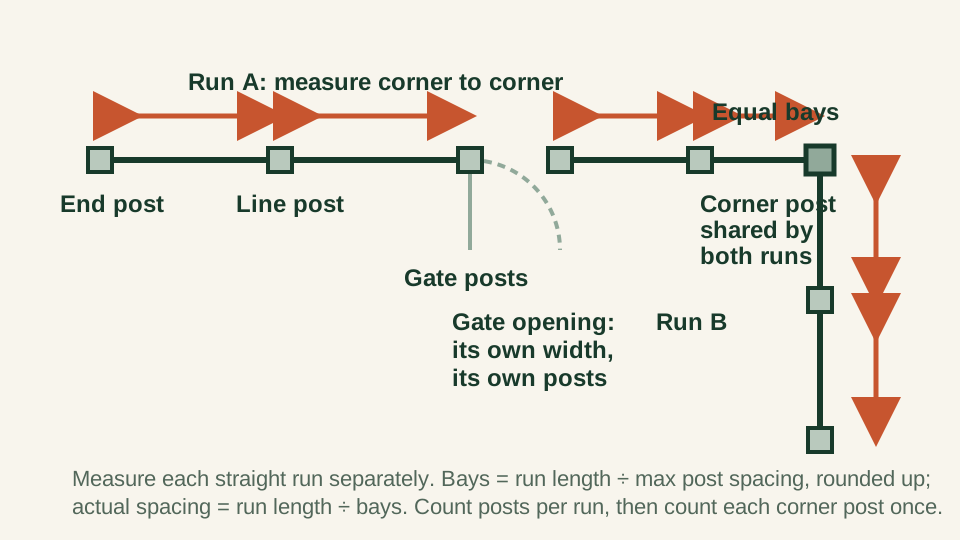
Posts = total bays + disconnected fence lines. Straight sections that join at corners share their corner posts.
Each gate occupies one bay on posts already counted, so bays to buy as fencing = bays − gates.
Real-world example
Worked example: 27 m side boundary, 2.7 m bays, 1 gate, 1 run
- Bays: 27 ÷ 2.7 = 10 exactly — no rounding needed.
- Posts: 10 bays + 1 run = 11 posts.
- Fence bays to buy: 10 bays − 1 gate = 9.
- Example cost with GST-inclusive prices: 11 posts × $25 = $275; 9 bays × $70 = $630.
Buy 11 posts and material for 9 bays (plus the gate, priced separately). With the example GST-inclusive prices above the estimate is $905 — enter 0% in the tax field when your prices already include GST.
Before you start
How to measure
- Enter one straight boundary directly, or list every straight section in metres so each section is rounded to a whole bay before totals are added.
- Use one disconnected line where sections meet at shared corners; increase the count only for fence lines that do not share a post.
- For a paling fence, enter the post spacing your rails suit (2.4 m rails → 2.4 m bays is typical); for Colorbond-style panels, enter the exact panel width from the supplier.
- Count each gate as one bay; double driveway gates may span more than one bay, so adjust the count accordingly.
Local guidance
Notes for Australia
- Boundary fences between neighbours are typically a shared matter in Australia — dividing-fence rules differ by state and territory, and the usual first step is written agreement with your neighbour before work starts. Check your state's rules.
- Contact Dial Before You Dig (now branded BYDA — Before You Dig Australia) for free plans of buried services before digging any post hole.
- Council rules commonly limit fence heights (front fences especially) and pool fencing has its own strict compliance regime — check with your council before building.
- Timber paling fences use hardwood or treated-pine posts, two or three rails per bay, and overlapped palings; Colorbond-style steel fences come as post-and-panel kits — both fit this calculator's bay model, only the prices differ.
- GST is 10% and consumer prices are usually advertised GST-inclusive; enter 0% tax for GST-inclusive quotes, or 10% for ex-GST trade pricing.
Quick reference
Common Australian fence planning values
| Fence type | Common bay width |
|---|---|
| Timber paling fence | 2.4–2.7 m between posts |
| Colorbond-style steel panel | Fixed panel width — use the supplier's figure |
| Post embedment | Roughly one-third of post height in the ground is a common rule of thumb |
Planning values only — soil, wind rating and the product you buy govern.
Good to know
Common mistakes to avoid
- Starting a boundary fence without agreeing it with the neighbour — dividing-fence rules in most states expect notice and cost-sharing discussion first.
- Digging without a BYDA (Dial Before You Dig) enquiry — it's free and takes minutes online.
- Guessing Colorbond panel width instead of using the supplier's exact figure — bays that don't match the panel won't assemble.
- Ignoring wind rating on exposed sites — high fences in wind regions can need engineered posts and footings.
- Comparing GST-inclusive and ex-GST quotes as if they were the same.
Need help?
Frequently asked questions
How many posts for a 30 m paling fence at 2.4 m bays?
ceil(30 ÷ 2.4) = 13 bays, so a single run needs 13 + 1 = 14 posts, with the last bay framed short.
Does this work for Colorbond fencing?
Yes — enter the exact panel width as the post spacing and the panel price per bay. The bay/post arithmetic is identical; only the terminology and materials change.
Do I have to split the cost with my neighbour?
Dividing-fence laws in each state and territory set out how neighbours share boundary-fence costs and what notice is required. This calculator only estimates materials — check your state's process before assuming who pays.
Keep planning
Related calculators
Transparency
About this calculator
- Written by:
- BuildMeasure Editorial Team
- Technically reviewed by:
- Pending independent technical reviewer (formula unit-tested; see methodology)
- Last reviewed:
- 2026-07-20
- Formula version:
- 1.2.0
- Region reviewed for:
- Australia
- Spotted an error?
- Report a correction
Methodology
- For one straight section, panel bays = section length ÷ post spacing, rounded UP. For a fence with corners, enter every straight-section length: the calculator rounds each section separately before adding its bays, so pooled partial bays cannot cause an under-order. Lengths are converted to metres internally.
- Posts = total bays + number of disconnected fence lines. Straight sections in one connected line share their corner posts; each disconnected line needs one additional end post. Exact multiples are not bumped up an extra bay.
- Each gate is assumed to occupy one bay and hang on posts already counted, so panels to buy = bays − gates. Gates and gate hardware are never costed by this tool.
- The cost estimate multiplies the post and panel counts by the prices you enter, then applies the tax rate you enter. No prices are built in.
- When prices are entered, material cost per foot or metre = the tax-inclusive calculated material total ÷ the full measured fence length in the region's default length unit. It is a comparison rate, not a contractor quote, and excludes gates, concrete, fixings, delivery and labour.
- The formula is covered by automated unit tests, including hand-calculated worked examples, and is versioned (see formula version on this page).
Sources & standards
- Utility location: Before You Dig Australia (BYDA, formerly Dial Before You Dig) provides free plans of buried services.
- Bay widths: 2.4–2.7 m paling-fence bays are common practice; steel panel systems use fixed manufacturer widths.
This tool provides a material estimate for planning purposes only. It is not a quotation, and it does not check boundary positions, wind loading, post embedment or local rules. Confirm the boundary line, any permit or approval requirements, and underground services before digging, and confirm quantities with your supplier before ordering.