Decks & Fences
Fence Cost Calculator per Metre UK — Posts and Panels
Enter one straight fence length or list every straight section, then add actual panel width, gates and supplier prices to get posts, panels, a VAT-aware material total and a comparable cost per metre.
Formula tested · Local units · No sign-up
Project inputs
Enter measurements
Use your preferred units. Results update automatically.
Show the calculation methodFormula, conversions, rounding, and assumptions+
Panel bays = fence length ÷ post spacing, rounded up. UK fence panels are sold in a standard 6 ft (1.83 m) width, so post centres normally match the panel — a 30 m run needs ceil(30 ÷ 1.83) = 17 bays.
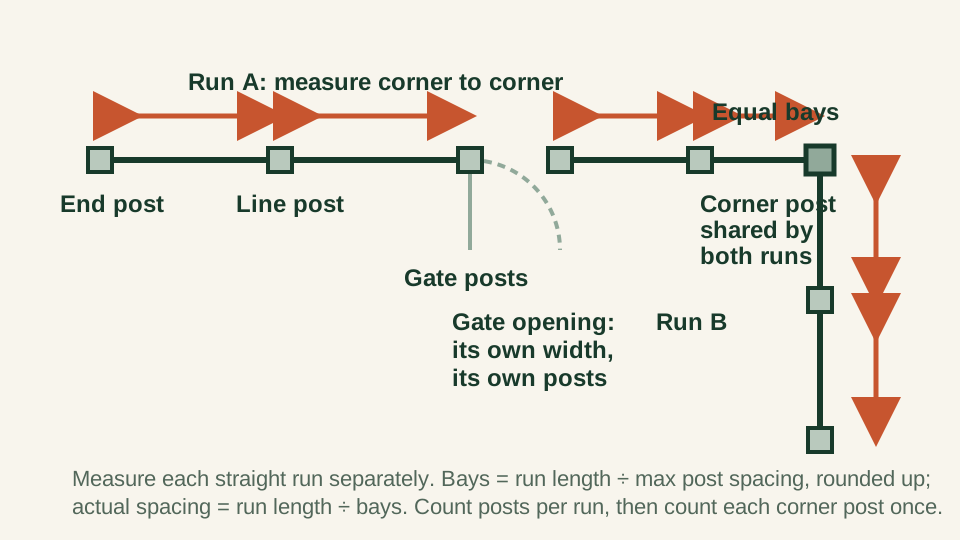
Posts = total bays + disconnected fence lines. Joined sections share corner posts, so a single connected 17-bay line needs 18 posts even where it turns.
Each gate occupies one bay and hangs on posts already counted, so panels to buy = bays − gates.
Material cost per metre = the calculated post-and-panel total including entered VAT ÷ total measured metres. It excludes the separately priced gate, post mix, gravel boards, caps, fixings, delivery, labour, and site work.
Real-world example
Worked example: 30 m garden fence, 6 ft (1.83 m) panels, 1 gate, 1 run
- Panel bays: 30 ÷ 1.83 = 16.39 → round up to 17 bays.
- Posts: 17 bays + 1 run = 18 posts.
- Panels to buy: 17 bays − 1 gate = 16 panels.
- Example cost: 18 posts × £15 = £270; 16 panels × £30 = £480; materials £750.
- VAT at 20%: £750 × 0.20 = £150.
- Cost per metre: £900 ÷ 30 m = £30.00/m for the included post-and-panel materials.
Buy 18 posts and 16 panels (plus the gate separately). The entered-price example is £900.00 including VAT, or £30.00 per measured metre for the included materials only.
Before you start
How to measure
- For one straight section, enter its length in metres. Where the boundary turns, enter each straight-section length in the comma-separated list so a partial panel is reserved for every section.
- Count joined sections as one connected fence line so their shared corner posts are not duplicated; increase the disconnected-line count only for separate boundaries.
- Set post spacing to the actual panel width — the nominal '6 ft panel' is 1.83 m; check your supplier's stated width, as some panels are 1.8 m exactly.
- The last bay is almost never a full panel width — the standard approach is to cut down one panel, which the rounded-up count already allows for.
Local guidance
Notes for United Kingdom
- Check who owns the fence before replacing it: your title plan or deeds may show boundary responsibility, and agreement with the neighbour avoids disputes.
- Fences above certain heights (commonly around 2 m, lower next to highways) can need planning permission — check with your local planning authority before building.
- Scan for buried services before digging post holes — hire or borrow a CAT scanner (cable avoidance tool) and consult utility plans for the street; there is no single national free marking service like the US 811.
- Concrete posts with gravel boards last longer at ground level and let panels slot in and out; timber posts look softer but sit in the wet zone — either works with this calculator, only the price changes.
- VAT at the standard 20% rate applies to most fencing supply; trade quotes are often ex-VAT.
Quick reference
Common UK panel and post options (planning values)
| Item | Common size / type |
|---|---|
| Lap or closeboard panel | 6 ft (1.83 m) wide |
| Panel heights | 3–6 ft, often with gravel board below |
| Posts | Concrete slotted or 75–100 mm timber |
| Post length | Panel height + ~600 mm in the ground |
| Cost per metre | Entered post-and-panel total incl. entered VAT ÷ full measured run |
Planning values only — match the panels and posts your merchant stocks.
Good to know
Common mistakes to avoid
- Assuming the fence is yours to replace — check the deeds and talk to the neighbour first.
- Digging without scanning for cables and pipes — a CAT scan takes minutes and post holes go deep enough to find services.
- Entering panel spacing as 2 m 'to be safe' when the panels are 1.83 m — the bays won't fit and the count will be wrong.
- Forgetting gravel boards, post mix and caps — this estimate covers posts and panels only.
- Comparing an ex-VAT trade quote against a VAT-inclusive retail price.
- Treating the material cost per metre as an installed quote even though gates, post mix, gravel boards, caps, fixings, delivery, labour, and access remain outside it.
Need help?
Frequently asked questions
How many panels and posts for a 20 m run of 6 ft panels?
ceil(20 ÷ 1.83) = 11 bays, so 11 panels and 12 posts for a single run with no gates. The eleventh panel gets cut down to fill the final part-bay.
Concrete or timber posts?
Concrete slotted posts resist rot at ground level and let you slide panels out for replacement; timber posts are lighter and look more natural but are the usual failure point. The calculator works with either — only your entered price changes.
Do I need planning permission for a garden fence?
Often not, but height limits apply (commonly around 2 m, lower where the fence fronts a highway) and conservation areas or listed properties have extra rules. Check with your local planning authority before you order materials.
What does the UK fence cost per metre include?
It divides the entered post-and-panel material total, including the VAT rate entered, by the full measured run. It does not infer prices or include gates, post mix, gravel boards, caps, fixings, delivery, waste removal, labour, access, or ground conditions.
Keep planning
Related calculators
Transparency
About this calculator
- Written by:
- BuildMeasure Editorial Team
- Technically reviewed by:
- Pending independent technical reviewer (formula unit-tested; see methodology)
- Last reviewed:
- 2026-07-20
- Formula version:
- 1.2.0
- Region reviewed for:
- United Kingdom
- Spotted an error?
- Report a correction
Methodology
- For one straight section, panel bays = section length ÷ post spacing, rounded UP. For a fence with corners, enter every straight-section length: the calculator rounds each section separately before adding its bays, so pooled partial bays cannot cause an under-order. Lengths are converted to metres internally.
- Posts = total bays + number of disconnected fence lines. Straight sections in one connected line share their corner posts; each disconnected line needs one additional end post. Exact multiples are not bumped up an extra bay.
- Each gate is assumed to occupy one bay and hang on posts already counted, so panels to buy = bays − gates. Gates and gate hardware are never costed by this tool.
- The cost estimate multiplies the post and panel counts by the prices you enter, then applies the tax rate you enter. No prices are built in.
- When prices are entered, material cost per foot or metre = the tax-inclusive calculated material total ÷ the full measured fence length in the region's default length unit. It is a comparison rate, not a contractor quote, and excludes gates, concrete, fixings, delivery and labour.
- The formula is covered by automated unit tests, including hand-calculated worked examples, and is versioned (see formula version on this page).
Sources & standards
- Panel width: 6 ft = 1.8288 m; UK panels are commonly sold as 6 ft / 1.83 m nominal width — confirm your supplier's exact size.
- Buried services: CAT (cable avoidance tool) scanning and utility record plans are the standard UK precautions before digging.
This tool provides a material estimate for planning purposes only. It is not a quotation, and it does not check boundary positions, wind loading, post embedment or local rules. Confirm the boundary line, any permit or approval requirements, and underground services before digging, and confirm quantities with your supplier before ordering.