Landscaping
Gravel Calculator
Enter the area dimensions in metres and the gravel depth in millimetres to get the cubic metres and tonnes to order, with wastage and an optional GST-aware cost estimate.
Formula tested · Local units · No sign-up
Project inputs
Enter measurements
Use your preferred units. Results update automatically.
Show the calculation methodFormula, conversions, rounding, and assumptions+
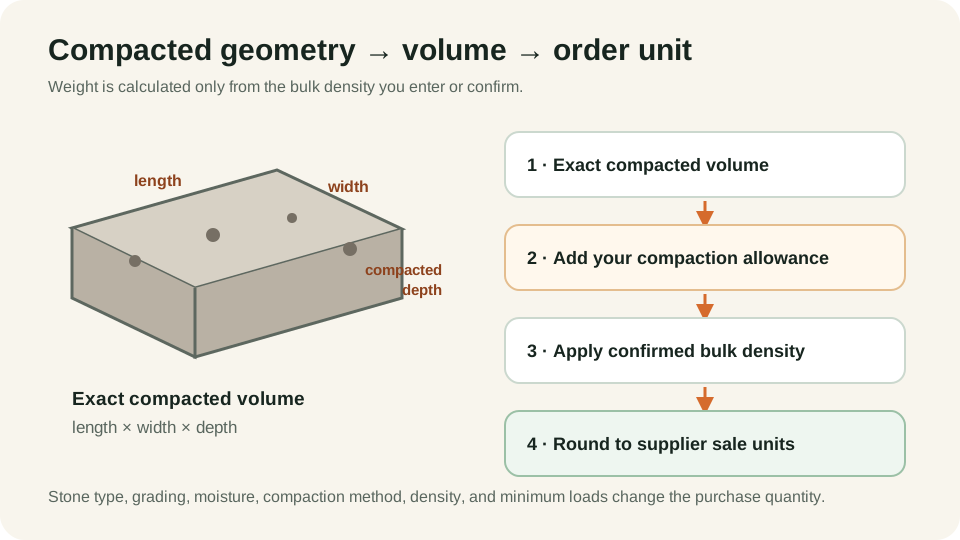
Volume = length × width × depth, with depth converted from millimetres to metres first — a 75 mm layer over 10 m × 3 m is 10 × 3 × 0.075 = 2.25 m³.
Australian landscape yards may sell gravel and crushed rock per tonne or per cubic metre. The calculator shows volume, converts it using the density you enter and rounds only when you enter the current quote's tonne increment.
Real-world example
Worked example: 10 m × 3 m driveway topping, 75 mm deep
- Convert depth: 75 mm = 0.075 m.
- Volume: 10 × 3 × 0.075 = 2.25 m³.
- For this example, enter a 5% allowance: 2.25 × 1.05 = 2.3625 m³.
- Enter the example density of 1,680 kg/m³: 2.3625 × 1,680 = 3,969 kg = 3.97 tonnes. Replace it with the selected product's density.
- Enter the example supplier increment of 0.25 tonne: 3.97 rounds up to 4 tonnes.
The example order is 4 tonnes only with the entered 5% allowance, 1,680 kg/m³ density and 0.25-tonne quote increment.
Before you start
How to measure
- Measure the area in metres and the depth in millimetres; for driveways, treat the road-base layer and the decorative topping as separate calculations.
- A 50–75 mm decorative layer is common for paths and garden areas; trafficked surfaces need compacted road base underneath.
- For long rural driveways, measure in sections where the width changes rather than averaging the whole run.
Local guidance
Notes for Australia
- Australian suppliers quote crushed rock, road base, scoria and decorative pebbles per tonne or per cubic metre — the calculator shows both so either quote works.
- Product names vary by state (e.g. 20 mm Class 2 or 3 road base, blue metal, cracker dust) and densities differ between them — ask your supplier for the tonnes-per-m³ figure for the exact product.
- GST is 10% and consumer prices are usually advertised GST-inclusive; trade or quarry-direct quotes may be ex-GST.
Quick reference
Gravel depth quick reference (typical planning values)
| Application | Common depth |
|---|---|
| Decorative pebbles over fabric | 40–50 mm |
| Garden paths | 50–75 mm |
| Driveway topping | 50–75 mm over compacted road base |
| Road base under driveways (separate material) | 100–150 mm compacted |
Planning values only — reactive soils and vehicle loads determine the real build-up.
Good to know
Common mistakes to avoid
- Typing depth in centimetres into a millimetre field — 7.5 instead of 75 gives a tenth of the material.
- Comparing a per-tonne quote against a per-m³ quote without using the selected product's stated density and sale basis.
- Using the same density for scoria (much lighter) as for blue metal — always check the product's figure.
- Treating a generic wastage percentage as a compaction conversion. Ask the supplier for the selected product's loose-to-compacted factor.
Need help?
Frequently asked questions
How many tonnes for a 6 m × 1.2 m path at 50 mm?
6 × 1.2 × 0.05 = 0.36 m³. With an entered 5% allowance and 1,680 kg/m³ density, that becomes about 0.64 tonnes. It rounds to 0.75 tonnes only when a 0.25-tonne quote increment is entered.
How many tonnes is a cubic metre of gravel?
At an entered density of 1,680 kg/m³, one cubic metre converts to 1.68 tonnes. That is an arithmetic example, not a default; use the supplier's figure for the exact product and condition.
Do I need road base under decorative gravel?
For anything that carries vehicles, yes — a compacted road-base layer does the structural work and the decorative layer sits on top. Run each layer through the calculator separately, since they're different products at different densities and prices.
Keep planning
Related calculators
Measure with confidence
Planning guides for this project
Transparency
About this calculator
- Written by:
- BuildMeasure Editorial Team
- Technically reviewed by:
- Pending independent technical reviewer (formula unit-tested; see methodology)
- Last reviewed:
- 2026-07-23
- Formula version:
- 1.1.0
- Region reviewed for:
- Australia
- Spotted an error?
- Report a correction
Methodology
- Volume is computed as length × width × depth, converted internally to SI units (metres) before any arithmetic to avoid unit drift.
- The optional wastage allowance is applied to exact finished volume for handling and uneven spreading. It is not a loose-to-compacted conversion; obtain that separately for the selected aggregate and method.
- Weight = total volume × the bulk density you enter for the exact product and condition. No default density is supplied because stone type, grading, moisture and loose or compacted state change the conversion.
- Supplier rounding occurs only when you enter the mass increment shown on the current quote. If the increment is blank, the calculator reports the unrounded calculated weight.
- The preliminary material subtotal multiplies calculated or supplier-rounded weight by the price you enter. Tax is added only after you confirm that the entered price excludes tax and provide a rate; an unresolved basis does not produce a final total.
- The formula is covered by automated unit tests, including hand-calculated worked examples, and is versioned (see formula version on this page).
Sources & standards
- Unit definitions: 1 tonne = 1,000 kg; metric units throughout.
- Density boundary: Weight is calculated only from the entered supplier density; no universal density or quarter-tonne sale increment is assumed.
This tool provides a material estimate for planning purposes only. It is not a quotation, and the weight conversion depends on the density you enter — stone type and moisture change it. Confirm quantities and density with your supplier before ordering.