Concrete & Masonry
Concrete Cost Calculator Australia — Delivered Quote
Turn a current premixed concrete supplier quote into an itemised AUD supply total while keeping physical volume, billed volume, fees and GST separate.
Formula tested · Local units · No sign-up
Project inputs
Enter measurements
Use your preferred units. Results update automatically.
Show the calculation methodFormula, conversions, rounding, and assumptions+
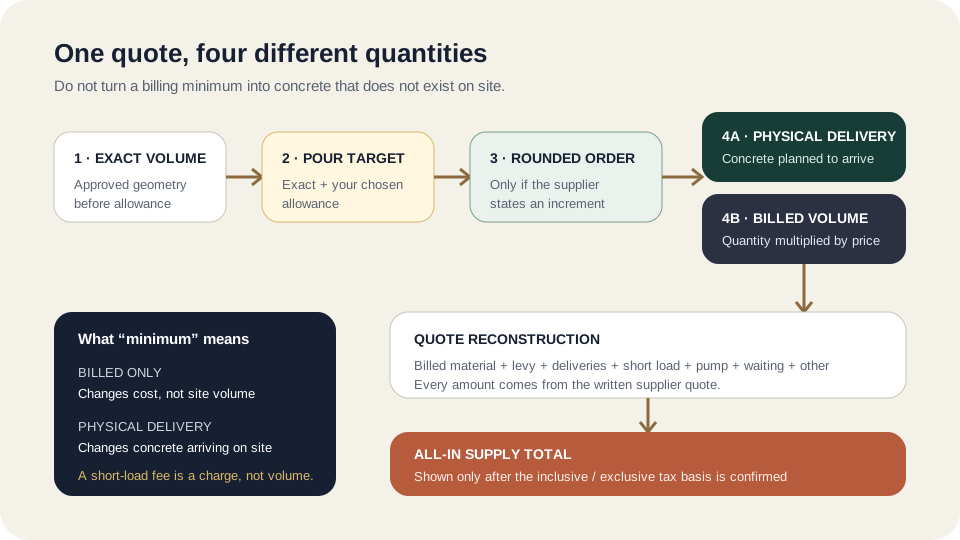
Exact volume is the measured or designed quantity brought from a volume calculation. Allowance volume = exact volume × entered allowance percentage. Pour target = exact volume + allowance. No allowance percentage is assumed by this calculator.
If the supplier specifies an order increment, increment-rounded order = ceiling(pour target ÷ increment) × increment. If no increment is written on the quote, the calculator leaves the pour target unrounded.
A minimum billed only rule changes the charged material volume but does not invent extra concrete on site: billed volume = max(increment-rounded order, minimum billed volume), while physical delivery remains the rounded order.
A minimum physical delivery rule changes both quantities. The supplier minimum is first rounded to the entered supplier increment where one exists; delivered and billed volume then become the larger of that minimum or the increment-rounded order.
Concrete charge = billed volume × entered base price per m³. A quoted per-volume levy also uses billed volume. Delivery/cartage = calculated load count × entered per-load fee; when no truck capacity is entered, that line is applied once and clearly warned.
Quote subtotal = material + levy + delivery + the entered short-load, pump/callout, waiting and other fixed totals. If prices exclude GST, entered GST = subtotal × confirmed rate. If prices include it, nothing is added again. An unconfirmed basis deliberately produces no final total.
Effective all-in cost is shown twice: final total ÷ exact required volume, and final total ÷ physically delivered volume. These answer different questions and must not be confused with the supplier's base unit price.
Real-world example
Checked example: billed minimum without fictitious surplus
- Suppose an exact requirement is 1.60 m³ and the user chooses 5% allowance. Allowance = 1.60 × 0.05 = 0.08 m³; pour target = 1.68 m³.
- If the written quote uses a 0.10 m³ increment, the physical order rounds up to 1.70 m³.
- If the quote bills a 2.00 m³ minimum but does not physically deliver that minimum, delivered volume remains 1.70 m³ and billed material volume becomes 2.00 m³.
- Physical excess is 1.70 − 1.68 = 0.02 m³. The 0.30 m³ difference between billed and delivered volume is displayed separately; it is not reported as concrete available for the pour.
- The base material line uses 2.00 × the user's entered price per m³. Every entered fee then appears as its own row before the confirmed GST treatment is applied.
The calculation preserves the distinction a normal order sheet needs: pour target, physical order, physical delivery, billed material quantity and complete entered-price total.
Before you start
How to measure
- Calculate the concrete volume from approved dimensions first. Use the slab or concrete-volume calculator for geometry; this page starts from a known exact volume and does not choose structural thickness or footing dimensions.
- Copy the supplier's exact product or mix reference into the note. The calculator records it for the printout but never recommends strength, class, slump, exposure, additives or fibres.
- Ask whether orders can be placed to an increment in m³. Enter only the increment stated by this supplier instead of assuming a universal quarter-unit rule.
- Ask what “minimum” means. Record whether it is a minimum physically delivered or only a minimum material quantity billed. A short-load or part-load surcharge is a fee, not automatically extra concrete.
- Enter the supplier's maximum volume for the proposed delivery vehicle only if it is confirmed. The tool uses it to count loads and price a per-load delivery line; it does not assume one truck size.
- Copy delivery/cartage, per-volume levies, the supplier-calculated short-load total, pump/callout, expected waiting scenario and other written quote charges into their separate rows.
- Confirm whether every entered price includes or excludes GST. If lines have mixed treatment, use the supplier's tax summary rather than applying one rate to all rows in this calculator.
- Print or copy the result and compare it back to the written quote. Confirm site access, placement rate, washout, return, cancellation, after-hours and price-validity terms before ordering.
Local guidance
Notes for Australia
- This Australia page uses m³, AUD, local number formatting and the label GST. It has no national, city or “2026 average” concrete price.
- Concrete, increment, minimum, vehicle capacity and fee inputs must come from a current local quote. The example button demonstrates the arithmetic only; every example supplier term and price must be replaced.
- Australian service-fee schedules commonly state whether amounts exclude GST. Confirm the basis on the specific local quote before calculating.
Quick reference
Concrete quantities and charges that must stay separate
| Stage | Formula or source | What it means |
|---|---|---|
| Exact volume | Approved geometry calculation | Concrete occupying the measured shape before allowance |
| Pour target | Exact volume + chosen allowance | Planning quantity before supplier sales rules |
| Increment-rounded order | Round pour target up to entered increment | Physical order before any delivery-minimum rule |
| Physical delivered volume | Rounded order, or larger confirmed physical minimum | Concrete planned to arrive on site |
| Billed material volume | Delivered volume, or larger confirmed billed-only minimum | Volume multiplied by the base unit price |
| Short/part-load charge | Exact total copied from quote | A fee; not automatically additional concrete |
| All-in supply total | Entered quote lines + confirmed tax treatment | Supply-side estimate, not installed slab cost |
The same word “minimum” can describe different commercial rules. Choose the rule from the written quote; do not infer it from the amount.
Good to know
Common mistakes to avoid
- Multiplying exact geometric volume by a headline price and calling it the delivered total.
- Treating a minimum billed volume as surplus concrete that will physically arrive.
- Applying a universal order increment or truck capacity instead of entering the supplier's rule.
- Adding a short-load fee and a volume minimum that describe the same charge. The calculator requires confirmation when both are entered.
- Adding GST to prices that already include it, or showing a final total before the quote basis is known.
- Pricing one delivery when the physical order needs multiple confirmed vehicle loads.
- Using a low base unit price to compare suppliers while ignoring cartage, levies, minimums, waiting and pump/callout lines.
- Calling the result an installed slab price even though forming, excavation, base, reinforcement, labour, finishing and curing are outside this supply calculator.
Need help?
Frequently asked questions
How much does one m³ of concrete cost?
There is no trustworthy universal figure. The mix, quantity, delivery distance, load policy, timing and added services affect a real quote. Enter the current supplier price and every quoted charge; the calculator reports both base price and effective all-in cost per m³.
Why is the billed concrete volume larger than the delivery?
Some written quotes use a minimum material quantity for billing without delivering that full minimum. Select “minimum billed only” to preserve the real delivered volume and show the billed-only difference separately.
Does a short-load fee mean I receive more concrete?
No. A short- or part-load line is normally a commercial charge associated with the load policy. Enter the quoted total as a fee; only choose a physical delivery minimum when the supplier actually requires that volume to arrive.
Can this calculate the cost of two cubic metres of concrete?
Yes on the metric regional pages. Enter 2 m³ as exact volume, then copy the supplier's allowance decision, increment, minimum rule, price per m³, fees and tax basis. The result will not invent a local price.
Does this include concrete pumping and waiting time?
Only when you enter quoted totals. Pump capacity, hose, mobilisation, minimum hours, free unloading time and waiting rates vary, so the calculator does not infer them.
Is this the total cost of a concrete slab?
No. It reconstructs entered ready-mix supply and delivery charges. Installed slab cost can also include excavation, sub-base, formwork, reinforcement, labour, finishing, curing, testing and equipment.
Keep planning
Related calculators
Measure with confidence
Planning guides for this project
Transparency
About this calculator
- Written by:
- BuildMeasure Editorial Team
- Technically reviewed by:
- Pending independent regional technical reviewer (formula unit-tested; supplier terms remain user-entered)
- Last reviewed:
- 2026-07-23
- Formula version:
- 1.0.0
- Region reviewed for:
- Australia
- Spotted an error?
- Report a correction
Methodology
- All source volume units are converted through cubic metres using exact legal unit conversions, then expressed in the regional ordering unit before supplier rules are applied.
- Increment rounding uses a floating-point boundary guard so a quantity already on an increment boundary does not gain an extra increment.
- Minimum billed and minimum physically delivered are separate branches with separate outputs. A physical minimum is rounded to the entered supplier increment only when both rules exist.
- Truck count = ceiling(delivered volume ÷ entered vehicle capacity). Final-load volume = delivered volume − capacity × (load count − 1). Capacity is never defaulted.
- Material and per-unit levy lines use billed volume. Per-load delivery uses calculated load count when capacity exists and one load otherwise, with a warning.
- Tax-exclusive mode adds the confirmed percentage to all entered quote lines; tax-inclusive mode adds zero; unconfirmed mode suppresses the final total and effective-unit outputs.
- Automated tests cover exact increment boundaries, billed-not-delivered minimums, physical minimum rounding, load and final-load counts, tax-inclusive handling, unresolved tax and double-charge confirmation.
Sources & standards
- NRMCA — CIP 31: Ordering Ready Mixed Concrete: Primary industry guidance that ready-mixed concrete is sold by fresh volume, truck capacities vary, order allowance is a purchaser decision and placement/access information must be communicated.
- Heidelberg Materials UK — Ready-mixed concrete pricing guide: Supplier evidence that pricing can vary with mix, distance, lead time, additions, part loads, returns and unloading time; used to justify quote inputs rather than average prices.
- CEMEX UK — Trading terms and conditions: Supplier terms enumerate supplementary part-load, returned-material, waiting-time and cancellation charges; evidence that a base unit price is not a complete invoice.
- Holcim Australia — Concrete service fees: Current regional fee-document index showing that concrete service schedules vary by region and explicitly list surcharge documents.
Planning estimate based only on the supplier terms and prices you enter. It is not a quotation, invoice, installed-project estimate, mix specification, structural design, placement plan, pump plan or safety assessment. Confirm approved dimensions and mix, quantity, access, delivery schedule, all charge lines, tax treatment and current terms with the designer, concrete producer, pump provider and relevant competent people before ordering or placing concrete.