Concrete & Masonry
Concrete Slab Calculator
Enter slab dimensions in metres and millimetres to get the cubic metres of pre-mixed concrete to order, with wastage and an optional GST-aware cost estimate.
Formula tested · Local units · No sign-up
Project inputs
Enter measurements
Use your preferred units. Results update automatically.
Show the calculation methodFormula, conversions, rounding, and assumptions+
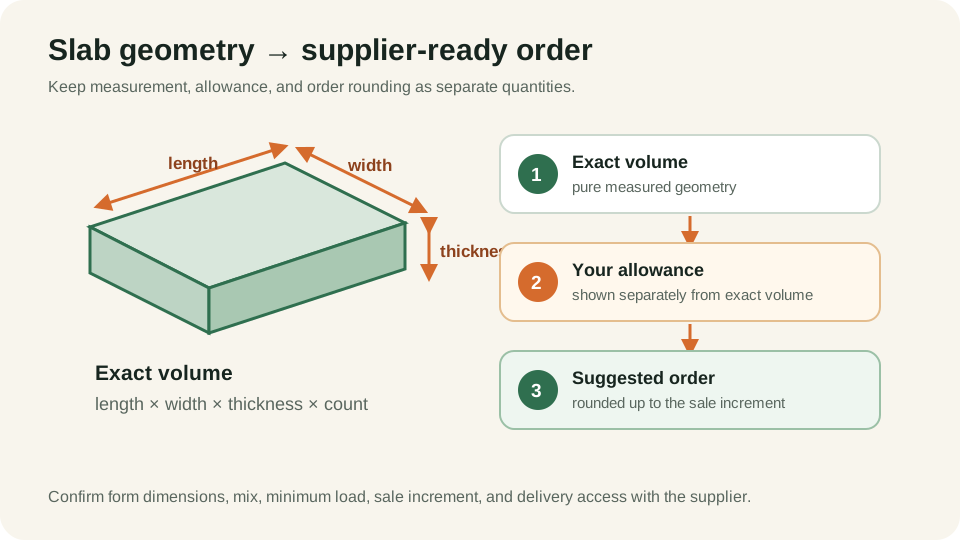
Volume = length × width × thickness. Australian practice measures plan dimensions in metres and slab thickness in millimetres, so the calculator converts before multiplying — a 4 m × 3 m slab at 100 mm is 4 × 3 × 0.1 = 1.2 m³.
Pre-mixed concrete volume is expressed in cubic metres. Supplier rounding occurs only when you enter the quote's cubic-metre increment.
Real-world example
Worked example: 4 m × 3 m shed slab, 100 mm thick
- Convert thickness: 100 mm = 0.1 m.
- Volume: 4 × 3 × 0.1 = 1.2 m³.
- Add 10% wastage: 1.32 m³.
- Round up to the ordering increment: 1.5 m³.
Order 1.5 m³. Enter your local quote per m³ — advertised consumer prices in Australia normally include 10% GST.
Before you start
How to measure
- Measure the formwork length and width in metres.
- Measure slab thickness in millimetres from the top of the compacted base to finished level; use the deepest reading if the base is uneven.
- Split L-shaped or stepped slabs into rectangles and add the volumes.
Local guidance
Notes for Australia
- Residential slab thicknesses of around 100 mm are common for sheds and paths; house slabs and driveways are engineered differently — slab design for dwellings falls under Australian standards and normally involves an engineer.
- Many councils require approval for larger slabs and shed bases — check local rules before pouring.
- GST is 10% and consumer prices are usually advertised GST-inclusive; trade accounts often see ex-GST pricing.
Quick reference
Slab thickness quick reference (typical nominal values)
| Application | Common nominal thickness |
|---|---|
| Shed slab | 100 mm |
| Path / patio | 75–100 mm |
| Driveway | 125–150 mm |
| Garage slab | 100–150 mm |
Nominal planning values only — reactive soils common in Australia can require engineered designs.
Good to know
Common mistakes to avoid
- Typing thickness in centimetres into a millimetre field — 10 instead of 100 gives one-tenth of the required volume.
- Not allowing wastage over an uneven crushed-rock base.
- Comparing GST-inclusive and ex-GST quotes as if they were the same.
- Pouring large slabs on reactive clay without engineering advice.
Need help?
Frequently asked questions
How much concrete for a 6 m × 4 m shed slab at 100 mm?
6 × 4 × 0.1 = 2.4 m³ exactly. With 10% wastage that's 2.64 m³, so order 2.75 m³.
Is a mini-mix truck an option for small slabs?
Small-load services may use different vehicles and commercial terms. Ask suppliers about access, minimum physical delivery, minimum billing, cartage and unit price instead of assuming a universal volume band.
Does this tool design the slab or reinforcement?
No. It estimates volume only. Reinforcement mesh, edge beams and slab design for Australian soil conditions are engineering matters — consult a professional for structural slabs.
Keep planning
Related calculators
Transparency
About this calculator
- Written by:
- BuildMeasure Editorial Team
- Technically reviewed by:
- Pending independent technical reviewer (formula unit-tested; see methodology)
- Last reviewed:
- 2026-07-23
- Formula version:
- 1.2.0
- Region reviewed for:
- Australia
- Spotted an error?
- Report a correction
Methodology
- Volume is computed as length × width × thickness × number of slabs, converted internally to SI units (metres) before any arithmetic to avoid unit drift.
- The chosen allowance is applied to the exact volume. Supplier rounding occurs only when you enter the increment shown on the current quote; if that field is blank, the planning volume remains unrounded.
- The preliminary material cost multiplies the planning or supplier-rounded quantity by the price you enter. Tax is added only after you confirm that the entered price excludes tax and supply a rate; an unresolved basis produces a subtotal, not a final total.
- The formula is covered by automated unit tests, including hand-calculated worked examples, and is versioned (see formula version on this page).
Sources & standards
- Unit definitions: Metric units throughout; 1 m³ = 1,000 litres.
- Supplier order terms: Enter the exact cubic-metre increment and GST basis from the current supplier quote; neither is assumed.
This tool provides a material estimate for planning purposes only. It is not a quotation, and it does not size reinforcement, check ground conditions, or replace professional structural advice. Confirm quantities and mix specification with your supplier before ordering.