Flooring & Tile
Tile and Grout Calculator with Spacer Width Australia
Enter the tiled area in metres, tile dimensions and spacer width in millimetres, then use the grout product's matching coverage row. Tile cartons and grout packages are rounded separately.
Formula tested · Local units · No sign-up
Project inputs
Enter measurements
Use your preferred units. Results update automatically.
Show the calculation methodFormula, conversions, rounding, and assumptions+
Each tile occupies its own size plus one grout joint: a 450 × 450 mm tile with a 3 mm joint takes up 0.453 × 0.453 = 0.2052 m². The area is divided by that footprint to get the exact tile count.
A wastage allowance is added — 10% for a straight lay, 15% for diagonal or brick-bond patterns — and the result is rounded up to a whole tile, then to whole boxes when you enter the tiles-per-box figure from the carton.
Grout packages use the entered m²-per-package coverage for the exact tile, joint width, joint depth and product, plus only the handling allowance you select.
Real-world example
Worked example: 4 m × 2 m laundry floor, 450 × 450 mm tiles, 3 mm joints
- Area: 4 × 2 = 8 m².
- Tile footprint: 0.453 × 0.453 = 0.2052 m².
- Exact count: 8 ÷ 0.2052 = 38.98 tiles.
- Add 10% wastage: 38.98 × 1.10 = 42.88 → round up to 43 tiles.
- Boxes of 6: 43 ÷ 6 = 7.17 → round up to 8 boxes.
- At an illustrative 5 m² grout coverage per package and a 5% entered allowance: 8 × 1.05 ÷ 5 = 1.68 → 2 packages.
Buy 8 cartons (48 tiles) and 2 grout packages only if the matching manufacturer chart row covers 5 m². Replace that illustrative coverage and enter current supplier prices if needed.
Before you start
How to measure
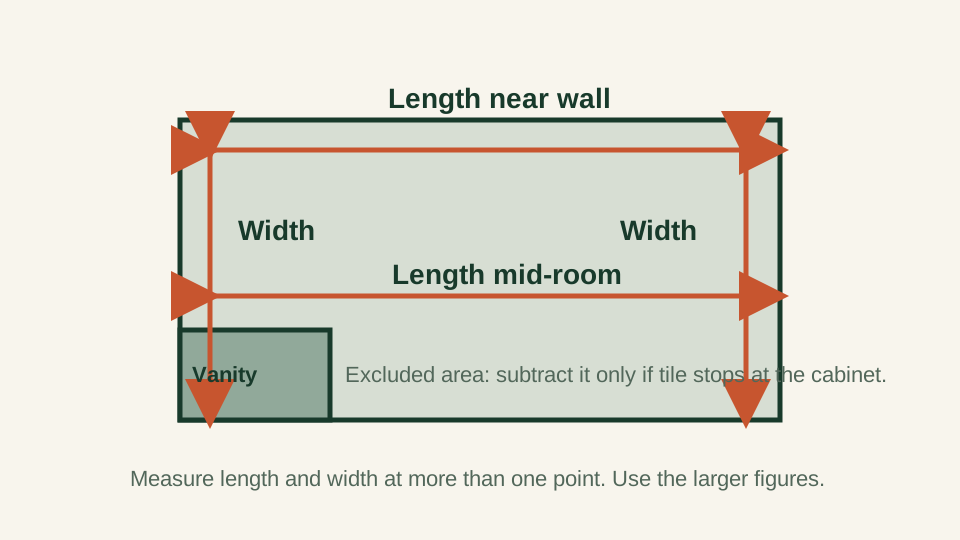
- Measure the room in metres; for wet areas, note that walls are often tiled to different heights (full height in showers, part height elsewhere) — measure each zone separately in direct-area mode.
- Take the exact tile size and tiles-per-carton from the carton label; Australian tiles are sized in millimetres.
- Grout joints of 2–5 mm are typical; 3 mm suits most floors. Rectified porcelain is often laid tighter — match your tiler's plan.
Local guidance
Notes for Australia
- Australian tiles are sized in millimetres — 300 × 300, 450 × 450, 600 × 600 floor formats and 300 × 600 wall tiles are common — and sold by the carton with m² coverage printed on it.
- Retailers usually advertise a per-m² price but sell whole cartons; this calculator counts cartons from the tiles-per-box figure so the quantity matches what you can actually buy.
- GST is 10% and advertised retail prices normally include it; waterproofing and wet-area work in Australia must meet the relevant standards and is usually a licensed trade — tiles are the DIY-safe part.
Quick reference
Common Australian tile sizes
| Format | Size | Typical use |
|---|---|---|
| Square floor | 300 × 300 mm | Laundries, bathrooms |
| Mid-size floor | 450 × 450 mm | Living areas, alfresco |
| Large format | 600 × 600 mm | Open-plan floors |
| Wall | 300 × 600 mm | Bathroom and kitchen walls |
Common formats for planning — actual sizes and tiles per carton are on the label.
Good to know
Common mistakes to avoid
- Typing centimetres into a millimetre field — 45 instead of 450 inflates the tile count a hundredfold.
- Ordering without wastage for an alfresco or outdoor area where edge cuts and breakage run high.
- Buying a top-up carton from a different batch — shade variation between batches is visible on a floor.
- Comparing a GST-inclusive advertised price against an ex-GST trade quote.
Need help?
Frequently asked questions
How many 450 × 450 tiles do I need for 10 m²?
With a 3 mm joint each tile occupies 0.453 × 0.453 = 0.2052 m², so 10 ÷ 0.2052 = 48.7 tiles. Adding 10% wastage gives 53.6, so buy 54 tiles.
How much wastage for a herringbone or diagonal lay?
Plan on 15% rather than the straight-lay 10% — angled cuts at every edge consume more tile, and small rooms lose proportionally more. Enter the percentage in the wastage field.
Is GST included in the estimate?
Only if you include it. Advertised Australian retail prices normally already include 10% GST, so enter the shelf price with tax at 0 — or an ex-GST trade price with 10% tax.
Keep planning
Related calculators
Transparency
About this calculator
- Written by:
- BuildMeasure Editorial Team
- Technically reviewed by:
- Pending independent technical reviewer (formula unit-tested; see methodology)
- Last reviewed:
- 2026-07-20
- Formula version:
- 1.2.0
- Region reviewed for:
- Australia
- Spotted an error?
- Report a correction
Methodology
- The area to tile comes either from length × width or from a directly entered area. All arithmetic runs internally in SI units (metres and m²); regional units (inches, mm, ft²) are converted exactly on the way in and out.
- Each tile's effective footprint is (tile length + grout gap) × (tile width + grout gap) — the grout joint is counted once per tile, which is how a repeating grid actually consumes floor area.
- Tile count = area ÷ footprint, multiplied by (1 + wastage %), then rounded UP to a whole tile. When you enter tiles per box, boxes = tile count ÷ tiles per box, rounded UP to a whole box.
- Grout package count uses the manufacturer's coverage for the exact tile size, joint width, joint depth, grout product, and package size. The calculator adds only the grout handling allowance you enter, divides by that coverage, and rounds UP to a whole package; it does not invent a universal grout yield.
- The cost estimate uses the separately rounded tile and grout purchasing quantities and the prices you enter, then applies the tax rate only when both included products have prices. No prices are built in.
- The formula is covered by automated unit tests, including hand-calculated worked examples, and is versioned (see formula version on this page).
Sources & standards
- Unit definitions: Metric units throughout; tile sizes in mm, areas in m².
- Wastage allowances: 10% straight lay / 15% diagonal are standard planning allowances; confirm with your tiler.
- Manufacturer grout coverage: MAPEI's manufacturer calculator uses tile size, thickness, joint width, area and grout product because actual coverage varies by the selected combination.
This tool provides a tile-and-grout material estimate for planning purposes only. It is not a quotation and does not calculate adhesive, trim, substrate preparation or waterproofing. Grout coverage varies with tile size, joint width, joint depth, product density and application; use the exact manufacturer coverage row and confirm quantities with your supplier.