Flooring & Tile
Tile and Grout Calculator with Spacer Width Canada
Enter the room in metres or feet, tile size and spacer width in millimetres or inches, then add the exact grout coverage from the product chart. The tool converts units and rounds tile boxes and grout packages separately.
Formula tested · Local units · No sign-up
Project inputs
Enter measurements
Use your preferred units. Results update automatically.
Show the calculation methodFormula, conversions, rounding, and assumptions+
Each tile occupies its own size plus one grout joint: a 330 × 330 mm tile (sold as 13-inch nominal) with a 3 mm joint takes up 0.333 × 0.333 = 0.1109 m². The area is divided by that footprint for the exact count.
A wastage allowance is added — 10% for a straight lay, 15% for diagonal patterns — and the result is rounded up to a whole tile, then to whole boxes when you enter tiles per box. Every input field accepts metric or imperial units and converts exactly.
Grout packages use the manufacturer's coverage for the same tile size, joint width, joint depth and package. A user-entered handling allowance is shown separately before whole-package rounding.
Real-world example
Worked example: 3 m × 2.5 m bathroom floor, 330 × 330 mm tiles, 3 mm joints
- Area: 3 × 2.5 = 7.5 m².
- Tile footprint: 0.333 × 0.333 = 0.1109 m².
- Exact count: 7.5 ÷ 0.1109 = 67.64 tiles.
- Add 10% wastage: 67.64 × 1.10 = 74.40 → round up to 75 tiles.
- Boxes of 10: 75 ÷ 10 = 7.5 → round up to 8 boxes.
- At an illustrative 5 m² per grout package and a 5% entered allowance: 7.5 × 1.05 ÷ 5 = 1.575 → 2 packages.
Buy 8 boxes (80 tiles) and 2 grout packages only if the exact manufacturer chart row covers 5 m². Enter the actual product coverage and local prices before buying.
Before you start
How to measure
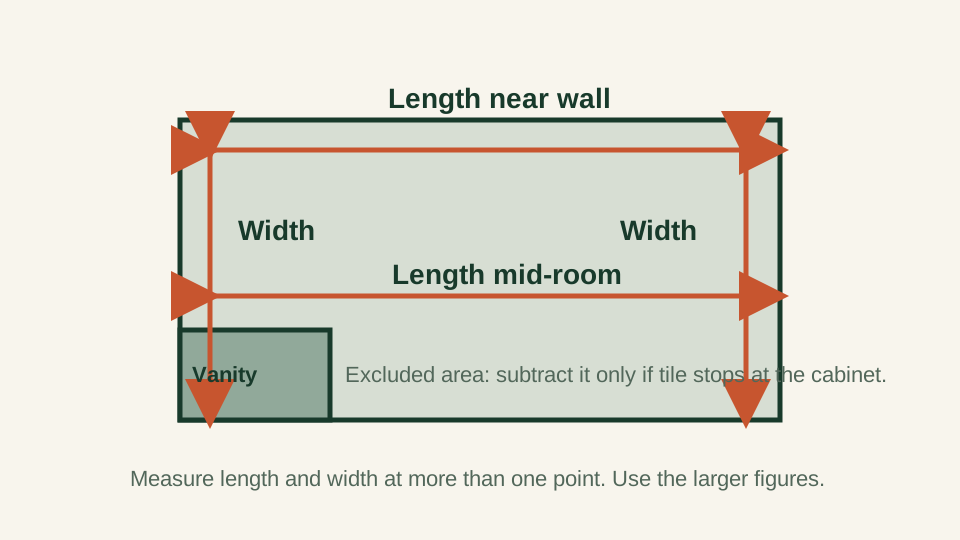
- Measure the room in whichever units you have — fields accept metres, centimetres, feet and inches, and mixing (say, a room in feet and tile in millimetres) is fine because everything converts internally.
- Canadian boxes usually carry bilingual labels with the tile size in both inches (nominal) and millimetres (actual) — enter the millimetre figure for the tighter estimate.
- Check both the tiles-per-box and the coverage (sq ft and m²) on the label; this calculator counts from tiles per box.
Local guidance
Notes for Canada
- Canadian tile shelves mix conventions: sizes are marketed in inches (12×12, 13×13, 12×24) while the actual dimensions on the bilingual label are metric (305, 330, 610 mm) — this calculator takes either.
- Coverage on boxes is typically printed in both square feet and square metres; contractors often quote in sq ft even though the tile is metric.
- Sales tax is 5% federal GST plus provincial tax or a combined HST depending on the province — enter your combined rate. Shelf prices are shown before tax.
Quick reference
Common Canadian tile sizes (nominal inch name vs metric label)
| Marketed as | Typical actual size | Typical use |
|---|---|---|
| 12 × 12 in | 305 × 305 mm | Bathrooms, entries |
| 13 × 13 in | 330 × 330 mm | Kitchens, floors |
| 12 × 24 in | 305 × 610 mm | Open floors, showers |
| 3 × 6 in subway | 76 × 152 mm | Backsplashes |
Nominal names for planning — the metric size on the box label is what governs the count.
Good to know
Common mistakes to avoid
- Entering the nominal inch size when the actual metric size differs — a '13-inch' tile is usually 330 mm, not 330.2 mm of exactly 13 inches; use the label figure.
- Mixing units without checking the per-field unit selector — a room in feet against tile in inches set to mm.
- Skipping the wastage allowance in small bathrooms where nearly every perimeter tile is cut.
- Assuming the same tax as your last renovation — GST/HST/PST combinations differ by province.
Need help?
Frequently asked questions
How many 300 × 300 mm tiles do I need for 5 m²?
With a 3 mm joint each tile occupies 0.303 × 0.303 = 0.0918 m², so 5 ÷ 0.0918 = 54.5 tiles. Adding 10% wastage gives 59.9, so buy 60 tiles.
The box shows coverage in square feet — can I still use this?
Yes. Enter your room in feet (or ft² in direct-area mode) and the tile in millimetres or inches — every field converts internally, so mixed units give the same count either way.
Why buy all the tile at once?
Tiles vary slightly in shade and size between production batches (the lot number is on the box). Ordering the full amount plus wastage in one batch keeps the floor consistent and leaves matched spares for repairs.
Keep planning
Related calculators
Transparency
About this calculator
- Written by:
- BuildMeasure Editorial Team
- Technically reviewed by:
- Pending independent technical reviewer (formula unit-tested; see methodology)
- Last reviewed:
- 2026-07-20
- Formula version:
- 1.2.0
- Region reviewed for:
- Canada
- Spotted an error?
- Report a correction
Methodology
- The area to tile comes either from length × width or from a directly entered area. All arithmetic runs internally in SI units (metres and m²); regional units (inches, mm, ft²) are converted exactly on the way in and out.
- Each tile's effective footprint is (tile length + grout gap) × (tile width + grout gap) — the grout joint is counted once per tile, which is how a repeating grid actually consumes floor area.
- Tile count = area ÷ footprint, multiplied by (1 + wastage %), then rounded UP to a whole tile. When you enter tiles per box, boxes = tile count ÷ tiles per box, rounded UP to a whole box.
- Grout package count uses the manufacturer's coverage for the exact tile size, joint width, joint depth, grout product, and package size. The calculator adds only the grout handling allowance you enter, divides by that coverage, and rounds UP to a whole package; it does not invent a universal grout yield.
- The cost estimate uses the separately rounded tile and grout purchasing quantities and the prices you enter, then applies the tax rate only when both included products have prices. No prices are built in.
- The formula is covered by automated unit tests, including hand-calculated worked examples, and is versioned (see formula version on this page).
Sources & standards
- Unit definitions: 1 in = 25.4 mm and 1 ft² = 0.09290304 m² (exact definitions).
- Wastage allowances: 10% straight lay / 15% diagonal are standard planning allowances; confirm with your installer.
- Manufacturer grout coverage: MAPEI's manufacturer calculator derives coverage from tile dimensions, joint width and selected product; enter the matching package coverage rather than a generic value.
This tool provides a tile-and-grout material estimate for planning purposes only. It is not a quotation and does not calculate adhesive, trim, substrate preparation or waterproofing. Grout coverage varies with tile size, joint width, joint depth, product density and application; use the exact manufacturer coverage row and confirm quantities with your supplier.