Concrete & Masonry
Concrete Volume Calculator
Enter your pour dimensions in metric or imperial — rectangular pads and footings or cylindrical sonotube piers — and get the cubic metres of ready-mix to order, with a wastage allowance.
Formula tested · Local units · No sign-up
Project inputs
Enter measurements
Use your preferred units. Results update automatically.
Show the calculation methodFormula, conversions, rounding, and assumptions+
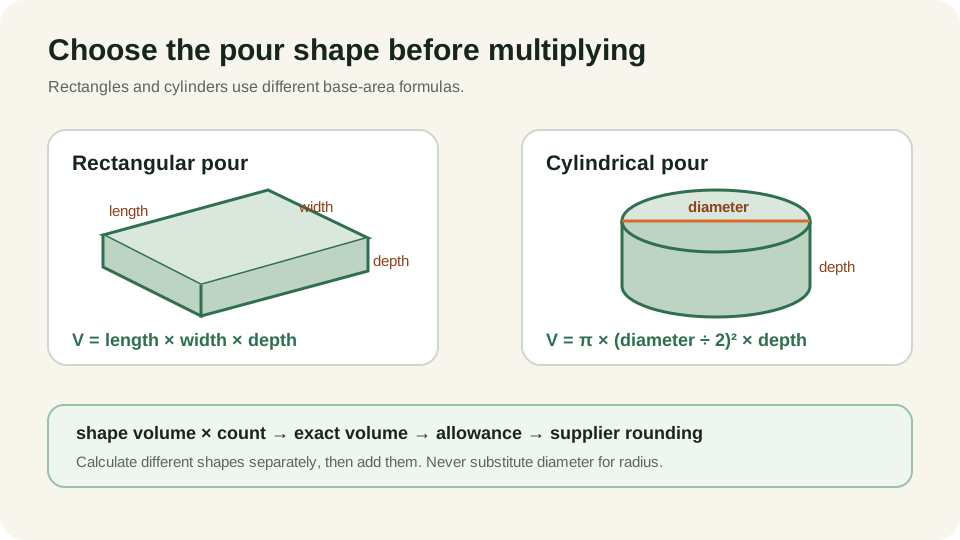
Rectangular pours use volume = length × width × depth; cylindrical pours (sonotube piers, deck footings) use volume = π × (diameter ÷ 2)² × depth, each multiplied by the number of pours.
Canadian ready-mix plants sell by the cubic metre, but many site measurements are still taken in feet and inches — the calculator accepts both and converts to a common unit before multiplying.
The allowance-adjusted total rounds only when you enter the cubic-metre increment stated on the supplier quote.
Real-world example
Worked example: 10 deck piers, 40 cm diameter × 1 m deep
- Volume per pier: π × (0.4 ÷ 2)² × 1 = π × 0.04 = 0.1257 m³.
- Ten piers: 0.1257 × 10 = 1.257 m³.
- Add 10% wastage: 1.257 × 1.10 = 1.382 m³.
- Round up to the ordering increment: 1.5 m³.
Order 1.5 m³. Enter your local ready-mix quote and combined GST/PST or HST rate for a cost estimate — rates differ by province.
Before you start
How to measure
- Measure sonotube piers by inside diameter and depth — the calculator accepts centimetres, metres or inches per field, so a 12-inch tube can stay in inches.
- Pier depth is set by local frost depth; measure from the bottom of the hole to the finished top of the tube.
- For pads and footings, measure plan dimensions at the formwork and depth at several points, using the largest.
Local guidance
Notes for Canada
- Canadian ready-mix is sold in cubic metres even though sonotubes and lumber are labelled in inches — double-check which units each number is in before entering it.
- Frost depth drives footing and pier depth across most of Canada, and exterior concrete is normally air-entrained for freeze–thaw resistance — tell your supplier the application.
- Sales tax is 5% federal GST plus provincial tax or a combined HST depending on the province — enter your combined rate.
Quick reference
Volume formulas by pour shape
| Shape | Formula | Typical use |
|---|---|---|
| Rectangular | length × width × depth | Pads, footings, walls |
| Cylindrical | π × (diameter ÷ 2)² × depth | Sonotube piers, posts |
Planning formulas only — bell-bottom pier forms add volume beyond a straight cylinder.
Good to know
Common mistakes to avoid
- Mixing unit systems mid-calculation — a 12-inch diameter entered as 12 cm gives roughly a quarter of the concrete per pier.
- Using diameter instead of radius when checking cylinder volume by hand.
- Ordering exterior concrete without air entrainment in freeze–thaw regions.
- Assuming the tax rate — GST/HST/PST combinations differ by province.
Need help?
Frequently asked questions
How much concrete for six 12-inch sonotubes, 1.2 m deep?
A 12-inch tube is about 30 cm across, so each pier is π × 0.15² × 1.2 = 0.085 m³. Six piers are 0.51 m³; with 10% wastage that's 0.56 m³, so order 0.75 m³ — at this quantity a small ready-mix or U-cart load usually beats hand-mixing bags.
Why does my supplier quote in cubic metres when my sonotubes are sized in inches?
Canadian ready-mix converted to metric decades ago while form products kept imperial labels. Enter the diameter in inches and the depth in metres — the calculator converts everything for you.
How deep should my deck piers be?
Below local frost depth, which varies widely across Canada and is set by your municipal building code. Check with your building department — this calculator only computes volume for the depth you enter.
Keep planning
Related calculators
Transparency
About this calculator
- Written by:
- BuildMeasure Editorial Team
- Technically reviewed by:
- Pending independent technical reviewer (formula unit-tested; see methodology)
- Last reviewed:
- 2026-07-23
- Formula version:
- 1.1.0
- Region reviewed for:
- Canada
- Spotted an error?
- Report a correction
Methodology
- Rectangular pours use volume = length × width × depth × count; cylindrical pours use volume = π × (diameter ÷ 2)² × depth × count. All inputs are converted to SI units (metres) before any arithmetic to avoid unit drift.
- The chosen allowance is applied to the exact volume. Supplier rounding occurs only when you enter the increment shown on the current quote; if that field is blank, the planning volume remains unrounded.
- The preliminary material cost multiplies the planning or supplier-rounded quantity by the price you enter. Tax is added only after you confirm that the entered price excludes tax and supply a rate; an unresolved basis produces a subtotal, not a final total.
- The formula is covered by automated unit tests, including hand-calculated worked examples, and is versioned (see formula version on this page).
Sources & standards
- Unit definitions: 1 ft = 0.3048 m (exact); ready-mix ordering unit is the cubic metre.
- Supplier order terms: Enter the exact cubic-metre increment and GST/HST basis from the current supplier quote.
This tool provides a material estimate for planning purposes only. It is not a quotation, and it does not size reinforcement, check ground conditions, or replace professional structural advice. Confirm quantities and mix specification with your supplier before ordering.