Concrete & Masonry
Concrete Volume Calculator
Enter your pour dimensions in metres and millimetres — rectangular or cylindrical — to get the cubic metres of ready-mixed concrete to order, with wastage and an optional VAT-aware cost estimate.
Formula tested · Local units · No sign-up
Project inputs
Enter measurements
Use your preferred units. Results update automatically.
Show the calculation methodFormula, conversions, rounding, and assumptions+
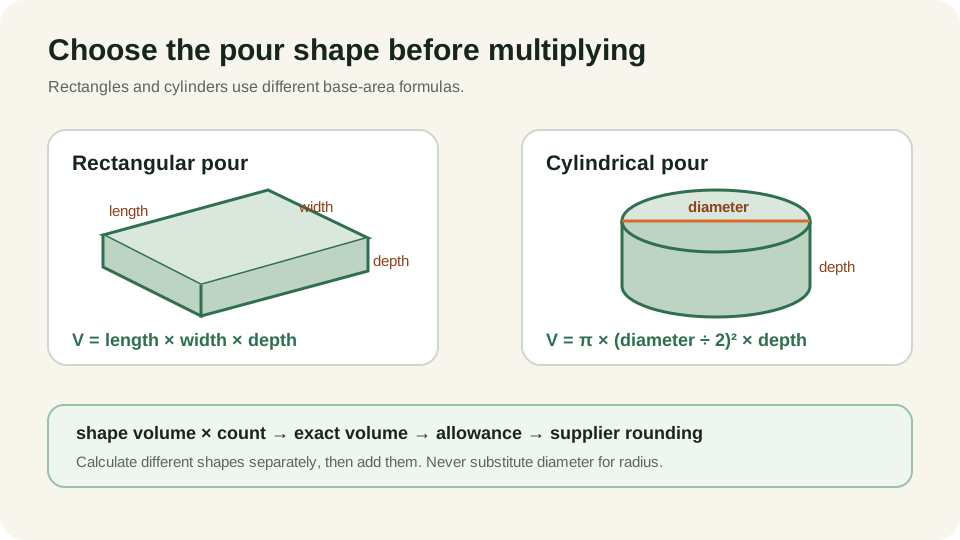
Rectangular pours (slabs, strip footings, walls) use volume = length × width × depth. Cylindrical pours (fence post holes, pad-and-pier bases) use volume = π × (diameter ÷ 2)² × depth. Either is multiplied by the number of identical pours.
UK practice measures plan dimensions in metres and depth in millimetres, so the calculator converts millimetres to metres before multiplying — a 150 mm depth is 0.15 m.
Ready-mixed concrete volume is expressed in cubic metres. The result rounds only when you enter the cubic-metre increment stated on the supplier quote.
Real-world example
Worked example: 5 m × 3 m base, 150 mm thick
- Convert depth: 150 mm = 0.15 m.
- Volume: 5 × 3 × 0.15 = 2.25 m³.
- Add 10% wastage: 2.25 × 1.10 = 2.475 m³.
- For this worked example, enter a 0.25 m³ supplier increment: 2.475 m³ rounds up to 2.5 m³.
The example becomes 2.5 m³ only with the entered 0.25 m³ quote increment. Replace it with the actual term, then use the related quote calculator for delivery, minimum, part-load and VAT lines.
Before you start
How to measure
- Measure plan dimensions inside the shuttering or trench in metres, and depth in millimetres from the base to finished level — use the deepest reading.
- For strip footings, treat the trench as a long rectangle: length along the trench, width across it.
- For fence post holes, measure the hole diameter and depth and use the cylindrical shape with the number of holes in the 'number of pours' field.
Local guidance
Notes for United Kingdom
- UK suppliers may offer plant-batched or on-site mixed supply under different minimum, callout, metering and delivery terms. Confirm the basis of sale instead of assuming every volumetric contract bills only discharged concrete.
- Footing dimensions for extensions and garden walls are normally agreed with building control or an engineer — this tool estimates volume only.
- VAT at the standard 20% rate applies to most concrete supply; trade quotes are often ex-VAT, so check before comparing.
Quick reference
Volume formulas by pour shape
| Shape | Formula | Typical use |
|---|---|---|
| Rectangular | length × width × depth | Slabs, strip footings, walls |
| Cylindrical | π × (diameter ÷ 2)² × depth | Post holes, piers |
Planning formulas only — trench sides rarely dig perfectly square, so allow wastage.
Good to know
Common mistakes to avoid
- Typing a depth in centimetres into a millimetre field — 15 instead of 150 gives a tenth of the concrete you need.
- Using the diameter instead of the radius when checking the cylinder maths by hand — it quadruples the volume.
- Choosing an allowance without comparing trench side variation, base over-dig and the actual measured sections.
- Not asking whether the quoted price includes VAT and delivery.
Need help?
Frequently asked questions
How much concrete for a 6 m strip footing, 600 mm wide and 300 mm deep?
6 × 0.6 × 0.3 = 1.08 m³ exactly. With 10% wastage that's 1.19 m³, so order 1.25 m³.
How much for 10 fence post holes, 300 mm diameter and 600 mm deep?
Each hole is π × 0.15² × 0.6 = 0.042 m³, so ten holes are 0.42 m³. With 10% wastage that's 0.47 m³ — order 0.5 m³, or use post-mix bags for this quantity.
Should I choose ready-mixed or volumetric for a footing pour?
On-site mixed supply can adapt during placement, while plant-batched supply arrives as prepared loads. Billing minimums, callouts and measured-quantity terms vary, so compare the complete written quotes and site constraints.
Keep planning
Related calculators
Measure with confidence
Planning guides for this project
Transparency
About this calculator
- Written by:
- BuildMeasure Editorial Team
- Technically reviewed by:
- Pending independent technical reviewer (formula unit-tested; see methodology)
- Last reviewed:
- 2026-07-23
- Formula version:
- 1.1.0
- Region reviewed for:
- United Kingdom
- Spotted an error?
- Report a correction
Methodology
- Rectangular pours use volume = length × width × depth × count; cylindrical pours use volume = π × (diameter ÷ 2)² × depth × count. All inputs are converted to SI units (metres) before any arithmetic to avoid unit drift.
- The chosen allowance is applied to the exact volume. Supplier rounding occurs only when you enter the increment shown on the current quote; if that field is blank, the planning volume remains unrounded.
- The preliminary material cost multiplies the planning or supplier-rounded quantity by the price you enter. Tax is added only after you confirm that the entered price excludes tax and supply a rate; an unresolved basis produces a subtotal, not a final total.
- The formula is covered by automated unit tests, including hand-calculated worked examples, and is versioned (see formula version on this page).
Sources & standards
- Unit definitions: Metric units used throughout; 1 m³ = 1,000 litres.
- Supplier order terms: Enter the exact cubic-metre increment and VAT basis from the current supplier quote; neither is assumed.
This tool provides a material estimate for planning purposes only. It is not a quotation, and it does not size reinforcement, check ground conditions, or replace professional structural advice. Confirm quantities and mix specification with your supplier before ordering.