Decks & Fences
Decking Calculator — Boards, Joists, and Fasteners
Enter your deck size in metres or feet and the approved fixing schedule to count boards, joists, regular fasteners, whole packs, and optional entered-price cost.
Formula tested · Local units · No sign-up
Project inputs
Enter measurements
Use your preferred units. Results update automatically.
Show the calculation methodFormula, conversions, rounding, and assumptions+
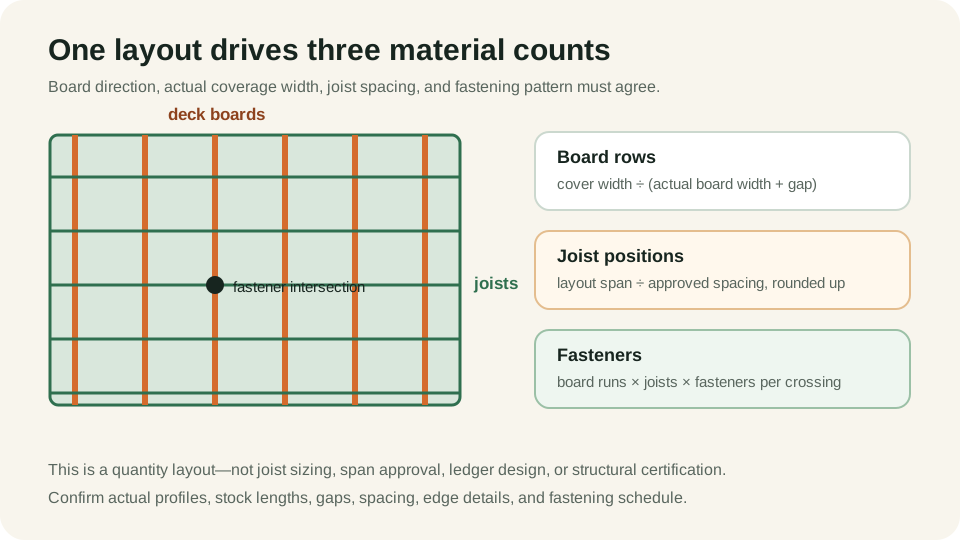
Rows of boards = deck width ÷ (board width + gap), rounded up. Canadian deck boards are imperial stock — a nominal 6 in board is actually 5.5 in (about 140 mm) — but you can enter every dimension in metric or imperial.
Boards per row = deck length ÷ board length, rounded up; boards to buy adds your wastage allowance and rounds up.
Joists = deck length ÷ joist spacing rounded up, plus one closing joist — 16 in (about 400 mm) on-centre is the common wood-deck spacing.
Regular fasteners = board rows × joists × fasteners per intersection, followed by a separate allowance and optional whole-pack rounding.
Real-world example
Worked example: 4.8 m × 3.6 m deck, 140 mm boards, 3 mm gap, 4.8 m boards, 400 mm centres
- Row width: 140 + 3 = 143 mm. Rows: 3.6 ÷ 0.143 = 25.17 → round up to 26 rows.
- Boards per row: 4.8 ÷ 4.8 = 1 board.
- Boards to buy: 26 × 1 × 1.10 (10% wastage) = 28.6 → round up to 29 boards.
- Joists: 4.8 ÷ 0.4 = 12 exactly, + 1 closing joist = 13 joists.
- Regular fasteners: 26 rows × 13 joists × 2 = 676; +5% = 709.8 → 710, or 8 packs of 100.
Buy 29 boards, 13 joists, and 710 regular fasteners (8 packs of 100). Enter actual board, joist, and fastener-pack prices plus the applicable tax rate.
Before you start
How to measure
- Measure the deck length (board direction) and width in whichever units your plan uses — fields accept metres, feet, millimetres and inches.
- Use the actual board width: nominal 5/4 × 6 decking measures 5.5 in (about 140 mm) across.
- Enter the stock length you'll buy — 8, 12 and 16 ft boards are common at Canadian yards; a 16 ft board is about 4.88 m.
- Confirm fastener type, count per crossing, corrosion compatibility, package quantity, and extra fasteners for seams, starters, edges, stairs, and fascia.
Local guidance
Notes for Canada
- Deck footings in most of Canada must bear below the local frost depth or the deck heaves seasonally — frost depth varies by region, so ask your municipal building department. Footings are not estimated by this tool.
- Most municipalities require a permit for attached or elevated decks, and many publish standard deck detail sheets — check before building.
- Pressure-treated lumber is the standard framing and budget decking choice; cedar and composite are common upgrades — the calculator handles any of them since you enter the board dimensions.
- Sales tax is 5% federal GST plus provincial tax, or a combined HST, depending on the province — enter your combined rate.
Quick reference
Common Canadian decking planning values
| Item | Common value |
|---|---|
| Board width (actual) | 5.5 in / ~140 mm |
| Drainage gap | 1/8 in / ~3 mm |
| Board stock lengths | 8, 12, 16 ft |
| Joist spacing | 16 in / ~400 mm on-centre |
| Face fasteners per regular crossing | 2 is a common plan value; approved system governs |
Planning values only — local code, frost depth and manufacturer charts govern.
Good to know
Common mistakes to avoid
- Mixing unit systems mid-entry — a 140 mm board typed as 140 in the inch field is a 3.5 m plank.
- Skipping the wastage allowance — crowned, split or checked pressure-treated boards get culled on site.
- Using the regular intersection quantity as the complete fastener schedule without adding project-specific starter, edge, seam, stair, and fascia details.
- Building footings above the frost line — the deck racks and doors stop closing within a couple of winters.
- Skipping the permit on an attached deck — ledger failures are the classic deck collapse, and inspections exist to catch them.
Need help?
Frequently asked questions
How many boards for a 14 ft × 10 ft deck with standard 5.5 in boards?
Row width is 5.625 in, so 120 in ÷ 5.625 = 21.33 → 22 rows. With 16 ft boards that's one per row, and 22 × 1.10 = 24.2 → 25 boards with 10% wastage. Joists at 16 in: 168 ÷ 16 = 10.5 → 11, + 1 = 12 joists.
Can I plan in metric and buy imperial lumber?
Yes — enter your plan in metres and the board sizes in inches (or their metric equivalents); everything is converted internally. Just remember stock lengths are imperial: a '4.8 m' board is really 16 ft = 4.877 m.
Does this tool size my joists and footings?
No. It counts boards and joists at the spacing you enter; joist depth, beam spans and frost footings are structural decisions governed by your local building code and permit process.
Does the fastener count work for hidden clips?
Use the manufacturer's approved clips per board/joist crossing in the editable field, but count starter clips, edge screws, butt-joint clips, blocking, stairs, and fascia separately. Proprietary systems override generic defaults.
Keep planning
Related calculators
Transparency
About this calculator
- Written by:
- BuildMeasure Editorial Team
- Technically reviewed by:
- Pending independent technical reviewer (formula unit-tested; see methodology)
- Last reviewed:
- 2026-07-20
- Formula version:
- 1.1.0
- Region reviewed for:
- Canada
- Spotted an error?
- Report a correction
Methodology
- Boards are assumed to run parallel to the deck length; joists run parallel to the width, spaced along the length. All dimensions are converted to metres internally before any arithmetic.
- Rows of boards = deck width ÷ (board width + gap), rounded UP. Boards per row = deck length ÷ board length, rounded UP — part boards count as whole boards because that's what you buy.
- Boards to buy = rows × boards per row × (1 + wastage%), rounded UP. Joists = deck length ÷ joist spacing, rounded UP, plus one closing joist. Exact multiples are not bumped up.
- Regular-layout fasteners = board rows × joists × fasteners per intersection. The editable fastener allowance is applied separately, then the quantity rounds up first to a whole fastener and, when entered, to whole supplier packs.
- The cost estimate multiplies board, joist, and optional fastener-pack counts by only the prices you enter, then applies the tax rate you enter. No prices are built in.
- The formula is covered by automated unit tests, including hand-calculated worked examples, and is versioned (see formula version on this page).
Sources & standards
- Board dimensions: Nominal 5/4 × 6 decking measures 5.5 in actual = 139.7 mm (1 in = 25.4 mm, exact).
- Joist spacing: 16 in on-centre is common Canadian wood-deck practice; local code and span tables govern.
This tool provides a material estimate for planning purposes only. It is not a quotation, and it does not size joists, bearers, posts, footings or ledger connections — deck structure is an engineering and permit matter. The regular-layout fastener count does not determine corrosion class, hidden-clip system, butt-joint blocking, starter clips, or edge details. Confirm the structural design, board fixing schedule, and quantities with qualified guidance, manufacturer instructions, and your supplier before ordering.