Decks & Fences
Decking Calculator — Boards, Joists, and Screws
Enter deck dimensions and the approved board, joist, and fixing layout to get boards, joists, regular board-to-joist screws, whole fastener packs, and optional entered-price cost.
Formula tested · Local units · No sign-up
Project inputs
Enter measurements
Use your preferred units. Results update automatically.
Show the calculation methodFormula, conversions, rounding, and assumptions+
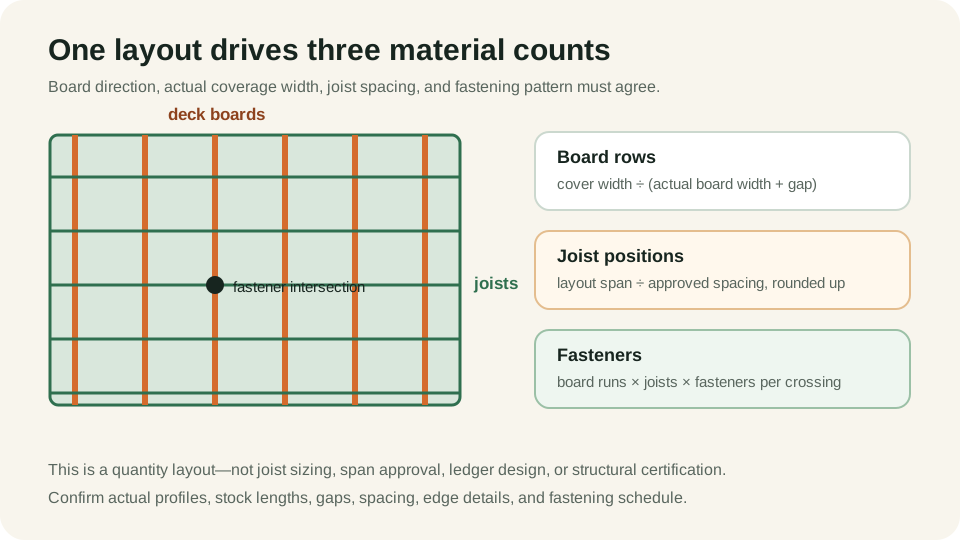
Rows of boards = deck width ÷ (board width + gap), rounded up. A standard 5/4 or composite deck board is 5.5 in wide; with a 1/8 in drainage gap each row takes 5.625 in of width.
Boards per row = deck length ÷ board length, rounded up — a 16 ft board on a 16 ft deck is exactly one board per row.
Boards to buy adds your wastage allowance and rounds up; joists = deck length ÷ joist spacing (16 in on-center is the common standard) rounded up, plus one closing joist.
Regular-layout screws = board rows × joists × screws per intersection. The calculator shows the 5% example allowance separately and rounds 100-count packages only after that allowance.
Real-world example
Worked example: 16 ft × 12 ft deck, 5.5 in boards, 1/8 in gap, 16 ft boards, 16 in joists
- Row width: 5.5 + 0.125 = 5.625 in. Rows: 144 in ÷ 5.625 = 25.6 → round up to 26 rows.
- Boards per row: 16 ÷ 16 = 1 board.
- Boards to buy: 26 × 1 × 1.10 (10% wastage) = 28.6 → round up to 29 boards.
- Joists: 192 in ÷ 16 = 12, + 1 closing joist = 13 joists.
- Regular-layout screws: 26 rows × 13 joists × 2 = 676. A 5% allowance produces 709.8 → 710 screws, or 8 whole 100-count packs.
- Example cost: 29 boards × $40 = $1,160; 13 joists × $15 = $195; materials $1,355; 7% tax $94.85.
Buy 29 boards, 13 joists, and 710 regular-layout screws (8 packs of 100). The $1,449.85 example total includes only the illustrated board and joist prices; fasteners join the total only when their real pack price is entered.
Before you start
How to measure
- Measure the finished deck length (the direction the boards run) and width in feet.
- Use the actual board width, not the nominal size — a 'six-inch' deck board actually measures 5.5 in; composite boards state their true width on the spec sheet.
- Enter the board length you'll actually buy (12, 16 and 20 ft are common stock lengths) — buying boards that span the deck avoids butt joints.
- Use the board and fastener manufacturer's approved screws or clips per crossing, pack count, corrosion resistance, edge distance, and butt-joint detail; enter extra detail fasteners separately through the allowance.
Local guidance
Notes for United States
- 16 in on-center is the common joist spacing for wood decking laid perpendicular to joists; many composite brands require closer spacing (often 12 in) for diagonal installs — follow the manufacturer's span chart.
- Most US jurisdictions require a permit for attached or elevated decks, and ledger attachment and footing details are inspected — check with your building department before building.
- Pressure-treated southern yellow pine is the standard framing lumber; decking itself may be treated wood, cedar or composite — the calculator works for any of them since you enter the board size.
- Sales tax varies by state and locality and is entered manually.
Quick reference
Common US decking planning values
| Item | Common value |
|---|---|
| Board width (actual) | 5.5 in |
| Drainage gap | 1/8 in (composite: per manufacturer) |
| Board stock lengths | 12, 16, 20 ft |
| Joist spacing | 16 in on-center (12 in for some composite/diagonal) |
| Face screws per regular crossing | 2 is a common plan value; approved system governs |
Planning values only — manufacturer span charts and local code govern.
Good to know
Common mistakes to avoid
- Using the nominal 6 in width instead of the actual 5.5 in — the row count comes out wrong.
- Ignoring the manufacturer's joist-spacing requirement for composite boards.
- Multiplying waste boards into the screw count or forgetting starter, edge, butt-joint, and blocking details — the tool keeps the regular intersection count and allowance separate.
- Forgetting wastage: cuts, crowned boards and damaged pieces routinely eat 10%.
- Treating this estimate as a structural design — footings, beams and ledger connections are not sized here and usually need a permit.
Need help?
Frequently asked questions
How many boards for a 12 ft × 12 ft deck?
Rows: 144 in ÷ 5.625 = 25.6 → 26 rows. With 12 ft boards that's one board per row, and 26 × 1.10 = 28.6 → 29 boards with 10% wastage. Joists at 16 in: 144 ÷ 16 = 9, + 1 = 10 joists.
What changes if I frame at 12 in on-center?
Only the joist count: for the 12 ft-long deck above, 144 ÷ 12 = 12, + 1 = 13 joists instead of 10. Board count is unchanged. Closer spacing is often required for composite or diagonal decking.
Does the calculator work for composite decking?
Yes — enter the composite board's actual width, required gap and stock length from its spec sheet. Composite brands set their own joist-spacing and gapping rules, which override the wood defaults shown here.
How many deck screws do I need?
For the regular grid, multiply board rows × joists × the approved screws per intersection, then add your explicit allowance. Hidden clips, starters, perimeter screws, doubled butt-joint framing, blocking, stairs, and fascia can require separate quantities.
Keep planning
Related calculators
Measure with confidence
Planning guides for this project
Transparency
About this calculator
- Written by:
- BuildMeasure Editorial Team
- Technically reviewed by:
- Pending independent technical reviewer (formula unit-tested; see methodology)
- Last reviewed:
- 2026-07-20
- Formula version:
- 1.1.0
- Region reviewed for:
- United States
- Spotted an error?
- Report a correction
Methodology
- Boards are assumed to run parallel to the deck length; joists run parallel to the width, spaced along the length. All dimensions are converted to metres internally before any arithmetic.
- Rows of boards = deck width ÷ (board width + gap), rounded UP. Boards per row = deck length ÷ board length, rounded UP — part boards count as whole boards because that's what you buy.
- Boards to buy = rows × boards per row × (1 + wastage%), rounded UP. Joists = deck length ÷ joist spacing, rounded UP, plus one closing joist. Exact multiples are not bumped up.
- Regular-layout fasteners = board rows × joists × fasteners per intersection. The editable fastener allowance is applied separately, then the quantity rounds up first to a whole fastener and, when entered, to whole supplier packs.
- The cost estimate multiplies board, joist, and optional fastener-pack counts by only the prices you enter, then applies the tax rate you enter. No prices are built in.
- The formula is covered by automated unit tests, including hand-calculated worked examples, and is versioned (see formula version on this page).
Sources & standards
- Board dimensions: 5.5 in is the actual width of a nominal 6 in deck board; 1 in = 25.4 mm (exact).
- Joist spacing: 16 in on-center is common US practice for perpendicular wood decking; manufacturer charts govern composites.
This tool provides a material estimate for planning purposes only. It is not a quotation, and it does not size joists, bearers, posts, footings or ledger connections — deck structure is an engineering and permit matter. The regular-layout fastener count does not determine corrosion class, hidden-clip system, butt-joint blocking, starter clips, or edge details. Confirm the structural design, board fixing schedule, and quantities with qualified guidance, manufacturer instructions, and your supplier before ordering.