Flooring & Tile
Flooring Calculator
Enter your room in metres or feet — Canadian flooring boxes are labelled in both sq ft and m², and this calculator converts either way and counts the boxes to buy.
Formula tested · Local units · No sign-up
Project inputs
Enter measurements
Use your preferred units. Results update automatically.
Show the calculation methodFormula, conversions, rounding, and assumptions+
Room area = length × width, converted to a common unit first. Canadian rooms are often measured in feet while box labels are bilingual with both sq ft and m² — the calculator accepts either and converts exactly.
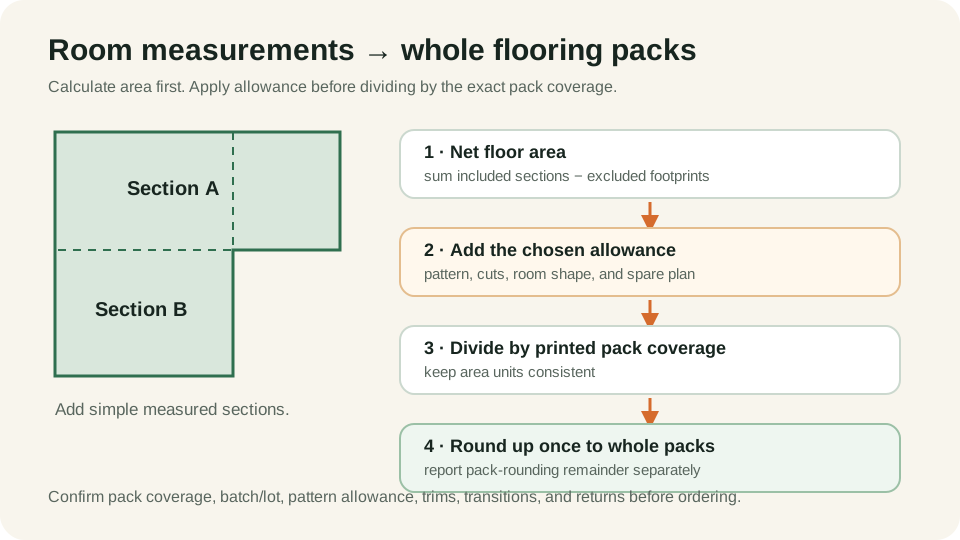
A wastage allowance is added on top (default 8% for a straight lay), then the total is divided by the coverage per box from the label and rounded up to whole boxes, because flooring is sold in sealed boxes.
Real-world example
Worked example: 4.2 m × 3.5 m living room, laminate, 8% wastage
- Room area: 4.2 × 3.5 = 14.7 m².
- Add 8% wastage: 14.7 × 1.08 = 15.88 m² to purchase.
- Boxes at 1.9 m² per box (from the label): 15.88 ÷ 1.9 = 8.36.
- Round up to whole boxes: 9 boxes.
Buy 9 boxes (17.1 m²). Enter your store's price per box and your province's combined GST/PST or HST rate for a cost estimate — rates differ by province.
Before you start
How to measure
- Measure the room in whichever units you have — each field accepts metres, centimetres, feet or inches and the tool converts, so a room in feet against a box labelled in m² is fine.
- Canadian box labels are bilingual and usually state coverage in both sq ft and m² — enter whichever figure you use, with the matching unit, and keep it consistent with your area unit.
- Include closets and doorway transitions; split L-shaped rooms into rectangles and add the areas in direct-area mode.
Local guidance
Notes for Canada
- Canadian flooring retail mixes conventions: prices are usually advertised per square foot, while the bilingual box label shows coverage in both sq ft and m² — this calculator takes either unit.
- Vinyl plank and laminate dominate the DIY market; in much of Canada, seasonal humidity swings make the manufacturer's acclimatization and expansion-gap instructions especially important.
- Sales tax is 5% federal GST plus provincial tax or a combined HST depending on the province — enter your combined rate. Shelf prices are shown before tax.
Quick reference
Typical wastage allowance by laying pattern (planning values)
| Pattern | Typical allowance |
|---|---|
| Straight lay, regular room | 8% |
| Straight lay, many doorways/alcoves | 10% |
| Diagonal lay | 12–15% |
| Herringbone / chevron | 15–20% |
Planning values only — your installer and the room's shape determine the real allowance.
Good to know
Common mistakes to avoid
- Entering a room measured in feet against a box coverage in m² without setting the units — the per-field unit selectors handle it, but only if they're set.
- Skipping the manufacturer's acclimatization period before installation in a climate with big seasonal humidity swings.
- Buying exactly the room area with no wastage or spare planks for repairs.
- Assuming the tax rate — GST/HST/PST combinations differ by province.
Need help?
Frequently asked questions
The box says 19.6 sq ft — how many square metres is that?
19.6 sq ft × 0.0929 = about 1.82 m². You don't need to convert by hand, though: enter the box coverage in ft² and your room in metres and the calculator reconciles the units exactly.
Is 8% wastage enough?
For a straight lay in a regular rectangular room, yes — it's the standard planning allowance. Go to 10% with many doorways or alcoves, and 15% or more for diagonal or herringbone patterns.
What tax rate should I enter?
Your province's combined rate: 5% GST everywhere plus PST or the provincial portion of HST depending on where you live. The calculator applies the rate you enter to the price you enter.
Keep planning
Related calculators
Transparency
About this calculator
- Written by:
- BuildMeasure Editorial Team
- Technically reviewed by:
- Pending independent technical reviewer (formula unit-tested; see methodology)
- Last reviewed:
- 2026-07-16
- Formula version:
- 1.0.0
- Region reviewed for:
- Canada
- Spotted an error?
- Report a correction
Methodology
- Room area comes either from length × width or from a directly entered area. All arithmetic runs internally in SI units (m²); regional units (feet, ft²) are converted exactly on the way in and out.
- The area to purchase = room area × (1 + wastage %). Wastage covers end-of-row cuts, defects and spares, and depends mainly on the laying pattern — the default 8% suits a straight plank lay.
- When you enter the coverage per box from the box label, boxes = purchase area ÷ box coverage, rounded UP to a whole box, because flooring is sold in sealed boxes.
- The cost estimate uses the price you enter: price per box × boxes when a box price is given (it takes precedence), otherwise price per area × the purchase area; the tax rate you enter is then applied. No prices are built in.
- The formula is covered by automated unit tests, including hand-calculated worked examples, and is versioned (see formula version on this page).
Sources & standards
- Unit definitions: 1 ft² = 0.09290304 m² (exact definition); box labels in Canada typically show both units.
- Wastage allowances: 8% straight lay / 15%+ herringbone are standard planning allowances; confirm with your installer.
This tool provides a material estimate for planning purposes only. It is not a quotation, and it does not cover underlay, trims, subfloor preparation or installation. Confirm quantities and box coverage with your flooring supplier before ordering.