UK materials guide
How Much Paint Do I Need? (UK, Litres and m²)
Work out emulsion for UK walls: measure in metres, deduct openings, multiply by two coats, divide by the tin's m² per litre, and round up to whole tins.
Published 2026-07-20 · Updated 2026-07-20 · BuildMeasure Editorial Team
Next step
Turn your measurements into a material estimate
Enter the recorded dimensions in the calculator. It shows the calculated amount, wastage allowance, and a supplier-ready suggested order.
Use the Paint CalculatorThe short answer: net area × coats ÷ label coverage, rounded up to whole tins
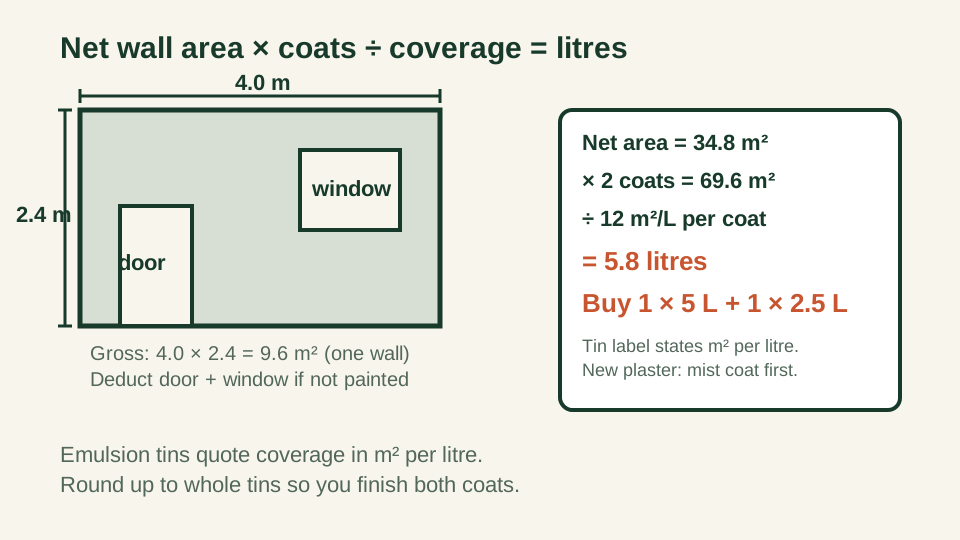
In the UK, walls and ceilings are painted with emulsion, and the tin quotes its coverage in square metres per litre. To work out how much paint you need, measure each wall in metres, multiply length by height for the area, add the walls together, then deduct any door or window you are not painting. Multiply that net area by the number of coats (two is standard for emulsion), divide by the coverage printed on the tin, and round up to whole 2.5 L or 5 L tins.
Coverage figures on the tin are 'up to' values measured on smooth, sealed surfaces. Dulux Matt, a typical standard emulsion, states coverage of up to 14 m² per litre and recommends two coats. To leave a margin for rollering, porous patches and touch-ups, the tables below plan at a slightly conservative 12 m² per litre per coat. New or bare plaster needs a mist coat (emulsion thinned with water) before the two full coats.
Litres and tins for two coats at 12 m² per litre per coat
Two coats means the paint has to cover the wall area twice, so the litres needed are the net wall area multiplied by two, divided by the coverage per coat. UK emulsion is sold mainly in 2.5 L and 5 L tins, so round the litres up to the nearest whole-tin combination.
Read the coverage from your own tin and adjust if it differs. At the tin's full 'up to 14 m² per litre' you would need slightly less; planning at 12 m² per litre per coat builds in a small safety margin.
| Net wall area | Litres for 2 coats | Tins to buy (2.5 L / 5 L) |
|---|---|---|
| 20 m² | 3.3 L | 1 × 5 L |
| 30 m² | 5.0 L | 1 × 5 L |
| 40 m² | 6.7 L | 1 × 5 L + 1 × 2.5 L |
| 60 m² | 10.0 L | 2 × 5 L |
Litres = net area × 2 coats ÷ 12 m²/L, rounded to one decimal. Tins rounded up to whole tins. Use your own tin's stated m² per litre; new plaster also needs a mist coat.
Worked example: a 4 m × 4 m room with a door and a window
The room is 4 m long, 4 m wide and 2.4 m high. The wall perimeter is (4 + 4) × 2 = 16 m. Gross wall area is perimeter × height = 16 × 2.4 = 38.4 m². Deduct one door at 0.9 × 2.0 = 1.8 m² and one window at 1.5 × 1.2 = 1.8 m², a total of 3.6 m². Net wall area = 38.4 − 3.6 = 34.8 m².
For two coats the paint must cover 34.8 × 2 = 69.6 m². At 12 m² per litre per coat: 69.6 ÷ 12 = 5.8 litres. One 5 L tin (5 L) is not enough, so buy 1 × 5 L + 1 × 2.5 L = 7.5 L, leaving a little for touch-ups. If the walls are new plaster, add a mist coat first using emulsion thinned with water as the tin directs.
Before you buy: paint measurement checklist
Run through these before ordering so the litres match the walls actually being painted.
- Each wall measured in metres (length × height) and added into a gross total.
- Doors and windows deducted only where you are not painting them.
- Number of coats decided (two coats standard for emulsion; strong colour changes may need more).
- Coverage read from the actual tin in m² per litre.
- New or bare plaster noted so a mist coat is added before the full coats.
- Litres rounded up to whole 2.5 L or 5 L tins.
Common mistakes when estimating emulsion
Most over- and under-buying comes from a handful of repeatable errors.
- Costing for one coat when emulsion needs two — always multiply the area by the number of coats.
- Treating the tin's 'up to' coverage as guaranteed; real coverage is usually lower on textured or porous walls.
- Forgetting the mist coat on new plaster, so the first full coat soaks in and looks patchy.
- Deducting every door and window even when frames and reveals are being painted the same colour.
- Buying odd part-tins instead of rounding up to whole tins that finish both coats with a touch-up margin.
Same project
Related measurement guides
Sources and limits
Check the project-specific details
- Dulux Matt product page (AkzoNobel) — Manufacturer product page stating coverage of up to 14 m² per litre, two coats, tin sizes, and a mist coat (paint thinned ~10% with water) on new, bare, absorbent surfaces.
- Dulux: How much paint do I need? — Dulux method: measure height × width in metres, deduct doors and windows, multiply by the number of coats, then divide by the square metres per litre stated on the tin.
Review status: Formulas and conversions covered by automated tests; measurement practice pending human trade review.
This guide supports planning only. It does not specify structural design, code compliance, or a supplier quotation.