UK materials guide
How Much Ballast and Cement for 1m³ of Concrete? (UK)
About 18 × 25 kg bags of cement and 1.2 m³ of all-in ballast make 1 m³ of general-purpose concrete at 1:4. Ratios, bulk bags and quantities for 2 m³ and 3 m³.
Published 2026-07-20 · Updated 2026-09-19 · BuildMeasure Editorial Team
Next step
Turn your measurements into a material estimate
Enter the recorded dimensions in the calculator. It shows the calculated amount, wastage allowance, and a supplier-ready suggested order.
Use the Concrete Volume CalculatorThe short answer: about 18 bags of cement and 1.2 m³ of ballast per m³
For 1 m³ of general-purpose concrete mixed at 1:4 cement to all-in ballast, plan on roughly 18 × 25 kg bags of cement and about 1.2 m³ of all-in ballast (around 2.5 bulk bags). For 2 m³ double it (about 36 bags and 2.4 m³), and for 3 m³ triple it (about 54 bags and 3.6 m³). The table further down shows smaller volumes and the working behind the figures.
In the UK, the simplest way to hand- or mixer-mix concrete for jobs like a shed base, a small path or setting posts is to combine cement with all-in ballast. All-in ballast is a pre-mixed blend of sharp sand and 10–20 mm gravel sold ready to use — you add only cement and water. Buying ballast pre-blended saves measuring separate sand and aggregate.
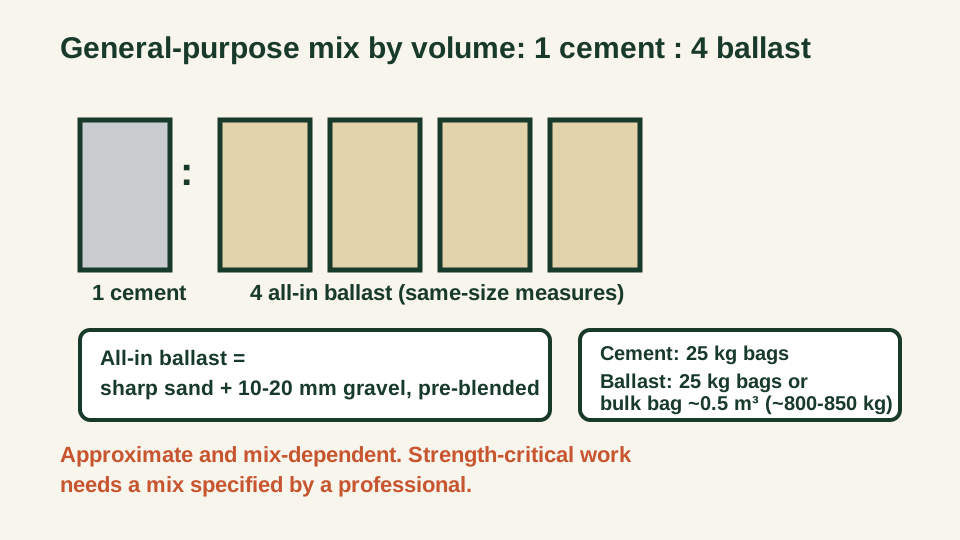
For general-purpose concrete, Blue Circle/Tarmac's standard mix is 1 part cement to 2 parts building (sharp) sand to 3 parts 20 mm gravel by volume. Using all-in ballast instead, the same Blue Circle guidance gives 1 part cement to 4 parts all-in ballast for general-purpose work (their leaner foundations mix is 1:5). Cement comes in 25 kg bags; ballast comes in 25 kg bags or in bulk bags of about 0.5 m³ (around 800–850 kg). These figures are approximate and mix-dependent, and any strength-critical or structural work needs a mix specified by a qualified professional — this guide is for general DIY quantities only.
Mix ratio by volume
Measure the parts by volume using the same bucket or shovel for each, and keep the ratio consistent across the whole job. The ratio below follows the manufacturer's general-purpose guidance; other published guidance uses leaner mixes such as 1:5 or 1:6 cement:ballast for less demanding work, so always check the recommendation printed on your cement bag.
| Component | By separate materials | Using all-in ballast |
|---|---|---|
| Cement | 1 part | 1 part |
| Sharp sand | 2 parts | (included in ballast) |
| 20 mm gravel | 3 parts | (included in ballast) |
| All-in ballast | — | ≈ 4 parts |
Based on Blue Circle/Tarmac's general-purpose guidance: 1:2:3 cement:sand:gravel, or 1:4 cement:all-in ballast when the sand and gravel come pre-blended. Confirm against the ratio printed on your cement bag.
Approximate quantities by concrete volume
First work out the volume of concrete you need (length × width × thickness, all in metres) with the concrete volume calculator. Then use the table as a planning estimate for cement and ballast at roughly 1:4 by volume. The quantities allow for the dry materials compacting as they mix and are rounded up; actual yield varies with the materials, the water added and how well it is compacted.
These are approximate figures for ordering, not a specified mix. For exact bag counts, use the cement manufacturer's own bag calculator and confirm with your supplier before ordering.
| Finished concrete | Cement (25 kg bags) | All-in ballast |
|---|---|---|
| 0.10 m³ | ≈ 2 bags | ≈ 0.12 m³ (part bulk bag / ~8 × 25 kg) |
| 0.25 m³ | ≈ 5 bags | ≈ 0.30 m³ (~1 bulk bag covers it) |
| 0.50 m³ | ≈ 9 bags | ≈ 0.60 m³ (~1.5 bulk bags) |
| 1.00 m³ | ≈ 18 bags | ≈ 1.20 m³ (~2.5 bulk bags) |
Approximate and mix-dependent, rounded up, assuming about 1.5 volumes of loose dry material per finished volume. Bulk bag taken as ~0.5 m³ (~800–850 kg); a 25 kg ballast bag as ~0.015 m³. Confirm exact quantities with your supplier or the manufacturer's bag calculator. Not for strength-critical or structural work.
Worked example: a 2.0 m × 1.5 m shed base, 100 mm thick
Volume of concrete = length × width × thickness = 2.0 × 1.5 × 0.10 = 0.30 m³. Allow for the dry materials compacting when mixed by taking about 1.5 volumes of loose dry material per finished volume: 0.30 × 1.5 = 0.45 m³ of dry mix.
Split that dry mix at 1:4 by volume (1 part cement to 4 parts ballast, so cement is 1/5 and ballast is 4/5 of the total). Cement = 0.45 × 1/5 = 0.09 m³; at roughly 0.017 m³ per 25 kg bag that is 0.09 ÷ 0.017 ≈ 5.3, so 6 × 25 kg bags rounded up. Ballast = 0.45 × 4/5 = 0.36 m³; at ~0.5 m³ per bulk bag that is about 0.7 of a bulk bag, so one bulk bag with some to spare (or about 24 × 25 kg bags). Add around 10% for waste and spillage. Treat the result as an estimate and confirm with your supplier.
Before you mix: ballast and cement checklist
Check these before ordering so the quantities and the mix match the job.
- Concrete volume calculated in metres (length × width × thickness).
- Mix ratio by volume decided and cross-checked against the cement bag.
- Same measure (bucket or shovel) used for every part to keep the ratio consistent.
- Cement bought in 25 kg bags; ballast in 25 kg bags or bulk bags (~0.5 m³).
- Waste allowance (about 10%) added.
- Strength-critical or structural work referred to a qualified professional for a specified mix.
Common mistakes mixing concrete from ballast
These errors are the usual causes of a weak, short or unworkable mix.
- Mixing sand and gravel separately when all-in ballast already blends both — double-check whether you have ballast or plain sand.
- Changing the measure part-way through, so the ratio drifts between batches.
- Ordering to the exact calculated volume with no allowance for compaction and waste.
- Adding too much water to make the mix easier to work, which weakens the set concrete.
- Treating these general-purpose quantities as a specified structural mix — foundations and load-bearing work need a professional specification.
Same project
Related measurement guides
Sources and limits
Check the project-specific details
- Tarmac Blue Circle: How to mix concrete — Manufacturer guidance stating a standard concrete mix of one part cement to two parts building sand to three parts 20 mm gravel, and to check the ratio on the cement bag.
- The Blue Circle Builders' Guide to Cement (Tarmac) — Manufacturer mix table giving general-purpose concrete as 1:2:3 cement:sand:20 mm aggregate, or 1:4 cement:all-in aggregate — the basis for the 1:4 ballast ratio in this guide.
- Tarmac Blue Circle bag calculator — Manufacturer tool for working out exact bag quantities for a job; use it to confirm the approximate figures in this guide before ordering.
- MP Moran: bulk bag ballast — UK builders' merchant listing a bulk (jumbo/major) bag of ballast as approximately 0.5 m³, around 800–850 kg.
- Tarmac: Ballast (all-in aggregate) — Manufacturer product page describing ballast as an all-in blend of sand and gravel used for mixing concrete.
Review status: Formulas and conversions covered by automated tests; measurement practice pending human trade review.
This guide supports planning only. It does not specify structural design, code compliance, or a supplier quotation.