Concrete & Masonry
Deck Mud Calculator — Square Feet, Thickness & Bags
Enter known mortar-bed square footage directly or calculate it from length × width, then add compacted thickness, exact product yield, and allowance to get volume and whole deck-mud bags.
Formula tested · Local units · No sign-up
Project inputs
Enter measurements
Use your preferred units. Results update automatically.
Show the calculation methodFormula, conversions, rounding, and assumptions+
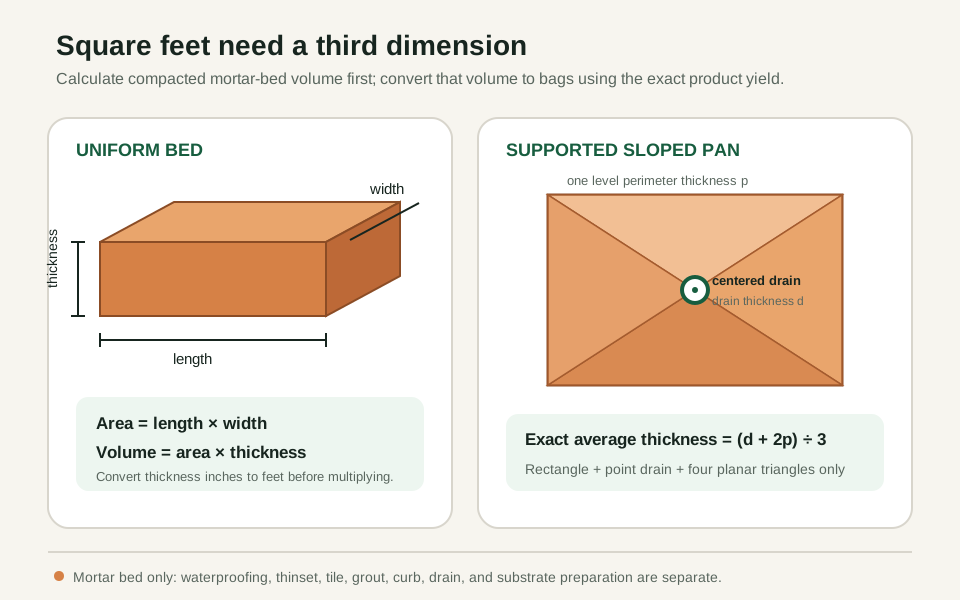
Uniform mortar bed: area = length × width, then exact mud volume = area × compacted thickness. Convert inches to feet before multiplying: volume (ft³) = length (ft) × width (ft) × thickness (in) ÷ 12.
Known-area mode starts from an already measured net square-foot area and uses the same area × compacted-thickness formula. It does not infer the room shape, deductions, or how the area was measured, so keep the source sketch or takeoff.
Centered-drain shower pan: this mode models a rectangle divided from a centered point drain to its four perimeter edges, creating four triangular planar faces with one level perimeter. A linear value over a triangle equals the mean of its three vertex values, so exact average thickness = (drain thickness + 2 × perimeter thickness) ÷ 3. Volume = rectangular plan area × that average thickness.
The centered-drain formula is not the shortcut (drain + perimeter) ÷ 2. That shortcut treats equal thickness intervals as equal areas, but more of a centered rectangular pan lies near its perimeter than near its point drain.
Order volume = exact geometric volume + the user-entered handling/waste allowance. Unrounded bags = order volume ÷ the exact mixed yield for one bag; whole bags are rounded up once.
Whole-bag rounding is reported separately from waste. Optional material cost equals whole bags × the current bag price entered by the user; it excludes tax, delivery, tools, labor, and every other installation-system component.
Real-world example
40 square feet of deck mud at 1½ inches
- An 8 ft × 5 ft rectangular mortar bed has 40 ft² of plan area.
- Convert 1½ in to feet: 1.5 ÷ 12 = 0.125 ft.
- Exact deck-mud volume is 40 ft² × 0.125 ft = 5.000 ft³.
- A user-selected 10% handling/waste allowance adds 0.500 ft³, making 5.500 ft³ before package rounding.
- For a product whose current technical sheet states 0.41 ft³ mixed yield per bag, 5.500 ÷ 0.41 = 13.41 bags. Round up once to 14 whole bags.
- Fourteen bags represent 5.740 ft³, so whole-bag rounding adds 0.240 ft³ beyond the allowance-adjusted quantity.
The example requires 14 bags at the entered 0.41 ft³ yield. Change the yield to the figure printed for the exact product and bag size you will buy.
Before you start
How to measure
- Confirm the assembly before measuring. This calculator estimates only the compacted mortar-bed layer—not waterproofing, bonding slurry, reinforcement, thinset, tile, grout, curb, drain, or substrate work.
- For a uniform bed, measure the rectangular length and width at the bed boundary and enter the specified compacted thickness. Break L-shapes or separate zones into rectangles and calculate each zone independently.
- If a drawing or checked worksheet already gives the net mortar-bed area, choose known-square-feet mode and enter it directly. Do not enter gross room area when benches, curbs, drains, walls, or other excluded zones change the mortar-bed footprint.
- For a sloped pan, use this mode only when the drain is centered, the boundary is rectangular, the entire perimeter is at one level, and the surface is four planar triangular faces. Enter thickness at the drain and at that level perimeter; the calculator does not choose either thickness.
- Do not use centered-drain mode for a linear or offset drain, multiple drains, curved pan, bench, curb, curbless transition, varying perimeter, or compound slope. Those conditions require a zone-by-zone takeoff from the actual installation drawing.
- Read the current product technical sheet, match the bag size, and enter its mixed yield in cubic feet or liters. Products with similar names or weights can state different yields and allowable thicknesses.
- Choose a handling/waste allowance for the actual staging, mixing, experience, and job conditions. MAPEI's general product-calculator guidance suggests 5% to 10% overage, but the field remains editable rather than prescribing that range.
- Verify substrate, bond or cleavage system, reinforcement, minimum and maximum thickness, water addition, mixing, placement, cure, and waterproofing sequence with the project documents and current product manufacturer.
Local guidance
Notes for United States
- This calculator is US-only and defaults to feet, inches, cubic feet per bag, USD, and manufacturer terminology used for deck mud, dry-pack mortar, mortar beds, and shower pans.
- “Deck mud” here means a sand-and-Portland-cement mortar bed or underlayment. It does not mean outdoor deck boards, deck stain, or a structural concrete slab.
- QUIKRETE's Deck Mud technical data lists approximately 0.41 ft³ yield for a 50 lb bag and 0.62 ft³ for a 75 lb bag at recommended consistency. Those are product-specific reference values, not defaults for every deck-mud product.
- MAPEI's 4 to 1 Mud Bed Mix technical data lists approximate direct-bond coverage of 5 to 6 ft² at 1 in and 2.5 to 3 ft² at 2 in for a 55 lb bag, and states actual coverage varies with substrate conditions and setting practices.
- Sakrete lists Sand Mix Topping & Bedding for mortar bedding and shower pans, with 0.30, 0.45, and 0.60 ft³ yields for its 40, 60, and 80 lb bags respectively, and a stated ½ in to 2 in application depth. Always verify the current sheet for the product in hand.
Quick reference
How square feet become deck-mud bags
| Planning stage | Calculation | 40 ft² example |
|---|---|---|
| Plan area | Length × width | 8 ft × 5 ft = 40 ft² |
| Uniform volume | Area × thickness ÷ 12 | 40 × 1.5 ÷ 12 = 5.000 ft³ |
| Allowance | Exact volume × chosen percentage | 5.000 × 10% = 0.500 ft³ |
| Volume to order | Exact volume + allowance | 5.000 + 0.500 = 5.500 ft³ |
| Unrounded bags | Order volume ÷ exact entered bag yield | 5.500 ÷ 0.41 = 13.41 |
| Purchase quantity | Round bags up once | 14 whole bags |
The 0.41 ft³ yield is the cited QUIKRETE 50 lb Deck Mud example. It is not a universal yield; replace it with the current technical-sheet value for the exact product and bag size.
Good to know
Common mistakes to avoid
- Multiplying square feet by a thickness entered in inches without dividing by 12, which overstates cubic feet twelvefold.
- Treating bag weight as bag volume. Pounds do not become cubic feet without the manufacturer's product-specific mixed yield.
- Using nominal coverage copied from another brand, bag size, consistency, thickness, or application instead of the exact current technical sheet.
- Averaging drain and perimeter thickness with (drain + perimeter) ÷ 2 for a point-drain pan. That does not represent the supported four-triangle geometry.
- Using centered-drain mode for an offset or linear drain, a non-level perimeter, or zones interrupted by curbs and benches.
- Hiding waste and whole-bag rounding in one padded number, making the order impossible to audit.
- Counting waterproofing or tile-setting mortar as deck-mud volume, or assuming this quantity calculation specifies a complete shower system.
Need help?
Frequently asked questions
How many square feet does one bag of deck mud cover?
Coverage equals the exact mixed yield in cubic feet × 12 ÷ compacted thickness in inches. A cited 0.41 ft³ bag covers about 4.92 ft² at 1 in, 3.28 ft² at 1½ in, or 2.46 ft² at 2 in before allowance. Use the current yield and thickness limits for your exact product.
How much deck mud do I need for 40 square feet?
Choose known-square-feet mode and enter 40 ft². At a uniform 1½ in thickness, that requires exactly 5.000 ft³. With a chosen 10% allowance and a product yielding 0.41 ft³ per bag, it becomes 13.41 bags, rounded up to 14. Different thickness, slope geometry, yield, or allowance changes the answer.
Is deck mud the same as thinset mortar?
No. This page estimates the thick mortar-bed volume. Thinset or another tile-setting mortar is a separate layer with product-specific trowel, coverage, substrate, and tile requirements; waterproofing is separate too.
Can this calculator estimate a sloped shower pan?
Yes, but only for the explicitly modeled case: a rectangular pan, centered point drain, one level perimeter, and four planar triangular faces. It uses the exact area-weighted thickness (drain + 2 × perimeter) ÷ 3. Other drain and boundary geometries require a takeoff from the actual plan.
Does the calculator decide shower slope or mortar thickness?
No. It converts user-entered, project-specified thicknesses into volume. Suitability, slope, drain elevation, reinforcement, substrate, bonding, waterproofing, and installation sequence must come from the approved assembly and current manufacturer instructions.
Keep planning
Related calculators
Transparency
About this calculator
- Written by:
- BuildMeasure Editorial Team
- Technically reviewed by:
- Pending independent tile-system reviewer (formula unit-tested; manufacturer data cited)
- Last reviewed:
- 2026-07-23
- Formula version:
- 1.1.0
- Region reviewed for:
- United States
- Spotted an error?
- Report a correction
Methodology
- Formula version 1.1.0 converts dimensions and direct square-foot areas to SI units internally, computes compacted volume, then converts results to US display units.
- Uniform mode is a rectangular prism. Sloped mode integrates a piecewise-linear thickness field over four triangles meeting at a centered point drain; each triangle uses the mean of its three vertex thicknesses.
- Automated tests cover length × width and direct-area uniform modes, the exact centered-drain derivation, allowance, whole-bag rounding, exact-multiple rounding, optional cost, validation, and output line availability.
- Product yield and coverage statements are attributed to current manufacturer technical sources. The calculator intentionally requires user-entered yield so future product changes do not become hidden assumptions.
- Editorial status: formula tested; primary manufacturer sources checked on the review date; independent tile-system review remains pending and is disclosed above.
Sources & standards
- QUIKRETE Deck Mud Technical Data Sheet: Manufacturer description, applications, 50/75 lb packaging, and approximate mixed yields of 0.41/0.62 ft³ at recommended consistency.
- MAPEI 4 to 1 Mud Bed Mix: Manufacturer product page and technical documentation for thick-bed mortar, coverage limitations, placement, and curing guidance.
- MAPEI Product Calculators: Manufacturer estimating disclaimer and general 5% to 10% overage guidance; actual jobsite coverage can vary.
- Sakrete Sand Mix Topping & Bedding: Manufacturer uses, bag sizes, mixed yields, and stated application depth for the specific Sand Mix product.
Planning estimate for deck-mud quantity only, not a shower, waterproofing, structural, code, or installation design. Verify field geometry, approved assembly, drain and perimeter elevations, substrate, bond or cleavage method, reinforcement, product yield, thickness limits, mixing, curing, waterproofing sequence, safety data, and purchase quantities with current project documents, the manufacturer, supplier, and qualified installer before work.