Site work planning guide
How to Measure Land Grading for a Cost Estimate
Measure cut-and-fill volumes for a land grading project and build a contractor-quote worksheet using your own rates, with no default prices assumed.
Published 2026-07-19 · Updated 2026-07-19 · BuildMeasure Editorial Team
Next step
Turn your measurements into a material estimate
Enter the recorded dimensions in the calculator. It shows the calculated amount, wastage allowance, and a supplier-ready suggested order.
Use the Gravel Calculator for imported fillGrading measures cut and fill separately, not one 'dirt' number
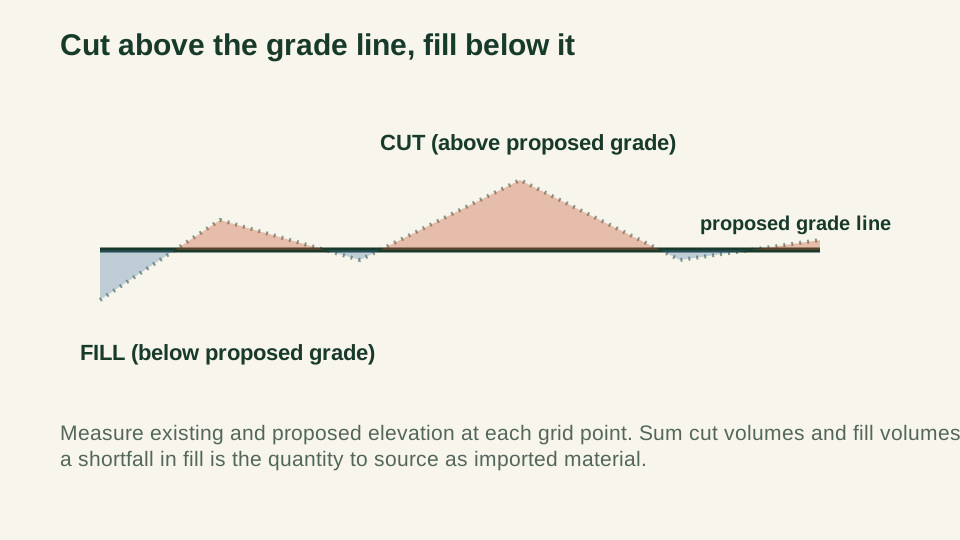
A land grading estimate has two volumes, not one: cut is soil removed from areas above your target grade, and fill is material added to areas below it. A site can need both at once — cut from a high corner, fill in a low corner — and a contractor prices them differently because cut material often has to be hauled away while fill material has to be sourced and imported.
Do not average the site to a single 'amount of dirt.' Measure cut and fill as two separate volumes and carry them as two separate line items all the way to the quote.
Establish a proposed grade line before measuring anything
Grading only makes sense relative to a target: the proposed finished grade. For a simple project this might be a single flat elevation (level a patio pad) or a constant slope for drainage (fall a yard away from the house). Mark the proposed grade with stakes and a string line, or a laser level, before recording any cut or fill numbers.
For anything beyond a small residential yard — new building pads, drainage that affects a neighboring property, or retaining structures — a licensed surveyor or civil engineer should set the proposed grade. This guide covers the measurement arithmetic for planning and contractor quotes, not structural or drainage design.
Estimate cut and fill volume from a grid of spot elevations
Lay a grid over the site (for a small yard, a 10 ft or 5 ft spacing is common) and record the existing ground elevation and the proposed grade elevation at each grid point, using a story pole, laser level, or surveyor's data if you have it. The difference at each point is that point's cut (existing above proposed) or fill (existing below proposed) depth.
Multiply each point's cut or fill depth by the grid cell's area, then add all the cut cells for total cut volume and all the fill cells for total fill volume. This grid method is a simplified version of the average end-area method contractors and surveyors use for larger sites.
| Grid point | Existing elevation (ft) | Proposed elevation (ft) | Cut (+) or fill (−) depth (ft) |
|---|---|---|---|
| A1 | |||
| A2 | |||
| B1 | |||
| B2 |
Cut (+) when existing ground is higher than proposed grade; fill (−) when existing ground is lower. Multiply each depth by the grid cell area, then sum cut cells and fill cells separately.
Build the contractor-quote worksheet with your own rates
Grading costs vary enormously by region, access, soil type, and equipment, so this worksheet uses no default prices — every rate is one you get from a contractor or supplier and enter yourself. Ask for cut (excavation and haul-off), fill (import and placement), and equipment mobilization as separate line items, because they are usually priced separately.
| Line item | Your quantity | Your rate | Your subtotal |
|---|---|---|---|
| Cut / excavation (cu yd) | |||
| Haul-off and disposal of excess cut | |||
| Imported fill material (cu yd or ton) | |||
| Fill placement and compaction | |||
| Equipment mobilization / minimum call-out | |||
| Total |
Leave any row blank that does not apply to your site — a level lot with only cut, for example, has no import line.
Imported fill: follow up with the gravel calculator
When a site needs more fill than the cut volume provides, the shortfall has to be imported. Take the fill shortfall in cubic yards from your worksheet above and run it through the gravel calculator to convert it into a weight-based order and an editable cost estimate, the same way you would for a driveway base layer.
If the imported material needs truck access to the site, review the access and delivery considerations in the bulk-vs-bagged materials guide before finalizing the order size.
Pre-quote site walk checklist
Walk the site with the contractor or estimator and confirm every item below before a number goes into a written quote.
- Proposed grade line marked with stakes, string, or a laser level reference.
- Grid of existing and proposed elevations recorded across the site.
- Total cut volume and total fill volume calculated separately, in cubic yards.
- Site access confirmed for excavation and delivery equipment (gate width, overhead clearance, weight limits).
- Disposal location and distance for excess cut material, if any.
- Source and haul distance for imported fill, if any.
- Drainage and any utility lines marked before excavation begins.
- Written quote itemizes cut, fill, haul, compaction, and mobilization separately.
Same project
Related measurement guides
Sources and limits
Check the project-specific details
- USDA Natural Resources Conservation Service — Federal guidance on site grading, drainage, and earthwork practices used as a primary reference for grading terminology.
- International Residential Code (IRC), grading and drainage provisions — Code-level definitions for finished grade and drainage away from structures; consult a local authority or surveyor for site-specific requirements.
Review status: Formulas and conversions covered by automated tests; measurement practice pending human trade review.
This guide supports planning only. It does not specify structural design, code compliance, or a supplier quotation.