Landscaping planning guide
How Many Bags Is 1 Cubic Yard of Mulch? Bulk vs. Bagged
One cubic yard of mulch is about 9 to 18 bags depending on bag size. Compare bulk delivery against bagged mulch, soil, or gravel by volume and cost.
Published 2026-07-16 · Updated 2026-07-19 · BuildMeasure Editorial Team
Next step
Turn your measurements into a material estimate
Enter the recorded dimensions in the calculator. It shows the calculated amount, wastage allowance, and a supplier-ready suggested order.
Use the Mulch CalculatorOne cubic yard equals 27 cubic feet — about 9 to 18 bags of mulch
A cubic yard is the standard unit for landscape material delivery. The number of bags that make up one cubic yard depends entirely on the bag size printed on the bag, so there is no single answer without that figure.
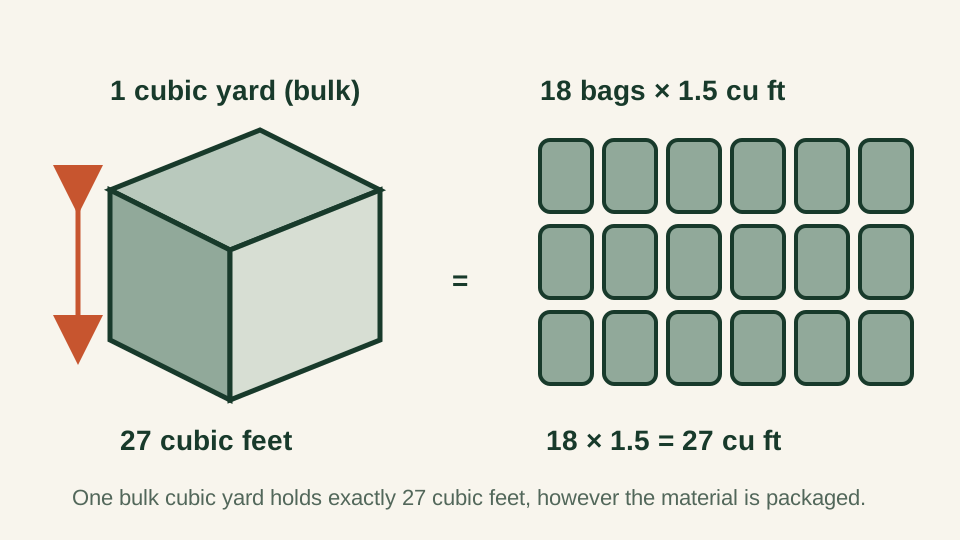
Bag volume varies by product. Common bag sizes for mulch, compost, and soil are 1.5, 2, and 3 cubic feet. A cubic yard of 27 cubic feet requires 18 bags of 1.5 cu ft, about 14 bags of 2 cu ft, or 9 bags of 3 cu ft.
Whether bulk or bags costs less depends entirely on your own quotes
Bulk material is priced per cubic yard and delivered by truck; bags are priced per bag and picked up or delivered individually. Neither format is generally cheaper — the price per cubic yard for bulk and the price per bag for bagged material both vary by region, supplier, and material, so this guide does not publish typical figures for either.
The only reliable comparison is between two real numbers: your local bulk supplier's quoted price per cubic yard (plus any delivery fee they quote), and your local store's price per bag for the same or equivalent material. The worksheet below turns those two quotes into a single comparable cost.
Bulk delivery requires truck access; bags work anywhere
Bulk material is delivered by truck and dumped, so the site needs a gate and driveway or parking area the delivery truck can reach and use. Confirm your supplier's specific truck dimensions, weight, and access requirements directly with them before ordering bulk — these vary by supplier and this guide does not state generic truck figures.
Bags can be hand-carried through any gate and stacked on site. This makes bags practical for townhouses, narrow side yards, and urban gardens where truck access may be limited or impossible.
Quality and blend vary between bulk suppliers
Bulk material is often mixed or blended on the fly by the supplier, and the exact composition can vary by load. Bagged material is consistent from bag to bag within a product line, but brand-to-brand variation is normal.
For a finished landscape, bulk mulch is usually fine. For critical applications (erosion control, certain plant requirements), bagged material with a guaranteed specification is more predictable.
Volume equivalence: bags per cubic yard
Use this table to convert between cubic yards (bulk) and bag counts (bagged), then fill in your own supplier's and store's quoted prices to compare the two.
| Bag size | Bags per cubic yard | Your price per bag | Your subtotal for 1 cu yd |
|---|---|---|---|
| 1.5 cu ft | 18 bags | 18 × your price per bag | |
| 2.0 cu ft | 13.5 bags (round to 14) | 14 × your price per bag | |
| 3.0 cu ft | 9 bags | 9 × your price per bag |
Bag prices vary by region, supplier, and material type. Enter the actual per-bag price quoted at your local store, then compare the subtotal against your bulk supplier's quoted price per cubic yard.
Decision process: bulk or bags?
Start with your total volume in cubic yards (from the calculator). Call a local bulk supplier for their quoted price per cubic yard and any delivery fee. Then check the per-bag price for the same material at your garden center or home improvement store and multiply by the bags-per-cubic-yard figure above.
Compare the two totals you actually collected — bulk price per cubic yard plus delivery fee, against bagged price × bags needed — and choose whichever is lower for your project, after confirming site access for whichever option you pick.
- Calculate total volume in cubic yards (or get this from the calculator).
- Call a bulk landscape supplier for their price per cubic yard and any delivery fee.
- Find the same or equivalent material in bags at a local store.
- Record the price per bag and the bag size in cubic feet.
- Multiply: (price per bag) × (27 ÷ bag size in cu ft) = cost per cubic yard equivalent.
- Compare bulk total cost (price per cu yd × volume + delivery fee) to the bagged equivalent cost.
- Confirm truck access and any access-related fees directly with the bulk supplier before ordering.
- Choose bulk or bags based on the two real quotes and site logistics, not a general assumption that one is cheaper.
Same project
Related measurement guides
Sources and limits
Check the project-specific details
- Landscape supply industry standards — National Association of Landscape Professionals; industry practices and material specifications.
- NIST unit conversion — Reference for cubic yard and cubic foot definitions.
Review status: Formulas and conversions covered by automated tests; measurement practice pending human trade review.
This guide supports planning only. It does not specify structural design, code compliance, or a supplier quotation.