Concrete & Masonry
Concrete Slab Cost and Volume Calculator
Enter any slab length, width, and thickness to calculate exact cubic yards, a separate allowance, the rounded ready-mix order, and an optional cost from the current supplier price you enter. The 12 × 12 ft example is editable.
Formula tested · Local units · No sign-up
Project inputs
Enter measurements
Use your preferred units. Results update automatically.
Show the calculation methodFormula, conversions, rounding, and assumptions+
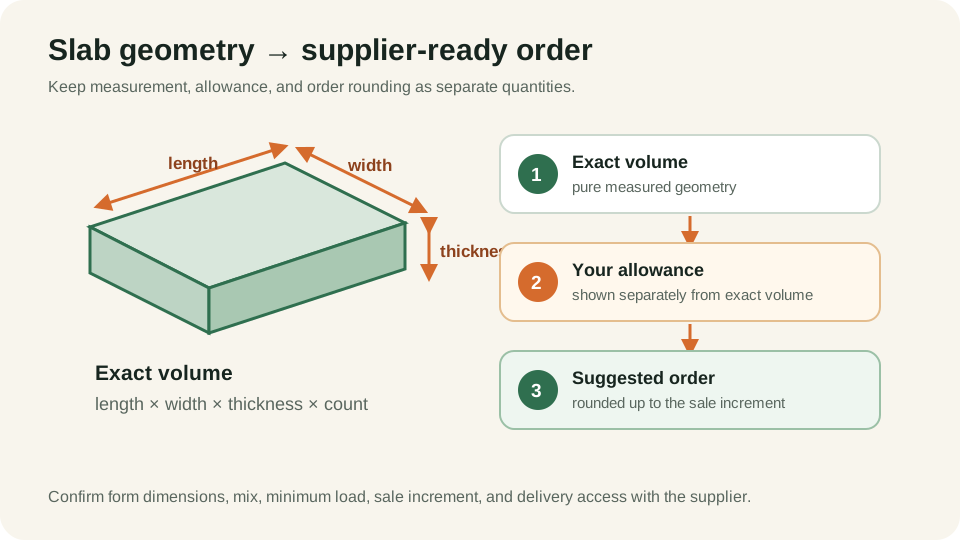
Volume = length × width × thickness. Because thickness is usually measured in inches while length and width are in feet, the calculator converts everything to a common unit before multiplying — a 12 ft × 12 ft slab at 4 inches is 12 × 12 × 0.333 = 48 cubic feet, not 576.
US ready-mix volume is expressed in cubic yards (27 cubic feet). Supplier rounding is optional and uses only the cubic-yard increment entered from the current quote.
Real-world example
Worked example: 12 ft × 12 ft slab, 4 in thick
- Convert thickness: 4 in ÷ 12 = 0.333 ft.
- Volume: 12 × 12 × 0.333 = 48 cubic feet.
- Convert to yards: 48 ÷ 27 = 1.78 cubic yards.
- Add 10% allowance: 1.78 × 1.10 = 1.96 cubic yards.
- For this worked example, enter the supplier's stated 0.25 yd³ increment: 1.96 yd³ rounds up to 2.00 yd³.
The geometric volume is 1.78 yd³; with the example 10% allowance it is 1.96 yd³, and the explicitly entered 0.25 yd³ supplier increment produces 2.00 yd³. A different or absent quote increment produces a different planning quantity.
Before you start
How to measure
- Measure the formed length and width of the slab at the top of the forms, in feet.
- Measure thickness in inches at several points if the sub-base is uneven, and use the largest value — a slab that averages thicker than planned is the most common reason pours come up short.
- For L-shaped slabs, split the shape into rectangles, calculate each one, and use the 'number of slabs' field or add the volumes.
Local guidance
Notes for United States
- US ready-mix is ordered in cubic yards. Minimums and short-load fees are supplier-specific commercial terms; copy them into the related ready-mix cost calculator rather than treating them as extra physical concrete.
- A nominal 4-inch slab is common for patios and walkways; driveways are often 5–6 inches. Local code and your soil conditions govern — check with your building department.
- Sales tax varies by state and locality and is entered manually; supplier quotes usually exclude it.
Quick reference
Slab thickness quick reference (typical nominal values)
| Application | Common nominal thickness |
|---|---|
| Walkway / patio | 4 in |
| Garage floor | 4–6 in |
| Residential driveway | 5–6 in |
| Shed base | 4 in |
Nominal values for planning only — soil, loads and local code determine the real requirement.
Good to know
Common mistakes to avoid
- Multiplying feet by inches without converting — this overstates volume by 12×.
- Leaving allowance at zero without checking formed dimensions, sub-base variation, over-excavation and placement losses for this specific pour.
- Forgetting that thickened edges and footings add volume beyond the flat slab.
- Comparing supplier quotes without checking whether delivery and short-load fees are included.
Need help?
Frequently asked questions
How much concrete do I need for a 12×12 slab, 4 inches thick?
12 × 12 × (4/12) = 48 cubic feet = 1.78 cubic yards exactly. A user-selected 10% allowance makes 1.96 yd³. It becomes 2.00 yd³ only if the supplier's entered increment is 0.25 yd³.
Should I order concrete by the bag or ready-mix truck?
As a rule of thumb, above roughly one cubic yard the mixing labour of bagged concrete becomes significant and ready-mix is usually more practical. An 80 lb bag yields about 0.6 cubic feet, so one cubic yard is roughly 45 bags.
Does this calculator include rebar or mesh?
No. It estimates concrete volume only. Reinforcement depends on the slab's use and local code — see the rebar calculator (coming soon) or ask your supplier.
Keep planning
Related calculators
Measure with confidence
Planning guides for this project
- How to Measure a Concrete Slab Before You Order →
- Concrete Order Quantities Explained →
- How to Measure an Irregular Concrete Slab →
- How to Calculate Concrete Slab Area (and Why It Isn't Volume) →
- How Much Concrete for a Driveway →
- How to Plan a Concrete Slab Pour →
- How Much Does a Yard of Concrete Cover? →
Transparency
About this calculator
- Written by:
- BuildMeasure Editorial Team
- Technically reviewed by:
- Pending independent technical reviewer (formula unit-tested; see methodology)
- Last reviewed:
- 2026-07-23
- Formula version:
- 1.2.0
- Region reviewed for:
- United States
- Spotted an error?
- Report a correction
Methodology
- Volume is computed as length × width × thickness × number of slabs, converted internally to SI units (metres) before any arithmetic to avoid unit drift.
- The chosen allowance is applied to the exact volume. Supplier rounding occurs only when you enter the increment shown on the current quote; if that field is blank, the planning volume remains unrounded.
- The preliminary material cost multiplies the planning or supplier-rounded quantity by the price you enter. Tax is added only after you confirm that the entered price excludes tax and supply a rate; an unresolved basis produces a subtotal, not a final total.
- The formula is covered by automated unit tests, including hand-calculated worked examples, and is versioned (see formula version on this page).
Sources & standards
- Unit definitions: 1 ft = 0.3048 m and 1 yd³ = 0.764554857984 m³ (exact international definitions).
- Supplier order terms: Order increment, physical minimum, billed minimum and short-load charges must be copied from the current supplier quote.
This tool provides a material estimate for planning purposes only. It is not a quotation, and it does not size reinforcement, check ground conditions, or replace professional structural advice. Confirm quantities and mix specification with your supplier before ordering.