Painting & Walls
Wallpaper Calculator UK — Rolls with Pattern Repeat
Enter the wall run and exact wallpaper label details to count full-height drops, simulate the pattern-match sequence, and round the result to whole rolls.
Formula tested · Local units · No sign-up
Project inputs
Enter measurements
Use your preferred units. Results update automatically.
Show the calculation methodFormula, conversions, rounding, and assumptions+
Drops required = total wall run ÷ actual roll width, rounded up once. Wallpaper is planned as vertical strips, not only square metres, because the final part-width strip still consumes a full-width drop.
Cut length per drop = greatest wall height + the combined top-and-bottom trimming allowance you enter. The allowance is kept visible rather than hidden in a generic waste percentage.
For a free match, drops can be cut consecutively. For straight, half-drop, and third-drop products, the roll plan advances to the next required pattern phase before each cut and records that advance as matching loss.
Whole rolls = the number of roll-length containers needed to pack the complete drop sequence. Optional reserve rolls are a separate user choice and are never folded silently into the calculated installation quantity.
Openings are not deducted automatically. A strip that crosses a door or window normally still needs to be cut at full wall height, and an offcut is reusable only when its width, length, pattern phase, and location all work.
Real-world example
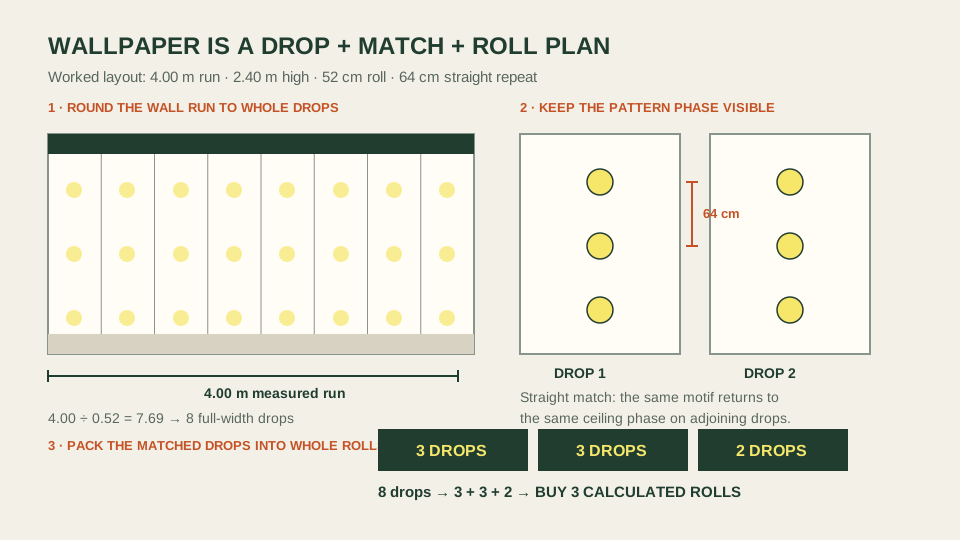
4 m wall run with a 64 cm straight repeat
- The wall run is 4.00 m and the selected roll is 52 cm wide: 4.00 ÷ 0.52 = 7.69, so the wall needs 8 full-width drops.
- The wall is 2.40 m high and the user enters 10 cm total trimming allowance, so every full cut is 2.50 m long.
- The product is a straight match with a 64 cm vertical repeat. After each 2.50 m cut, the roll advances 6 cm to the next identical pattern phase before the following cut.
- One 10 m roll supplies 3 matched drops. The complete strip plan is 3 + 3 + 2 drops across 3 rolls.
- Eight 52 cm drops cover 4.16 m of run, so 16 cm is trimmed from the final drop. No extra reserve roll or price is included in the example.
Buy 3 calculated rolls for the example layout. The 52 cm width, 10 m length, 64 cm repeat, and straight-match designation are example label inputs—replace each one with the exact selected product.
Before you start
How to measure
- Group only walls that use the same product and have the same maximum cutting height. Measure each wall width, add those widths to get the run, and treat a different-height area as a separate calculation.
- Measure floor-to-ceiling height at several points because floors and ceilings may not be level. Use the greatest value, then add the separate top-and-bottom trimming allowance appropriate to the hanging instructions.
- Read roll width and usable roll length from the exact product label or technical sheet. Products can be wider, shorter, sold as panels, or supplied as coordinated A/B sets, so a generic ‘standard roll’ assumption is unsafe.
- Copy the match type exactly: free/random, straight, half-drop, or third-drop. Then enter the vertical pattern repeat; it is the distance from one design point to the next identical point vertically, not the paper width.
- Do not deduct doors and windows from the wall run. Record large openings on a sketch and let the installer decide whether a particular offcut can replace a full drop without breaking the sequence.
- Before ordering, confirm that every roll has the same batch or run number. Before cutting, lay out and number the drops in hanging order and follow the manufacturer’s instructions.
Local guidance
Notes for United Kingdom
- This page is published for the United Kingdom and defaults to metres and centimetres, GBP, UK terminology, and optional VAT handling.
- Enter the sale price exactly as quoted. If the price already includes VAT, leave the VAT-to-add field blank; if a trade quote excludes VAT, enter the applicable rate shown for that purchase.
- Wallpaper manufacturers describe several match types. A straight match repeats at the same ceiling position on adjoining drops; a half-drop alternates by half a repeat; a third-drop cycles through thirds before returning.
- The tool handles ordinary continuous rolls. Murals, panel sets, borders, reverse-hang products, and coordinated A/B rolls have product-specific layouts and should use the manufacturer’s calculator or cutting plan.
Quick reference
What each wallpaper label field changes
| Product field | Planning effect | Where to verify |
|---|---|---|
| Roll width | Sets strip width and whole-drop count | Exact product label or technical sheet |
| Usable roll length | Limits how many matched drops fit in each roll | Exact sale-unit specification |
| Vertical repeat | Controls the distance between identical design phases | Pattern-repeat specification |
| Free / random match | No design-phase advance between drops | Match symbol or hanging instructions |
| Straight match | Every adjoining drop returns to the same phase | Match symbol or technical sheet |
| Half- / third-drop | Cycles adjoining drops through two or three phases | Product-specific hanging instructions |
| Batch or run number | Keeps colour and production run consistent | Every roll label before opening |
A square-metre coverage figure alone cannot show whether the required full-height matched drops fit into the available roll lengths.
Good to know
Common mistakes to avoid
- Dividing wall area by roll area and ignoring that the job must be cut into full-height strips.
- Treating pattern repeat and pattern match as the same input. Repeat is a vertical distance; match describes how adjoining drops align.
- Subtracting a door or window area even though the surrounding strip still has to be cut at full height.
- Assuming all wallpaper rolls are 10 m × 52 or 53 cm instead of reading the selected product specification.
- Entering only the wall height and forgetting the total trimming allowance at the ceiling and skirting board.
- Using a straight-match calculation for a half-drop, third-drop, A/B, mural, or panel product.
- Ordering a later roll without checking the batch number, then discovering a colour or print-run difference during hanging.
- Cutting several drops before checking the first installed drops for pattern, colour, and manufacturing defects.
Need help?
Frequently asked questions
How does pattern repeat change the number of wallpaper rolls?
Matched drops may require part of the roll to be advanced before the next full-height cut begins at the correct design phase. That alignment material and the remaining tail on each roll can reduce the number of usable drops per roll, even when the nominal roll area looks sufficient.
What is the difference between a straight match and half-drop match?
A straight match places the same pattern point at the same ceiling level on adjacent drops. A half-drop places the next drop half a vertical repeat lower, so odd and even drops form two alternating phases. Select the designation printed for the exact product.
Should I subtract doors and windows?
Not in the basic strip plan. A drop crossing an opening generally still consumes full wall height. A large offcut may be reusable elsewhere, but only if its dimensions and pattern phase fit the exact position; confirm that on a numbered wall layout.
How much trimming allowance should I add?
Use the selected wallpaper’s hanging instructions and the wall condition. Enter the combined extra length for the top and bottom of each drop. The example uses 10 cm only as an editable demonstration, not a universal recommendation.
Can this calculator handle wallpaper murals or A/B rolls?
No. Murals, fixed panels, coordinated A/B rolls, and other set-based designs have a prescribed panel order and may be sold only as sets. Use the product-specific layout and calculator, then confirm the wall dimensions with the manufacturer or decorator.
Why might two calculators give different roll counts?
They may use different assumptions for usable roll length, trimming, repeat phase, drop-match handling, openings, or contingency. Compare the displayed drop count and cut plan—not only the final roll number—and prefer the selected manufacturer’s product calculator when available.
Keep planning
Related calculators
Transparency
About this calculator
- Written by:
- BuildMeasure Editorial Team
- Technically reviewed by:
- Pending independent technical reviewer (formula unit-tested; see methodology)
- Last reviewed:
- 2026-07-20
- Formula version:
- 1.0.0
- Region reviewed for:
- United Kingdom
- Spotted an error?
- Report a correction
Methodology
- All dimensions are converted to metres before arithmetic using exact SI definitions. Display rounding occurs only after the roll plan is complete.
- Drops required = guarded ceiling(total wall run ÷ roll width). Covered run and final-drop trim are reported separately.
- Each physical strip length = greatest wall height + the user-entered total trimming allowance. No hidden waste percentage or opening deduction is applied.
- Pattern phases are 0 for straight match, alternating 0 and one-half repeat for half-drop, and cycling 0, one-third, and two-thirds repeat for third-drop. Each roll starts at phase 0 and advances only enough to reach the next required phase before a full strip is cut.
- A new roll starts when the next alignment advance plus full cut length no longer fits. Whole rolls are counted from that sequence; optional reserve rolls are then added as a separate user input.
- Optional cost = rolls to order × user-entered price, plus only the VAT percentage the user enters. No current wallpaper price is invented or embedded.
- Automated tests cover free, straight, half-drop, and third-drop sequences, whole-drop and whole-roll rounding, exact-boundary behaviour, reserve rolls, cost/VAT, invalid label inputs, publication scope, and the worked example.
Sources & standards
- Wallcoverings Association — Pattern Matches: Industry association definitions for vertical pattern repeat, random match, straight-across match, half-drop match, and multiple-drop matches.
- Wallcoverings Association — Standard Installation of Residential Wallpapers: Industry installation guidance to check run/lot numbers, allow for match and trimming, cut panels in sequence, and inspect material before continuing.
- Graham & Brown UK — Wallpaper Frequently Asked Questions: UK manufacturer explanations of repeat and free, straight, and offset matches, plus label-based roll calculation, opening measurement, trimming, and batch considerations.
- Cole & Son — Frequently Asked Questions: UK manufacturer guidance for drop count, roll yield, large repeat and half-drop allowance, batch numbers, and straight, half-drop, and third-drop terminology.
- NIST — SI Units: Length: Official exact length relationships used by the shared conversion library for metre, centimetre, millimetre, foot, and inch inputs.
This calculator is a material-planning estimate for ordinary continuous wallpaper rolls. It does not replace the selected product’s label, batch information, hanging instructions, manufacturer calculator, wall-condition assessment, or a professional decorator’s cutting plan. Confirm all quantities before ordering and all match positions before cutting.