Materials estimating guide
How Much Decking Do I Need? (UK Boards, Joists and Screws)
How much decking do I need? Rows = deck width ÷ (board + 5 mm gap), times boards per row, plus 10%. UK board sizes, joists, screws and a 3.6 × 4.8 m example.
Published 2026-09-19 · Updated 2026-09-19 · BuildMeasure Editorial Team
Next step
Turn your measurements into a material estimate
Enter the recorded dimensions in the calculator. It shows the calculated amount, wastage allowance, and a supplier-ready suggested order.
Use the Decking CalculatorHow much decking do I need? Rows × boards per row, plus 10%
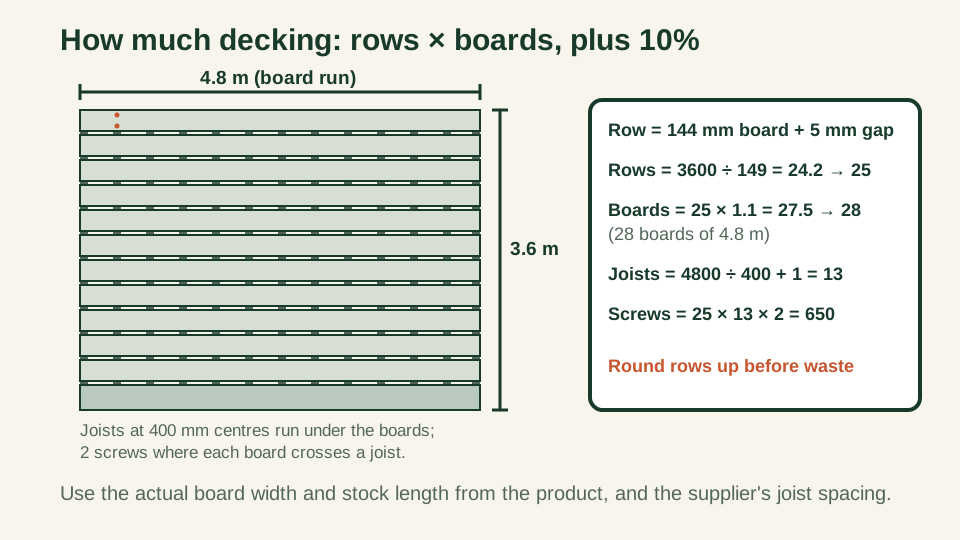
To work out how much decking you need, divide the deck width (across the boards) by the board width plus the gap to get the number of rows, rounding up. Multiply by the boards needed to cover each row's length, then add 10% for cuts and waste. A 4.8 m × 3.6 m deck in 144 mm boards with 5 mm gaps needs 25 rows, so 28 boards of 4.8 m.
UK decking is sold by the board, so the answer is a board count at a stock length, not lineal metres. Wickes lists 120 mm boards (25 × 120 mm) in 1.8, 2.4 and 3.6 m lengths and 144 mm boards (27 × 144 mm) in 2.4, 3.6 and 4.8 m. B&Q calls the 2.4 m × 144 mm board its most popular size. Always use the actual width printed on the product, not a rounded figure.
The UK numbers you need: board sizes, gaps, joist centres and screws
Retailer installation guides agree on the gaps but differ slightly on joist spacing. Wickes sets internal joists at 400 mm intervals; B&Q gives a maximum of 450 mm for boards laid square and 300 mm for diagonal or chevron layouts. This guide plans at 400 mm. The board supplier's instructions govern your deck.
| Item | Planning value | Source |
|---|---|---|
| Board widths | 120 mm and 144 mm (Wickes); 144 mm (B&Q) | Wickes range, B&Q guide |
| Stock lengths | 1.8, 2.4, 3.6 m (120 mm); 2.4, 3.6, 4.8 m (144 mm) | Wickes range |
| Gap along the boards | 5–8 mm timber; 6 mm solid composite | Wickes and B&Q guides |
| Gap at board ends | 3 mm | B&Q guide |
| Joist centres, boards laid square | 400 mm (Wickes); max 450 mm (B&Q) | Wickes and B&Q guides |
| Joist centres, diagonal or chevron | 300 mm | B&Q guide |
| Screws | 2 per board at every joist; 64 mm decking screws | B&Q and Wickes guides |
| Waste allowance | 10% for boards laid square | B&Q guide |
Planning values only. Composite boards have their own gap, joist spacing and clip system — use the manufacturer's figures. Joist size, spans, posts and footings are structural decisions outside this guide.
Worked example: a 4.8 m × 3.6 m deck with 144 mm boards
The boards run along the 4.8 m length, so the width across the boards is 3.6 m. Each row takes 144 mm of board plus a 5 mm gap = 149 mm. Rows = 3,600 ÷ 149 = 24.16, rounded up to 25 rows (the last row is ripped down). A 4.8 m board covers each row in one piece, so boards = 25 × 1 = 25. Add 10%: 25 × 1.1 = 27.5, so buy 28 boards of 4.8 m.
Joists run across the 3.6 m width, spaced along the 4.8 m length: 4,800 ÷ 400 = 12 spaces, plus 1 = 13 joists of 3.6 m, or 13 × 3.6 = 46.8 m of joist timber. Screws: 25 rows × 13 joists × 2 = 650; with a 10% allowance, 650 × 1.1 = 715, bought in whole packs. At the Wickes price of £25 for a 27 × 144 × 4800 mm board, the boards cost 28 × £25 = £700 (published price checked 19 Sep 2026, excluding delivery; prices change — get a quote). Joists, screws, posts and membrane are extra.
Two cross-checks. B&Q's area method: one board with gaps covers (0.144 + 0.005) × (4.8 + 0.003) = 0.7156 m², so 17.28 m² ÷ 0.7156 = 24.15 boards × 1.1 = 26.6, or 27 boards. The row method gives 28 because it rounds the part row up first, which is the safer purchase. Next, widen the gap within the 5–8 mm range: 24 rows × 144 mm + 23 gaps × 6 mm = 3,456 + 138 = 3,594 mm fits the 3.6 m width with no ripped row, and 24 × 1.1 = 26.4 rounds up to 27 boards.
Boards, joists and screws for common UK deck sizes
The table uses 144 mm boards with a 5 mm gap (149 mm per row), boards that match the deck length so each row is one board, joists at 400 mm centres plus one closing joist, and two screws at each board-joist crossing. Change any of these and the numbers change, which is what the decking calculator is for.
| Deck (board run × across) | Area | Rows | Boards to buy (+10%) | Joists | Screws (2 per crossing) |
|---|---|---|---|---|---|
| 2.4 m × 2.4 m | 5.76 m² | 17 | 19 × 2.4 m | 7 | 238 |
| 3.6 m × 2.4 m | 8.64 m² | 17 | 19 × 3.6 m | 10 | 340 |
| 3.6 m × 3.6 m | 12.96 m² | 25 | 28 × 3.6 m | 10 | 500 |
| 4.8 m × 3.6 m | 17.28 m² | 25 | 28 × 4.8 m | 13 | 650 |
| 4.8 m × 4.8 m | 23.04 m² | 33 | 37 × 4.8 m | 13 | 858 |
Rows = width across boards ÷ 0.149 m, rounded up. Boards = rows × 1.1, rounded up. Joists = run length ÷ 0.4 m, rounded up, + 1. Screws = rows × joists × 2, before any allowance. Butt joints, picture-frame edges and fascia need extra fixings.
Board direction and length change the order
Try both directions before buying. Turning the same 4.8 m × 3.6 m deck so the boards run across the 3.6 m side gives 4,800 ÷ 149 = 32.2, so 33 rows of 3.6 m boards: 33 × 1.1 = 36.3, so 37 boards. At the Wickes price of £18 for a 27 × 144 × 3600 mm board that is 37 × £18 = £666, against £700 for 28 of the 4.8 m boards. The frame changes too: 10 joists of 4.8 m instead of 13 of 3.6 m, and longer joists need the right support.
If a row needs more than one board, plan where the joins fall. B&Q advises positioning end-to-end joins halfway across a joist so both boards can be screwed down, and staggering the joins across the deck. Staggered joins can add offcut waste beyond 10%, so sketch the layout first.
Before you buy: decking checklist
Tick these off so the order matches the deck you will build.
- Deck length (board direction) and width (across the boards) measured in metres.
- Actual board width and stock length copied from the product, not a nominal size.
- Gap along the boards chosen (5–8 mm timber; the manufacturer's figure for composite) and 3 mm at board ends.
- Joist centres taken from the board supplier (400 mm is a common planning value; 300 mm for diagonal layouts).
- Rows rounded up, boards per row worked out, and 10% added for boards laid square.
- Screws counted at 2 per board per joist, plus extras for joins and edges, bought in whole packs.
- Height checked: the Planning Portal says decking over 30 cm above the ground, or covering more than half the garden, falls outside permitted development in England.
Common questions
Quick answers to the decking questions UK searchers ask most.
- How many decking boards do I need? — Rows = width ÷ (board width + gap), rounded up; boards = rows × boards per row, plus 10%. A 3.6 m × 3.6 m deck in 144 mm boards needs 25 rows, so 28 boards of 3.6 m.
- How do I use a decking calculator in m²? — Area alone is not enough: the board width, gap and stock length decide the count. Enter the deck length and width in metres with the board size, and the calculator returns boards, joists and screws.
- How much does decking cost in the UK? — Boards × the board price, plus joists, screws, posts and membrane. At Wickes' published £25 per 4.8 m × 144 mm board, 28 boards are £700 (checked 19 Sep 2026, excluding delivery).
- Is a composite decking calculation different? — The method is the same, but use the manufacturer's board width, fixed gap (B&Q gives 6 mm for solid composite), joist spacing and clip count.
- How many screws per decking board? — Two at every joist the board crosses. A 4.8 m board over 13 joists takes 26 screws.
Same project
Related measurement guides
Sources and limits
Check the project-specific details
- Wickes — Timber deck boards range — Retailer range listing 25 × 120 mm boards at 1800, 2400 and 3600 mm and 27 × 144 mm boards at 2400, 3600 and 4800 mm, priced 25 × 120 × 2400 mm £8, 25 × 120 × 3600 mm £11, 27 × 144 × 3600 mm £18 and 27 × 144 × 4800 mm £25, excluding delivery. Published price checked 19 Sep 2026; prices change — get a quote.
- Wickes — How to lay decking — Retailer guide setting internal joists at 400 mm intervals, a 5–8 mm expansion gap between boards, 64 mm decking screws and noggins no more than 1200 mm apart.
- B&Q — How to plan decking — Retailer guide giving 2.4 m × 144 mm as its most popular board, 5–8 mm gaps along timber boards (6 mm for solid composite), 3 mm end gaps, joists at a maximum of 450 mm (300 mm diagonal), and a 10% wastage allowance.
- B&Q — How to build a basic ground-level deck — Retailer guide instructing two decking screws where each board meets a joist, joins positioned halfway across a joist, and staggered joins.
- Planning Portal — Decking: planning permission — Official England guidance: decking is permitted development only if no more than 30 cm above the ground and covering no more than 50% of the garden, with extra limits in designated areas.
Review status: Formulas and worked examples checked by hand; measurement practice pending human trade review.
This guide supports planning only. It does not specify structural design, code compliance, or a supplier quotation.