Sub-base planning guide
How Much MOT Type 1 Sub-Base Do You Need?
Work out the tonnes of MOT Type 1 sub-base for a UK drive or patio, taking compacted depth, compaction allowance and density as plan and supplier inputs.
Published 2026-07-20 · Updated 2026-07-20 · BuildMeasure Editorial Team
Next step
Turn your measurements into a material estimate
Enter the recorded dimensions in the calculator. It shows the calculated amount, wastage allowance, and a supplier-ready suggested order.
Use the Gravel CalculatorWhat MOT Type 1 is — and what this page does
MOT Type 1 is the common name for the Type 1 unbound mixture in Clause 803 of the Specification for Highway Works (Series 800). The 'MOT' comes from the historical Ministry of Transport specification; today it is a well-graded crushed aggregate laid and compacted as a sub-base under drives, patios, and paths. Its grading is a supplier-declared value assessed against BS EN 13285.
This guide works out how much to order. It does not tell you how deep to build the sub-base or which product to buy — depth, compaction, and grading are set by your plan and supplier.
Depth and compaction allowance are plan and supplier inputs
Two figures drive the order and both come from outside this page: the compacted depth your plan calls for, and the compaction (consolidation) allowance your supplier states for the material. This guide uses example numbers only to show the arithmetic and recommends none of them.
MOT Type 1 is denser and better-graded than loose decorative gravel, so its weight per cubic metre is usually higher than a general gravel figure. Always use your supplier's density for Type 1 rather than a generic number.
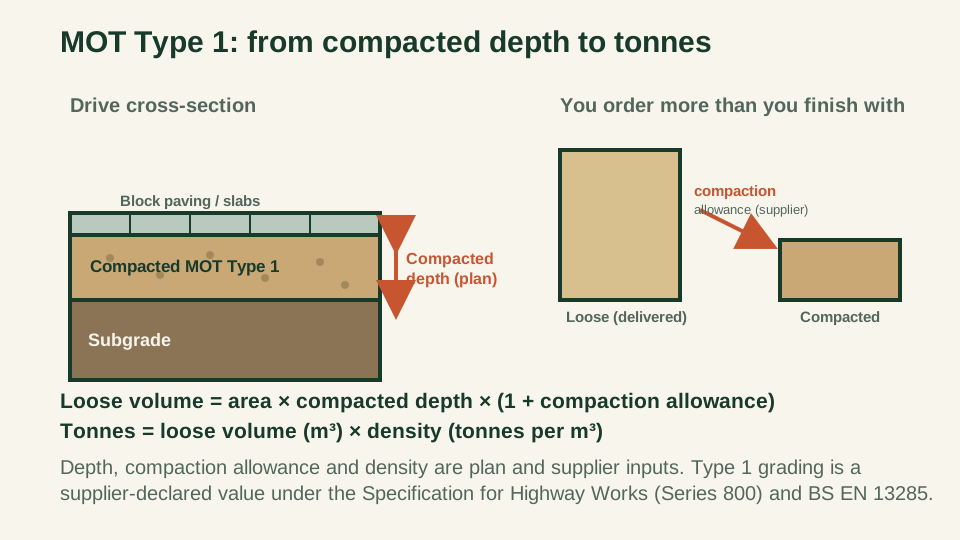
Compacted volume = area × compacted depth
Measure the area of the drive or patio in metres, and take the compacted depth from your plan in millimetres (convert to metres by dividing by 1,000). Compacted volume = area × compacted depth.
For a 5 m × 4 m drive with an example 150 mm (0.15 m) compacted depth: 20 m² × 0.15 = 3.0 m³ compacted. If the area has several parts or different depths, measure each and add them.
From compacted volume to loose ordered volume
Type 1 consolidates when it is compacted, so you order more loose material than the compacted volume. Loose volume = compacted volume × (1 + compaction allowance), where the allowance is the figure your supplier or plan provides.
For example, if your supplier's allowance means ordering one-fifth more, 3.0 m³ compacted × 1.20 = 3.6 m³ loose. Enter the loose volume — or the allowance — in the calculator rather than a number this page invents.
From volume to tonnes
UK suppliers sell Type 1 loose by the tonne and in bulk bags. Convert the loose volume to tonnes with the supplier's density in tonnes per cubic metre: tonnes = loose volume × density. Bulk-bag fill varies by supplier, so check the stated weight or volume on the product.
The gravel calculator converts cubic metres to tonnes using an editable density and rounds up to the next quarter tonne — replace its example default with your supplier's Type 1 figure.
| Step | Formula | Example |
|---|---|---|
| Area | length × width | 5 × 4 = 20 m² |
| Compacted volume | area × compacted depth | 20 × 0.15 = 3.0 m³ |
| Loose volume | compacted × (1 + allowance) | 3.0 × 1.20 = 3.6 m³ |
| Tonnes | loose volume × density | 3.6 × density |
Compacted depth, compaction allowance, and density are your plan and supplier inputs. This page recommends none of them.
Worked example: 5 m × 4 m drive
Plan and supplier figures, shown to demonstrate the method: area 5 m × 4 m; compacted depth 150 mm; the supplier's consolidation allowance works out to ordering 20% more; and — as a placeholder only — the calculator's editable default density of 1,680 kg/m³ (1.68 tonnes/m³).
Area: 20 m². Compacted volume: 20 × 0.15 = 3.0 m³. Loose volume: 3.0 × 1.20 = 3.6 m³.
Tonnes at the placeholder density: 3.6 × 1.68 = 6.05 tonnes, which the calculator rounds up to 6.25 tonnes. UK suppliers commonly quote Type 1 at working densities above this placeholder, so their figure will typically give a higher tonnage — use theirs.
Field worksheet
Confirm each figure with your plan and supplier before ordering.
- Area of the drive or patio in square metres (split complex shapes and add).
- Compacted depth from your plan (mm), converted to metres.
- Compacted volume (m³).
- Compaction or consolidation allowance from your supplier.
- Loose volume to order (m³).
- Supplier density for Type 1 (tonnes/m³) entered in the calculator.
- Tonnes rounded up to the supplier's increment, plus bulk-bag fill weight if buying bags.
- Grading confirmed as Type 1 to the Specification for Highway Works and BS EN 13285 with the supplier.
Same project
Related measurement guides
Sources and limits
Check the project-specific details
- Specification for Highway Works, Series 800 (MCHW) — Clause 803 defines the Type 1 unbound mixture; its grading is a supplier-declared value under BS EN 13285. This page sets no grading or depth.
- NIST unit definitions — Exact metric length and volume definitions used in the cubic-metre and tonnage conversions.
Review status: Formulas and conversions covered by automated tests; measurement practice pending human trade review.
This guide supports planning only. It does not specify structural design, code compliance, or a supplier quotation.