Concrete coverage reference
How Much Does a Yard of Concrete Cover?
One cubic yard of concrete covers 81 sq ft at 4 inches thick. Coverage equals 324 divided by thickness in inches, with a full thickness table.
Published 2026-07-20 · Updated 2026-07-20 · BuildMeasure Editorial Team
Next step
Turn your measurements into a material estimate
Enter the recorded dimensions in the calculator. It shows the calculated amount, wastage allowance, and a supplier-ready suggested order.
Use the Concrete Slab CalculatorOne cubic yard covers 81 square feet at 4 inches thick
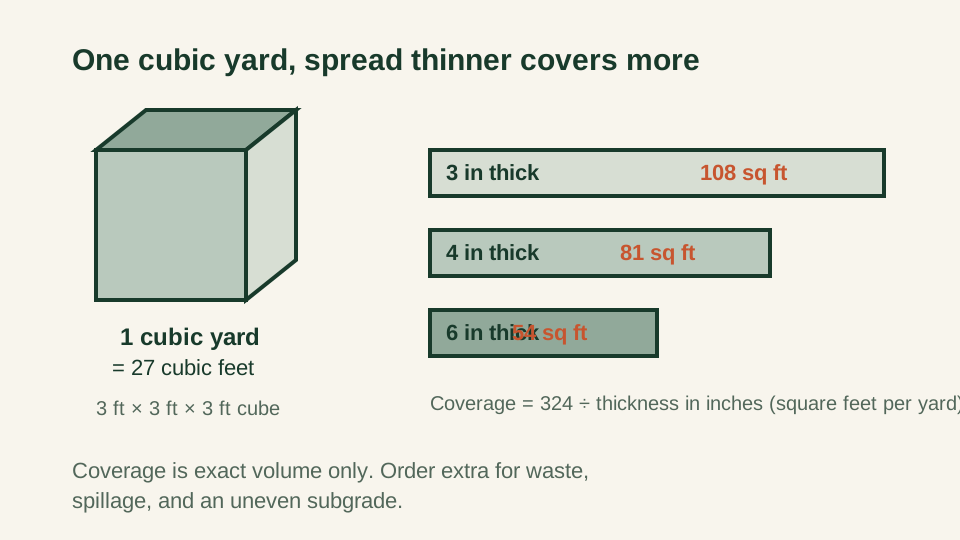
A cubic yard of concrete is a fixed volume: 27 cubic feet. How much floor it covers depends entirely on how thick you pour it. Spread thin, one yard covers a large area; poured thick, the same yard covers much less. At the common 4-inch slab thickness, one cubic yard covers 81 square feet.
The rule is one line of arithmetic: coverage in square feet = 324 ÷ thickness in inches. The 324 comes from 27 cubic feet × 12, because thickness has to be converted from inches into feet before it divides into the volume. Read the table below for the standard thicknesses, or use the concrete slab calculator to work from your own slab dimensions.
Coverage per cubic yard by slab thickness
Each figure is the area that exactly one cubic yard (27 cubic feet) of concrete covers at that thickness. Thinner pours stretch further; thicker pours cover less. These are exact-volume numbers, not order quantities.
| Slab thickness | Thickness in feet | Coverage per cubic yard |
|---|---|---|
| 3 in | 0.25 ft | 108 sq ft |
| 4 in | 0.333 ft | 81 sq ft |
| 5 in | 0.417 ft | 64.8 sq ft |
| 6 in | 0.5 ft | 54 sq ft |
| 8 in | 0.667 ft | 40.5 sq ft |
Coverage = 324 ÷ thickness in inches. Figures are exact volume; add waste before ordering.
Working backwards: yards needed for a slab size
Turn the same relationship around to get the concrete needed for a finished slab. At 4 inches thick, divide the slab area in square feet by 81 (the coverage per yard) to get the exact cubic yards. The waste column adds a typical 10% allowance for spillage, uneven subgrade, and slightly over-target thickness; always round the final figure up to your supplier's ordering increment.
| Slab size | Area | Exact concrete | Plus 10% waste |
|---|---|---|---|
| 10 ft × 10 ft | 100 sq ft | 1.23 cu yd | 1.36 cu yd |
| 12 ft × 12 ft | 144 sq ft | 1.78 cu yd | 1.96 cu yd |
| 20 ft × 20 ft | 400 sq ft | 4.94 cu yd | 5.43 cu yd |
Exact concrete = area ÷ 81 at 4 in thick. Round the waste-adjusted figure up to the supplier increment.
Why coverage is the wrong number to order from
Coverage tells you the exact volume of a perfect pour. Real pours are never perfect. A subgrade that dips half an inch below target, forms that bow slightly outward, concrete left in the chute or wheelbarrow, and normal spillage all consume concrete that the coverage figure never counted. Ordering the exact coverage volume is how slabs run short with the truck already leaving.
Coverage-per-yard is a reference number, not a purchase quantity. The exact calculated volume, the waste-adjusted volume, the supplier's order increment, and the supplier's minimum load are four different numbers, and you always buy from the larger, rounded-up figures. Our separate guide on ordering concrete walks through all four.
- Thickness confirmed in inches for every part of the slab.
- Coverage read from the table, or area divided by the coverage figure for that thickness.
- Subgrade checked so it is not pouring deeper than the target thickness.
- Waste allowance of about 10% added to the exact volume.
- Final figure rounded up to the supplier's ordering increment and minimum load.
Worked example: a 12 ft × 16 ft patio at 4 inches
Slab area = 12 × 16 = 192 square feet. Coverage at 4 inches is 324 ÷ 4 = 81 square feet per cubic yard. Exact concrete = 192 ÷ 81 = 2.37 cubic yards.
Check it the long way: volume = 192 sq ft × (4 ÷ 12) ft = 64 cubic feet, and 64 ÷ 27 = 2.37 cubic yards — the same answer. Now add waste: 2.37 × 1.10 = 2.61 cubic yards, then round up to whatever increment your supplier sells. The 2.37 figure is the coverage math; the 2.61-and-round-up figure is what you actually order.
Common mistakes
The mistakes below all come from treating a coverage figure as if it were a shopping list.
- Ordering the exact coverage volume with no allowance for waste, spillage, or an uneven base.
- Leaving thickness in inches when working the volume by hand — divide inches by 12 first, or the answer is off by a factor of twelve.
- Using the 4-inch coverage of 81 sq ft for a 6-inch pour, which actually covers only 54 sq ft per yard.
- Averaging a single thickness across a slab whose subgrade dips, which quietly increases the real volume.
- Treating thickened edges, footings, or a monolithic turn-down as part of the flat slab instead of separate volumes.
Same project
Related measurement guides
Sources and limits
Check the project-specific details
- NIST Handbook 44 (2026), Appendix C: General Tables of Units of Measurement — U.S. customary volume table stating 27 cubic feet = 1 cubic yard (exactly), the basis for the 324 ÷ thickness coverage formula.
- NIST Special Publication 811, Appendix B.8: Factors for units listed alphabetically — Exact conversion factors for the cubic yard and cubic foot, confirming the 27-to-1 volume relationship used throughout this guide.
Review status: Formulas and conversions covered by automated tests; measurement practice pending human trade review.
This guide supports planning only. It does not specify structural design, code compliance, or a supplier quotation.