Concrete planning guide
Concrete Order Quantities Explained
Understand the four different quantities that decide how much concrete to order: exact volume, waste allowance, order increment, and supplier minimum.
Published 2026-07-16 · Updated 2026-07-16 · BuildMeasure Editorial Team
Next step
Turn your measurements into a material estimate
Enter the recorded dimensions in the calculator. It shows the calculated amount, wastage allowance, and a supplier-ready suggested order.
Use the Concrete Slab CalculatorFour different quantities stack up to what you actually order
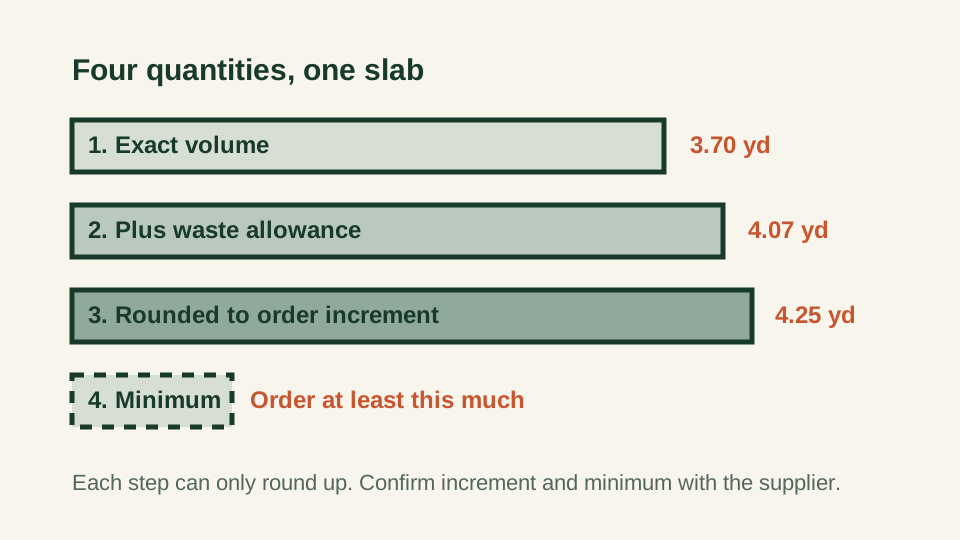
A concrete order is not just 'round up the volume.' There are four distinct quantities: the exact volume you calculated, a waste allowance on top of that, the supplier's standard ordering increment, and the supplier's minimum load.
These are not the same thing. A 2.2 cubic yard slab plus 10% waste is 2.42 cubic yards, which rounds up to the supplier's standard 0.5 cu yd increment (2.5 cu yd), then is checked against their 3 cu yd minimum (so you order 3 cu yd).
Exact volume is the base number
This is the result of your measurement: length × width × thickness (for a slab) or the sum of all sections. Measure carefully and convert all units to the same scale before multiplying.
Waste allowance accounts for mishaps and overages
5% to 10% is typical for residential concrete work. A 5% allowance covers small measurement errors, concrete that does not fill forms to the exact edge, and spillage. A 10% allowance is safer for complex forms, outdoor pours with wind, or irregular sections.
Exact volume × (1 + waste %) = quantity you need.
Order increment is the supplier's standard batch size
Ready-mix suppliers do not deliver 2.37 cubic yards. They deliver in standard increments, usually 0.25, 0.5, or 1.0 cubic yard steps. An order of 2.37 cu yd rounds up to 2.5 cu yd.
Always ask the supplier about their standard increment before placing an order.
Minimum load is the smallest truck trip they will make
Most ready-mix suppliers have a minimum load, often 3, 4, or 5 cubic yards. If your rounded order (with waste allowance and increment) is less than the minimum, you pay for the full minimum and may have excess concrete left over.
For very small jobs, it may be cheaper to use bagged concrete than to order a minimum load of ready-mix.
Worked example: a 12 by 10 foot patio, 4 inches thick
Volume: 12 × 10 × (4 ÷ 12) = 12 × 10 × 0.333 = 40 cubic feet = 1.48 cubic yards.
With 10% waste: 1.48 × 1.10 = 1.628 cubic yards.
Round to the supplier's 0.5 cu yd increment: 1.628 rounds up to 2.0 cubic yards.
Check against minimum: the supplier's 3 cu yd minimum means you order 3 cubic yards.
You pay for 3 cu yd even though you only need 1.48 cu yd. You will have about 1.5 cu yd left over. For a small patio, bagged concrete may be more practical.
| Step | Calculation | Result |
|---|---|---|
| 1. Measure and convert | 12 ft × 10 ft × 4 in (÷12) = 40 cu ft | 1.48 cu yd |
| 2. Add waste allowance | 1.48 cu yd × 1.10 | 1.628 cu yd |
| 3. Round to increment | Round 1.628 to next 0.5 cu yd step | 2.0 cu yd |
| 4. Apply minimum | Supplier minimum is 3 cu yd; 2.0 < 3 | 3.0 cu yd (ordered) |
This example assumes a 3 cu yd minimum and 0.5 cu yd increment. Always confirm these with your supplier.
Questions to ask the concrete supplier
Before placing an order, ask for these details in writing so there are no surprises.
- What is the minimum load for a truck delivery?
- What is the standard order increment (0.25, 0.5, or 1.0 cu yd)?
- Is there a delivery fee? Does it apply if you are on their route?
- Is there a short-load fee or surcharge for volumes below the minimum?
- What is the standard working time for their concrete mix in current weather conditions?
- Do they offer a slump adjustment (wetter or stiffer mix) and is there an extra charge?
- What is their on-site chute reach, or do you need to arrange for a pump or longer chute?
- Can they place concrete at the specific day and time you need it?
Same project
Related measurement guides
Sources and limits
Check the project-specific details
- National Ready Mixed Concrete Association (NRMCA) — Industry practices and guidelines for ready-mix concrete delivery and ordering.
- NIST unit conversion: cubic yard definition — Reference for the exact cubic yard and cubic foot definitions used in concrete orders.
Review status: Formulas and conversions covered by automated tests; measurement practice pending human trade review.
This guide supports planning only. It does not specify structural design, code compliance, or a supplier quotation.