Deck planning guide
How to Measure a Deck for Boards
Measure deck dimensions and understand how nominal board sizes differ from actual widths. Account for gaps, direction, and waste to calculate decking needed.
Published 2026-07-16 · Updated 2026-07-16 · BuildMeasure Editorial Team
Next step
Turn your measurements into a material estimate
Enter the recorded dimensions in the calculator. It shows the calculated amount, wastage allowance, and a supplier-ready suggested order.
Use the Decking CalculatorNominal lumber size is not the actual size
Lumber is sold by nominal size: 5/4×6, 2×8, 2×10, etc. The actual dimensions are smaller after surfacing and drying. A 5/4×6 nominal deck board is actually about 1 inch thick and 5.5 inches wide, not 1.25 × 6 inches.
Always check the actual width (sometimes called dressed width or finished width) printed on the lumber specification or data sheet. This is the measurement you use to calculate how many boards fit across a deck width.
Gaps between boards reduce the usable width
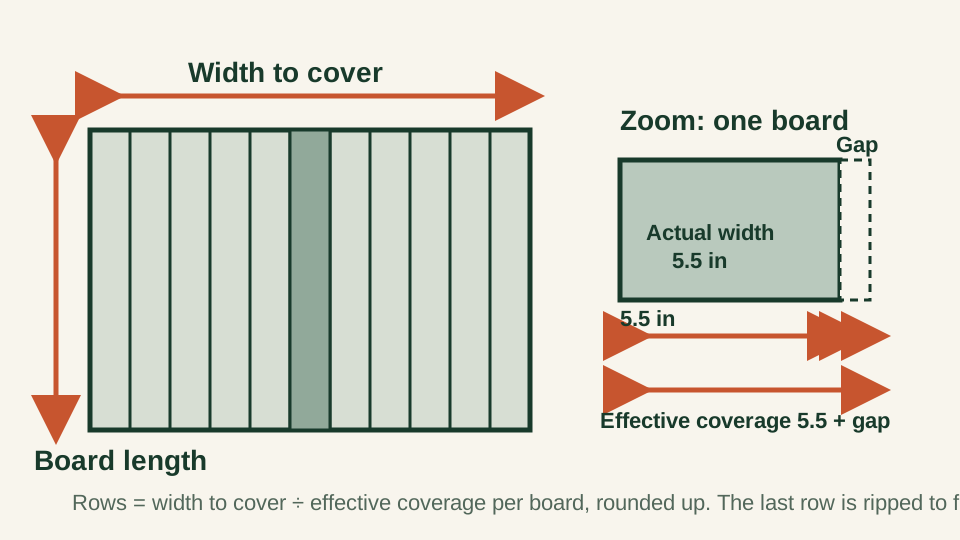
Deck boards are installed with small gaps (typically 1/8 to 1/4 inch) between them for drainage and thermal movement. If you install boards 5.5 inches wide with 1/8-inch gaps, the space covered is 5.5 + 0.125 = 5.625 inches per board run.
This gap is critical. Ignoring it leads to underestimating the number of boards or misaligning the final board to an edge.
Board direction affects layout and waste
Deck boards can run parallel to the house (long direction), perpendicular (short direction), or diagonal. Parallel runs minimize cut waste for standard rectangular decks. Perpendicular or diagonal patterns create more waste at the edges.
Diagonal or herringbone patterns are visually striking but require more material. Plan 10–15% waste for diagonal; 5–10% for straight runs.
Measure the deck dimensions and calculate board count
Measure the deck width (perpendicular to the board run direction). Divide by the board width plus gap (5.625 inches in the example above). Round up to the nearest whole board, then multiply by the deck length along the run direction.
Deck area 12 ft × 20 ft with 5.625-inch boards running the 20 ft length: 12 ft = 144 inches ÷ 5.625 inches per board = 25.6 boards (round up to 26 boards). Each board is 20 ft long, so the total decking length is 26 × 20 = 520 linear feet.
Common deck board sizes and actual widths
Pressure-treated, composite, and hardwood decking are sold in standard nominal sizes. Actual width varies slightly between manufacturers and species, so always confirm with your supplier.
| Nominal size | Actual width (in) | With 1/8" gap (in) | With 1/4" gap (in) |
|---|---|---|---|
| 5/4×4 | 3.5 | 3.625 | 3.75 |
| 5/4×6 | 5.5 | 5.625 | 5.75 |
| 2×4 | 3.5 | 3.625 | 3.75 |
| 2×6 | 5.5 | 5.625 | 5.75 |
| 2×8 | 7.25 | 7.375 | 7.5 |
| 2×10 | 9.25 | 9.375 | 9.5 |
Actual widths are dressed (milled smooth) dimensions. Some hardwoods or specialty products may vary. Confirm with your supplier before calculating.
Account for waste and rip cuts
Straight runs across a rectangular deck typically generate 5–10% waste at edges and cut ends. Diagonal or herringbone patterns waste 10–15% due to angled cuts.
Add the waste percentage to your calculated decking length before ordering. A deck needing 500 linear feet of boards with 10% waste is 550 linear feet to order.
Worked example: 12 × 20 ft deck with 5/4×6 boards
Deck size: 12 ft (width) × 20 ft (length). Board direction: parallel to the 20 ft length. Board: 5/4×6 (actual 5.5 in wide). Gap: 1/8 inch.
Board spacing: 5.5 + 0.125 = 5.625 inches.
Width in inches: 12 ft = 144 inches.
Board count across width: 144 ÷ 5.625 = 25.6 boards (round up to 26).
Each board is 20 ft long. Total: 26 boards × 20 ft = 520 linear feet.
Add 10% waste: 520 × 1.10 = 572 linear feet (order 29 twenty-foot boards, which is 580 linear feet).
Pre-purchase checklist
Before ordering decking, confirm the board size, grade, treatment, and availability.
- Deck width and length in feet, measured from the house and to the outer edge.
- Intended board direction (parallel, perpendicular, or diagonal).
- Nominal board size chosen (5/4×6, 2×8, etc.).
- Actual (dressed) width confirmed with the lumber supplier.
- Gap size (1/8, 3/16, or 1/4 inch) you plan to use during installation.
- Calculated board count and total linear feet needed.
- Waste allowance (5–10% for straight, 10–15% for diagonal) included.
- Grade and treatment of the board (pressure-treated, composite, cedar, etc.).
- Availability and lead time from the supplier.
- Unit price (per board or per linear foot) and total order cost.
Same project
Related measurement guides
Sources and limits
Check the project-specific details
- American Lumber Standard Committee (ALSC) grading rules — Nominal and actual dimensions for hardwood and softwood decking.
- American Wood Protection Association (AWPA) standards — ANSI-accredited standards for pressure-treated wood, including the Use Category System for decking exposure.
- International Building Code (IBC) deck construction — Deck design, fastening, spacing, and material requirements.
Review status: Formulas and conversions covered by automated tests; measurement practice pending human trade review.
This guide supports planning only. It does not specify structural design, code compliance, or a supplier quotation.