Fence planning guide
How to Measure a Fence Line
Measure fence runs by post type: end posts, corner posts, regular posts, and gates. Calculate board and post quantities for a complete fence.
Published 2026-07-16 · Updated 2026-07-16 · BuildMeasure Editorial Team
Next step
Turn your measurements into a material estimate
Enter the recorded dimensions in the calculator. It shows the calculated amount, wastage allowance, and a supplier-ready suggested order.
Use the Fence CalculatorFences are made of runs, posts, and bays
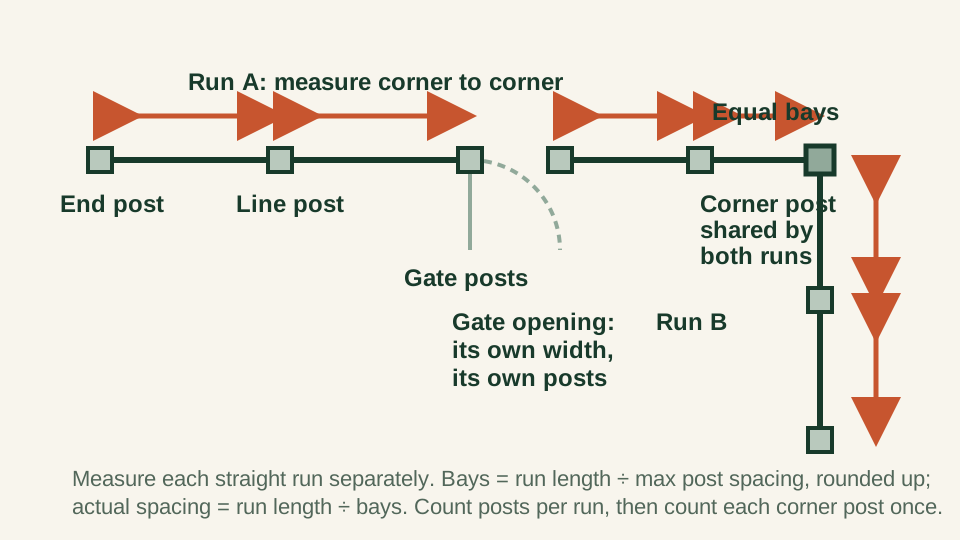
A fence run is a section of fence between two corner or end posts. A bay is the space between two adjacent posts where pickets or boards span. Posts are the vertical supports spaced at regular intervals (typically 4, 5, or 6 feet apart).
To measure a fence, you identify each run, measure its total length, decide on the post spacing (bay width), count the posts, then calculate the pickets or boards.
Types of posts: end, corner, and regular
End posts start and finish the fence at property lines or transitions. Corner posts occur where the fence direction changes 90 degrees. Regular posts space the pickets or boards within a run at equal intervals (every 4–6 feet).
End and corner posts may need to be larger (4×4 instead of 2×4) or set deeper for strength. Regular posts can be smaller (2×2 or 2×4) because they only support picket load.
Calculate posts by dividing run length by bay width
If a run is 40 feet long and you space posts 5 feet apart, the number of bays is 40 ÷ 5 = 8 bays. The number of posts for that run is 8 + 1 (one at each end of the run) = 9 posts.
This holds for any run in a straight line. Corners change direction, so each corner post is counted only once (it belongs to both runs), but you count it separately to avoid double-counting.
Handle corners and gates carefully
Where the fence turns a corner, two runs meet. The corner post is at the intersection. Count it as the end post of one run and the start post of the next run to avoid duplication.
A gate opening is a skip in the regular spacing. If the gate is 4 feet wide and regular post spacing is 5 feet, the posts around the gate remain 5 feet apart; the gate simply occupies one bay.
Worked example: rectangular perimeter fence
A rectangular yard is 60 ft × 40 ft. Post spacing is 5 feet.
North side: 60 ft ÷ 5 ft = 12 bays → 13 posts (including both corners).
East side: 40 ft ÷ 5 ft = 8 bays → 9 posts, but the north-east corner is already counted on the north side, so the east side adds 8 new posts (including the south-east corner).
Repeat for the south and west sides, being careful to count each corner post only once.
Total posts: 13 (north, both corners included) + 8 (east, its north-east corner already counted) + 12 (south, its south-east corner already counted) + 7 (west, both of its corners already counted) = 40 posts.
For simplicity, count the perimeter and divide by bay width, then add 1 for closure: (60 + 40 + 60 + 40) ÷ 5 = 40 bays → 40 posts (one per bay on a closed loop, or add 1 if you are thinking about end posts separately).
Pickets per run: if pickets are 4 inches wide with 1-inch spacing, that is 5 inches per picket (including the gap to the next). A 60-foot run is 720 inches ÷ 5 inches per bay slot = 144 pickets. Repeat for all runs.
Field measurement checklist
Walk the entire fence perimeter with a tape measure. Record each run below.
| Run (e.g., north side) | Length (ft) | Post spacing (ft) | Bays | Posts |
|---|---|---|---|---|
| Total |
Posts = (length ÷ spacing) + 1 for an open run. For corners, count once. For gates, skip the regular spacing in one bay.
Cross-cluster link: post holes and concrete
After you know the number and size of posts, use the concrete-volume calculator to measure concrete for each post hole. A 4×4 post in a 12-inch auger hole 30 inches deep requires a specific volume; multiply by the total post count.
See the 'How to measure post holes for concrete' guide for details.
Pre-order checklist
Before ordering fence materials, confirm post and picket sizes, spacing, and finish.
- Total fence perimeter and each run length (straight, corner, gate opening).
- Post spacing (distance between posts in feet).
- Total post count, separating end/corner posts from regular posts.
- Post size (2×2, 2×4, 4×4) for end/corner vs regular.
- Picket or board width (nominal size, actual width, and spacing/gap).
- Total picket or board count per run, then for the entire fence.
- Waste allowance (5% for straight cuts, 10% for notches or angles).
- Post-hole depth and auger hole size (check local frost-line depth).
- Concrete volume for setting posts (from the post-hole concrete calculator).
- Gate style and size, with separate picket count for gate versus fence.
Same project
Related measurement guides
Sources and limits
Check the project-specific details
- International Building Code (IBC) fence standards — Height limits, post spacing, and setback requirements for residential fences.
- Lumber standard dimensions — Nominal and actual dimensions for posts, pickets, and boards used in fence construction.
Review status: Formulas and conversions covered by automated tests; measurement practice pending human trade review.
This guide supports planning only. It does not specify structural design, code compliance, or a supplier quotation.