Landscaping planning guide
How to Measure Mulch Beds
Measure the area of mulch beds by length and width for rectangles, or radius for circular beds, then multiply by the desired depth in inches to calculate volume.
Published 2026-07-16 · Updated 2026-07-16 · BuildMeasure Editorial Team
Next step
Turn your measurements into a material estimate
Enter the recorded dimensions in the calculator. It shows the calculated amount, wastage allowance, and a supplier-ready suggested order.
Use the Mulch CalculatorMulch beds have three dimensions: length, width, and depth
Mulch depth is a third dimension, not just surface area. The volume of mulch you need is the area of the bed multiplied by the depth you want to add.
A 20-foot-long, 3-foot-wide bed with 2 inches of mulch is different from the same bed with 4 inches. Double the depth, double the mulch volume.
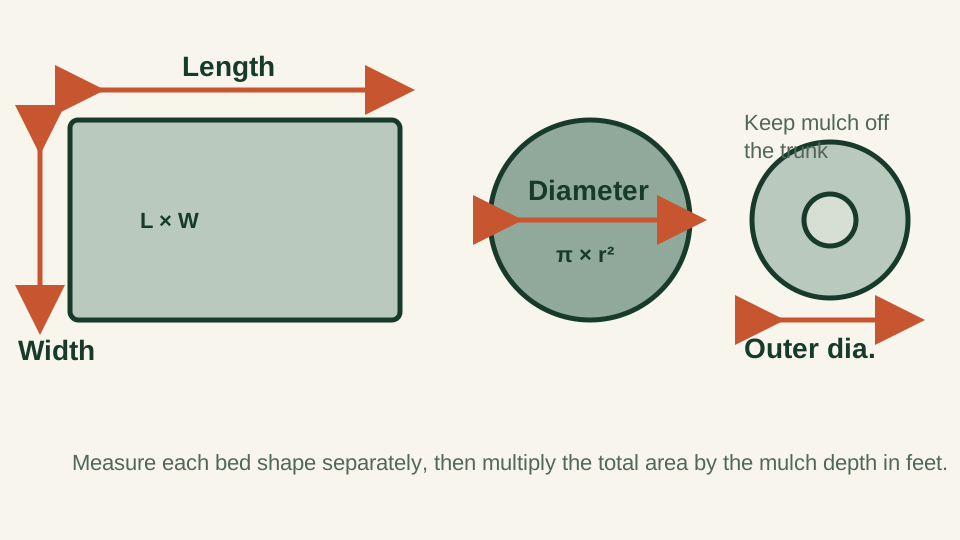
Rectangular beds: length × width × depth
For a rectangular bed, measure the length and width in feet. Measure or decide on the depth in inches (2, 3, or 4 inches is typical). Multiply length × width × (depth ÷ 12), then convert to cubic yards by dividing by 27.
A 15 ft × 4 ft bed with 3 inches of mulch is 15 × 4 × (3 ÷ 12) = 15 cubic feet = 0.56 cubic yards.
Circular beds: π × radius² × depth
For a circular bed, measure the diameter (the full width across the center). Divide by 2 to find the radius. The area is π × radius². Multiply by depth (in feet, converted from inches) to get volume.
A circular bed 6 feet in diameter has a radius of 3 feet. Area: π × 3² = 28.3 sq ft. With 3 inches (0.25 ft) of mulch: 28.3 × 0.25 = 7.1 cubic feet = 0.26 cubic yards.
Irregular beds: decompose into rectangles and circles
If a bed has curves along only part of its edge, split it into a rectangle and one or more circular or arc sections. Measure each section separately, calculate its volume, and add them together.
A teardrop or kidney-shaped bed can be split into a rectangle and a semicircle. Measure the rectangle dimensions and the semicircle radius, then calculate each part.
Standard mulch depths and coverage
Depth affects both appearance and weed suppression. Shallow mulch (2 inches) covers but does not suppress many weeds. Medium depth (3 inches) is standard for most gardens. Deep mulch (4 inches) provides more weed control but can bury small plants or affect irrigation.
Mulch settles and decomposes over time, so a depth of 3 inches becomes 2 inches by year-end. Plan to refresh annually or adjust your initial depth upward if you want sustained coverage.
| Bed type | Dimensions | Depth | Volume (cu ft) | Volume (cu yd) |
|---|---|---|---|---|
| Rectangular | 20 ft × 3 ft | 2 in | 10 | 0.37 |
| Rectangular | 20 ft × 3 ft | 3 in | 15 | 0.56 |
| Rectangular | 20 ft × 3 ft | 4 in | 20 | 0.74 |
| Circular | 6 ft diameter | 2 in | 4.7 | 0.17 |
| Circular | 6 ft diameter | 3 in | 7.1 | 0.26 |
| Circular | 6 ft diameter | 4 in | 9.4 | 0.35 |
Volume = area × (depth ÷ 12). Circular area = π × radius². Convert cubic feet to cubic yards by dividing by 27.
Field measurement checklist
Walk each bed with a tape measure and record the dimensions below. For informal or curved beds, measure the approximate rectangular bounds and estimate the adjustment for curves.
- Bed label or location (north garden, entryway, etc.).
- Bed type: rectangular, circular, or irregular.
- For rectangular: length and width in feet.
- For circular: diameter in feet.
- Depth of mulch you plan to add, in inches (typically 2, 3, or 4 inches).
- Any soil amendments or existing mulch to work around.
- Condition of the bed edge (defined border, soft edge, etc.) that affects measurement.
- Total for all beds before ordering.
Worked example: two beds to mulch
You have a rectangular front bed (18 ft × 2.5 ft, 3 inches deep) and a circular planter (4 ft diameter, 3 inches deep).
Rectangular: 18 × 2.5 × (3 ÷ 12) = 11.25 cubic feet.
Circular: π × 2² × (3 ÷ 12) = 3.14 cubic feet.
Total: 11.25 + 3.14 = 14.39 cubic feet ≈ 0.53 cubic yards (plus 10% waste allowance = 0.58 cu yd, round to 0.5 or 0.75 cu yd depending on supplier increment).
Same project
Related measurement guides
Sources and limits
Check the project-specific details
- NIST unit conversion reference — Reference for exact foot and yard definitions used in volume conversions.
- Clemson Cooperative Extension Home & Garden Information Center: Mulch — University extension guidance on mulch depths — about 2 to 3 inches for fine-textured mulch and up to 4 inches for coarse — and keeping mulch off trunks and stems.
Review status: Formulas and conversions covered by automated tests; measurement practice pending human trade review.
This guide supports planning only. It does not specify structural design, code compliance, or a supplier quotation.