Walls & Insulation
Plasterboard Calculator
Enter your room dimensions in metres to get the number of plasterboard sheets to buy, with standard opening deductions, a wastage allowance and an optional GST-aware cost estimate.
Formula tested · Local units · No sign-up
Project inputs
Enter measurements
Use your preferred units. Results update automatically.
Show the calculation methodFormula, conversions, rounding, and assumptions+
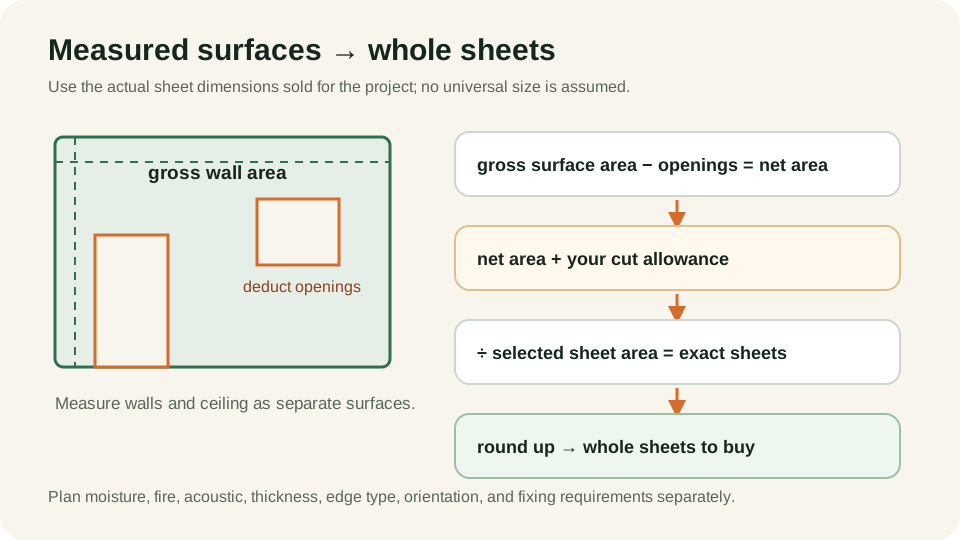
Wall area = 2 × (room length + room width) × wall height. A 6 m × 4 m room with 2.7 m ceilings — a common Australian ceiling height — has 2 × (6 + 4) × 2.7 = 54 m² of wall.
Doors and windows are deducted at editable standard sizes — 1.9 m² per door and 1.4 m² per window.
The net area gets a wastage allowance, is divided by the sheet area (1200 × 2400 mm = 2.88 m²; 1200 × 3000 mm = 3.6 m²), and rounds up to whole sheets.
Real-world example
Worked example: 6 m × 4 m room, 2.7 m walls, 2 doors, 2 windows
- Wall area: 2 × (6 + 4) × 2.7 = 54 m² (walls only).
- Deduct openings: 2 doors × 1.9 + 2 windows × 1.4 = 6.6 m².
- Net area: 54 − 6.6 = 47.4 m².
- Add 10% wastage: 47.4 × 1.10 = 52.14 m².
- Divide by a 1200 × 3000 mm sheet (3.6 m²): 52.14 ÷ 3.6 = 14.48 → round up to 15 sheets.
Buy 15 sheets of 1200 × 3000 mm plasterboard. Enter your supplier's price for a cost estimate — advertised consumer prices in Australia normally include 10% GST, so enter 0% tax if your price is GST-inclusive.
Before you start
How to measure
- Measure room length and width in metres, and wall height floor to ceiling — Australian homes commonly have 2.4 m or 2.7 m ceilings, and sheet length is usually chosen to span the wall or run horizontally without extra joints.
- For a single wall, garage lining or a patch job, use 'single wall / known area' mode and enter the m² directly.
- Count doors and windows per room, adjusting counts for oversized openings such as sliding stacker doors.
Local guidance
Notes for Australia
- Australian plasterboard (often called Gyprock after the dominant brand, the way 'sheetrock' is used in the US) comes in 1200 mm-wide sheets, commonly 2400–6000 mm long; 10 mm is the usual thickness for walls and ceilings in dry areas.
- Wet areas (bathrooms, laundries) require water-resistant board and compliant wall systems — the sheet count is the same but the product and installation rules differ.
- Sheets are typically fixed horizontally to timber or steel studs with screws and adhesive daubs, then flush-jointed with paper tape and three coats of compound — jointing materials are not included in this estimate.
- GST is 10% and consumer prices are usually advertised GST-inclusive; trade accounts often see ex-GST pricing.
Quick reference
Common Australian plasterboard sizes (planning values)
| Sheet size | Area | Typical use |
|---|---|---|
| 1200 × 2400 mm | 2.88 m² | Standard walls, easiest to handle |
| 1200 × 3000 mm | 3.6 m² | 2.7 m+ walls run horizontally, fewer joints |
Longer sheets (up to 6000 mm) exist for ceilings and long walls — match your supplier's stock.
Good to know
Common mistakes to avoid
- Using 2400 mm sheets on 2.7 m walls without planning the extra course — longer sheets fixed horizontally often waste less.
- Skipping the wastage allowance: cuts around power points, cornice and openings routinely consume 5–10% extra.
- Using standard board in wet areas where water-resistant board is required.
- Comparing GST-inclusive and ex-GST quotes as if they were the same.
Need help?
Frequently asked questions
How many sheets for a 3.6 m × 3 m bedroom with 2.4 m walls, 1 door and 1 window?
Wall area is 2 × (3.6 + 3) × 2.4 = 31.68 m². Deduct 3.3 m² of openings for 28.38 m² net; with 10% wastage that's 31.22 m², and 31.22 ÷ 2.88 = 10.84, so buy 11 sheets of 1200 × 2400 mm.
Would 1200 × 3000 mm sheets reduce the count for that room?
Yes — 31.22 ÷ 3.6 = 8.67, so 9 sheets instead of 11, with fewer joints to set. Weigh that against handling: 3-metre sheets are heavier and awkward in small rooms.
Is the price I enter GST-inclusive?
Enter whatever your supplier quotes. Retail shelf prices in Australia include 10% GST, so leave the tax field at 0 for those; if you have an ex-GST trade price, enter 10 in the tax field instead.
Keep planning
Related calculators
Transparency
About this calculator
- Written by:
- BuildMeasure Editorial Team
- Technically reviewed by:
- Pending independent technical reviewer (formula unit-tested; see methodology)
- Last reviewed:
- 2026-07-16
- Formula version:
- 2.0.0
- Region reviewed for:
- Australia
- Spotted an error?
- Report a correction
Methodology
- The area to board is walls (plus the ceiling if included). In room mode, wall area = 2 × (length + width) × height; the ceiling adds length × width. All lengths are converted to metres internally before any arithmetic to avoid unit drift.
- Openings are deducted using clearly-labelled editable standard sizes (door 1.9 m² / 20 ft², window 1.4 m² / 15 ft²) multiplied by the counts you enter; the net area is floored at zero.
- Sheets = net area × (1 + wastage%) ÷ sheet area, rounded UP to a whole sheet, because sheets are only sold whole. Exact multiples are not bumped up an extra sheet.
- The cost estimate simply multiplies the sheet count by the price you enter, then applies the tax rate you enter. No prices are built in.
- The formula is covered by automated unit tests, including hand-calculated worked examples, and is versioned (see formula version on this page).
Sources & standards
- Sheet areas: 1200 × 2400 mm = 2.88 m² and 1200 × 3000 mm = 3.6 m² (exact).
- Opening deductions: Editable planning standards of 1.9 m² per door and 1.4 m² per window — adjust to your actual openings.
This tool provides a material estimate for planning purposes only. It is not a quotation, and it does not account for fire, moisture or acoustic board requirements, fixings, jointing materials or labour. Confirm quantities and board specification with your supplier before ordering.