Painting & Walls
Wall and Ceiling Paint Calculator Canada
Enter room dimensions in metres or feet and get separate two-coat wall and ceiling paint lines in litres. The calculator deducts wall openings, measures the ceiling as length × width, and rounds each product to whole cans.
Formula tested · Local units · No sign-up
Project inputs
Enter measurements
Use your preferred units. Results update automatically.
Show the calculation methodFormula, conversions, rounding, and assumptions+
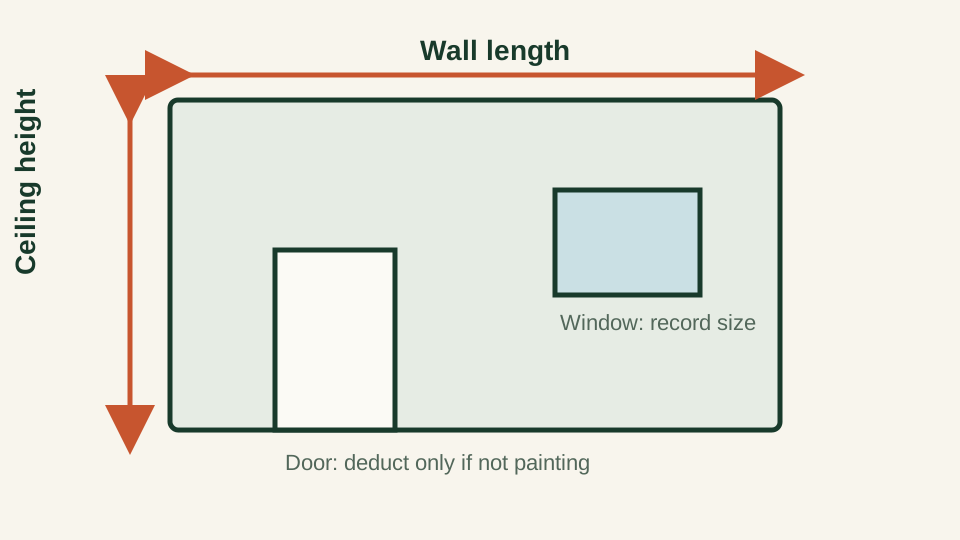
Wall area = 2 × (room length + room width) × wall height, converted to a common unit first. Canadian paint is labelled in litres and m², but many rooms are still measured in feet — the calculator accepts both and converts internally.
Standard openings are deducted: 1.9 m² per door and 1.4 m² per window (editable typical values). The remaining paintable area is multiplied by the number of coats.
Ceiling area = length × width and is multiplied by its own coat count. A directly entered wall area needs a separate ceiling-area entry when the ceiling is included.
Litres = coat-area ÷ the matching coverage per litre. Wall and ceiling cans are rounded separately — set each container size to what your store sells, such as the common 3.78 L can.
Real-world example
Worked example: 4 m × 3 m bedroom, 2.4 m ceilings, 2 coats
- Wall area: 2 × (4 + 3) × 2.4 = 33.6 m².
- Deduct openings: 1 door (1.9 m²) + 1 window (1.4 m²) = 3.3 m² → 30.3 m² paintable.
- Two coats: 30.3 × 2 = 60.6 m² to cover.
- Wall paint: 60.6 ÷ 11 m²/L = 5.51 litres → 2 × 3.78 L cans.
- Ceiling: 4 × 3 = 12 m²; two coats = 24 m²; 24 ÷ 11 = 2.18 litres → 1 × 3.78 L ceiling-paint can.
Buy 2 × 3.78 L wall-paint cans and 1 × 3.78 L ceiling-paint can. Enter each product's store price and your province's applicable combined tax rate for a complete estimate.
Before you start
How to measure
- Measure length, width and height in whichever units you have — each field accepts metres, centimetres, feet or inches and the tool converts.
- Count doors and windows; the calculator subtracts standard areas (1.9 m² per door, 1.4 m² per window). Measure patio doors and picture windows separately.
- Use the separate ceiling settings when its coverage rate, finish, or can size differs from the wall product.
- If you measured the room in feet, double-check the unit selector on each field — mixing feet into a metres field is the most common input error.
Local guidance
Notes for Canada
- Canadian paint cans carry bilingual (English/French) labels with coverage stated in litres and square metres, though many stores still talk in gallons — the common large can is 3.78 L, the metric twin of a US gallon.
- Rooms are often measured in feet while paint is sold metric; this calculator accepts both so you don't have to convert by hand.
- Sales tax is 5% federal GST plus provincial tax, or a combined HST, depending on the province — enter your combined rate. Shelf prices are usually shown before tax.
Quick reference
Typical coverage by surface (planning values — check your can)
| Surface | Typical coverage per coat |
|---|---|
| Previously painted smooth drywall | 11–12 m²/L |
| New or primed drywall | 9–11 m²/L |
| Textured or porous surfaces | 8–10 m²/L |
| Rough masonry | 5–8 m²/L |
Editable planning values only — the bilingual label on your can states the coverage that governs.
Good to know
Common mistakes to avoid
- Mixing unit systems mid-calculation — entering a room measured in feet into fields set to metres.
- Assuming a 'gallon' of paint is 4 litres everywhere — the common Canadian can is 3.78 L; set the container size to what your store actually sells.
- Forgetting the tax difference between provinces when comparing online prices.
- Skipping primer on new drywall and then wondering why coverage fell short of the label figure.
Need help?
Frequently asked questions
How much paint for a 10 ft × 10 ft room with 8 ft ceilings?
In metric that's roughly 3.05 m × 3.05 m with 2.44 m walls: wall area is about 29.7 m². Deduct one door, double for two coats, and the wall paint is about 5.1 litres, or two 3.78 L cans at 11 m²/L. The 9.29 m² ceiling needs about 1.69 litres for two coats, or one separate 3.78 L can.
Why does the can say litres when the store calls it a gallon?
Canada sells paint in metric sizes with bilingual labels; the 3.78 L can is the direct metric equivalent of a US gallon, so the old name stuck. Enter the litre size printed on the can as the container size.
What tax rate should I enter?
Your province's combined rate: 5% GST everywhere, plus PST or the provincial portion of HST depending on where you live. The calculator applies whatever rate you enter to the price you enter.
Keep planning
Related calculators
Transparency
About this calculator
- Written by:
- BuildMeasure Editorial Team
- Technically reviewed by:
- Pending independent technical reviewer (formula unit-tested; see methodology)
- Last reviewed:
- 2026-07-20
- Formula version:
- 1.1.0
- Region reviewed for:
- Canada
- Spotted an error?
- Report a correction
Methodology
- Wall area comes either from room dimensions (perimeter × wall height, i.e. 2 × (length + width) × height) or from a directly entered area. All arithmetic runs internally in SI units (m² and litres) to avoid unit drift; regional units are converted on the way in and out.
- Standard opening deductions (door and window areas, clearly labelled next to the inputs and editable via the counts) are subtracted from the wall area, floored at zero. The paintable area is multiplied by the number of coats to get the total area to cover.
- When the ceiling is included, room mode calculates its area as length × width; direct-area mode uses the ceiling area you enter. Ceiling coats, coverage, container size, and price stay separate from the wall product so the tool never silently treats two finishes as interchangeable.
- Paint volume = coat-area ÷ the coverage rate you enter. Wall and ceiling container counts are each rounded UP to the next whole container, because separate paint products cannot share a partly used can in the estimate.
- The cost estimate multiplies each container count by the matching price you enter, then applies the tax rate only when every included product has a price. No prices are built in.
- The formula is covered by automated unit tests, including hand-calculated worked examples, and is versioned (see formula version on this page).
Sources & standards
- Unit definitions: 1 ft = 0.3048 m (exact); 3.78 L is the common Canadian large paint can, matching one US gallon.
- Coverage defaults: 10–12 m² per litre per coat is a typical interior paint label range; the label on your can governs.
This tool provides a wall-and-ceiling paint material estimate for planning purposes only. It is not a quotation, and it does not assess surface condition, primer requirements, trim paint or colour-change coverage. Confirm quantities and each product's coverage rate with your paint supplier before buying.