Painting & Walls
Paint Calculator for 2 Coats Including Ceiling
Enter room dimensions in feet, choose two wall and ceiling coats, and get separate gallon and can counts for wall paint and ceiling paint. Door and window deductions apply only to the walls, while each product keeps its own coverage, can size, and optional price.
Formula tested · Local units · No sign-up
Project inputs
Enter measurements
Use your preferred units. Results update automatically.
Show the calculation methodFormula, conversions, rounding, and assumptions+
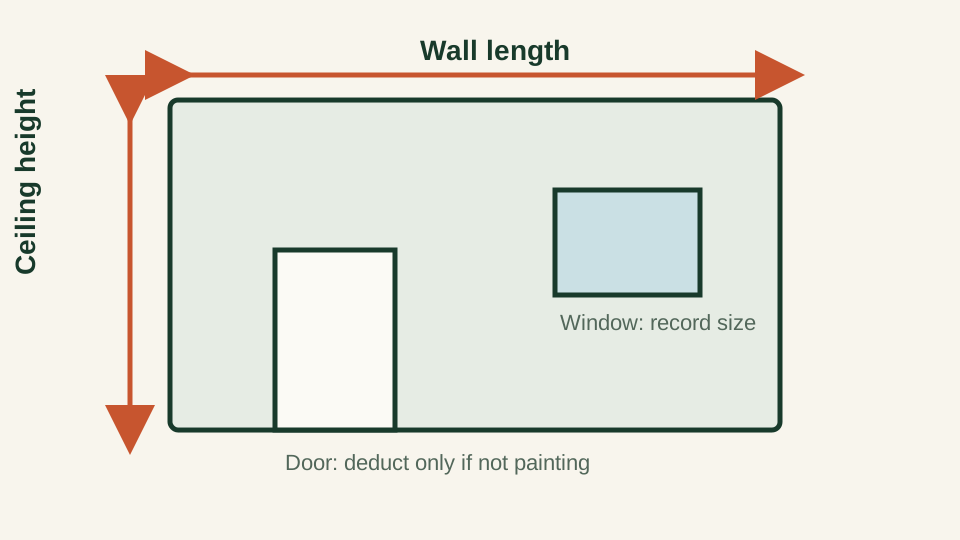
Wall area = 2 × (room length + room width) × wall height. A 12 ft × 10 ft room with 8 ft ceilings has 2 × 22 × 8 = 352 sq ft of wall. You can also enter a measured wall area directly.
Standard openings are deducted: 20 sq ft per door and 15 sq ft per window (editable typical values — measure unusual openings). The remaining paintable area is multiplied by the number of coats.
When you include the ceiling, its area is room length × width and its coat-area is calculated separately. In direct wall-area mode, enter a separate ceiling area.
Gallons = coat-area ÷ the product's coverage per gallon. The calculator rounds wall cans and ceiling cans separately, because flat ceiling paint and wall paint are normally different products.
Real-world example
Worked example: 12 ft × 10 ft bedroom, 8 ft ceilings, 2 coats
- Wall area: 2 × (12 + 10) × 8 = 352 sq ft.
- Deduct openings: 1 door (20 sq ft) + 2 windows (2 × 15 sq ft) = 50 sq ft → 302 sq ft paintable.
- Two coats: 302 × 2 = 604 sq ft to cover.
- Wall paint: 604 ÷ 350 sq ft/gal = 1.73 gallons → 2 one-gallon cans.
- Ceiling: 12 × 10 = 120 sq ft; two coats = 240 sq ft; 240 ÷ 350 = 0.69 gallon → 1 one-gallon can of ceiling paint.
Buy 2 one-gallon cans of wall paint and 1 one-gallon can of ceiling paint. If your entered prices are $40 and $35, an 8% entered sales-tax rate makes the combined example $124.20; replace every price and rate with your local quote.
Before you start
How to measure
- Measure the room's length and width in feet at floor level, and the wall height from floor to ceiling.
- Count doors and windows rather than measuring each one — the calculator subtracts a standard 20 sq ft per door and 15 sq ft per window. Measure and adjust for oversized openings like patio doors.
- Use room-dimensions mode to calculate the ceiling as length × width. If you enter wall area directly, measure the ceiling plane separately and enter that area too.
- For rooms with alcoves or bump-outs, measure the full perimeter and use direct-area mode (perimeter × height).
Local guidance
Notes for United States
- US paint is sold by the US gallon (128 fl oz) and quart; common can sizes are 1 quart, 1 gallon and 5 gallons. The 5-gallon bucket is usually the cheapest per gallon for large jobs.
- Coverage on US labels is quoted in square feet per gallon — typically 300–400 for interior wall paint on a previously painted smooth surface.
- Sales tax varies by state and locality and is entered manually; shelf prices are usually shown before tax.
Quick reference
Typical coverage by surface (planning values — check your label)
| Surface | Typical coverage per coat |
|---|---|
| Previously painted smooth drywall | 350–400 sq ft/gal |
| New or primed drywall | 300–350 sq ft/gal |
| Textured or porous surfaces | 250–300 sq ft/gal |
| Rough masonry or stucco | 150–250 sq ft/gal |
Editable planning values only — the coverage figure on your specific paint can governs.
Good to know
Common mistakes to avoid
- Using one coat in the calculation when the color change needs two — dark-to-light repaints often need two coats plus primer.
- Taking the label's best-case coverage on a porous or textured wall — coverage drops sharply on rough surfaces.
- Combining wall and ceiling litres before rounding cans even though the finishes are separate products — this calculator rounds each shopping-list line independently.
- Buying exactly the computed amount with no can left over for touch-ups.
Need help?
Frequently asked questions
How much paint do I need for a 12×12 room with 8 ft ceilings?
Wall area is 2 × (12 + 12) × 8 = 384 sq ft. With no deductions and 2 coats, wall paint is 768 ÷ 350 = 2.19 gallons, so buy 3 one-gallon wall-paint cans. The ceiling is 144 sq ft; two coats is 288 sq ft, so at the same example coverage it needs 0.82 gallon and 1 separate one-gallon ceiling-paint can.
Does a gallon of paint really cover 400 square feet?
Only under good conditions — smooth, sealed, previously painted walls. 300–400 sq ft per gallon per coat is the typical label range; use the lower end for new drywall or textured walls, and always check your specific can.
Should I calculate primer separately?
Yes. Primer has its own coverage rate and you usually need one coat of it, not two. Run this calculator once for primer (1 coat, your primer's coverage) and once for the topcoat.
Keep planning
Related calculators
Measure with confidence
Planning guides for this project
Transparency
About this calculator
- Written by:
- BuildMeasure Editorial Team
- Technically reviewed by:
- Pending independent technical reviewer (formula unit-tested; see methodology)
- Last reviewed:
- 2026-07-20
- Formula version:
- 1.1.0
- Region reviewed for:
- United States
- Spotted an error?
- Report a correction
Methodology
- Wall area comes either from room dimensions (perimeter × wall height, i.e. 2 × (length + width) × height) or from a directly entered area. All arithmetic runs internally in SI units (m² and litres) to avoid unit drift; regional units are converted on the way in and out.
- Standard opening deductions (door and window areas, clearly labelled next to the inputs and editable via the counts) are subtracted from the wall area, floored at zero. The paintable area is multiplied by the number of coats to get the total area to cover.
- When the ceiling is included, room mode calculates its area as length × width; direct-area mode uses the ceiling area you enter. Ceiling coats, coverage, container size, and price stay separate from the wall product so the tool never silently treats two finishes as interchangeable.
- Paint volume = coat-area ÷ the coverage rate you enter. Wall and ceiling container counts are each rounded UP to the next whole container, because separate paint products cannot share a partly used can in the estimate.
- The cost estimate multiplies each container count by the matching price you enter, then applies the tax rate only when every included product has a price. No prices are built in.
- The formula is covered by automated unit tests, including hand-calculated worked examples, and is versioned (see formula version on this page).
Sources & standards
- Unit definitions: 1 US gallon = 3.785411784 litres and 1 ft² = 0.09290304 m² (exact definitions).
- Coverage defaults: 300–400 sq ft per gallon per coat is the typical interior wall paint label range; the label on your can governs.
This tool provides a wall-and-ceiling paint material estimate for planning purposes only. It is not a quotation, and it does not assess surface condition, primer requirements, trim paint or colour-change coverage. Confirm quantities and each product's coverage rate with your paint supplier before buying.