Landscaping
Mulch Calculator — Bags vs Bulk Cost UK
Enter border measurements, depth, bag litres, the supplier's bulk increment, and optional prices to compare independently rounded bag and bulk orders.
Formula tested · Local units · No sign-up
Project inputs
Enter measurements
Use your preferred units. Results update automatically.
Show the calculation methodFormula, conversions, rounding, and assumptions+
Volume = bed area × depth. Depth is entered in centimetres and converted to metres first — a 5 cm layer on a 20 m² border is 20 × 0.05 = 1 m³, which is 1,000 litres.
UK bark and mulch is sold in litre bags (50 L and 70 L are common sizes — check your product), in bulk bags of roughly a cubic metre, or loose by the cubic metre. Bag counts round up to whole bags.
Bulk volume rounds only to the supplier increment entered. In the example, 1.05 m³ rounds to 1.25 m³ at a 0.25 m³ increment, separately from the 21-bag calculation.
Real-world example
Worked example: 5 m × 4 m border, 5 cm deep
- Area: 5 × 4 = 20 m².
- Convert depth: 5 cm = 0.05 m.
- Volume: 20 × 0.05 = 1.0 m³.
- Add 5% wastage: 1.0 × 1.05 = 1.05 m³ = 1,050 litres.
- Bags: 1,050 ÷ 50 = 21 bags of 50 L exactly.
- At an entered 0.25 m³ sale increment, 1.05 m³ rounds to a 1.25 m³ bulk order; 0.20 m³ is added by supplier rounding.
The purchase choices are 21 bags of 50 L or 1.25 m³ at the example bulk increment. Enter comparable VAT-basis supplier prices; delivery and nominal bulk-bag fill remain separate checks.
Before you start
How to measure
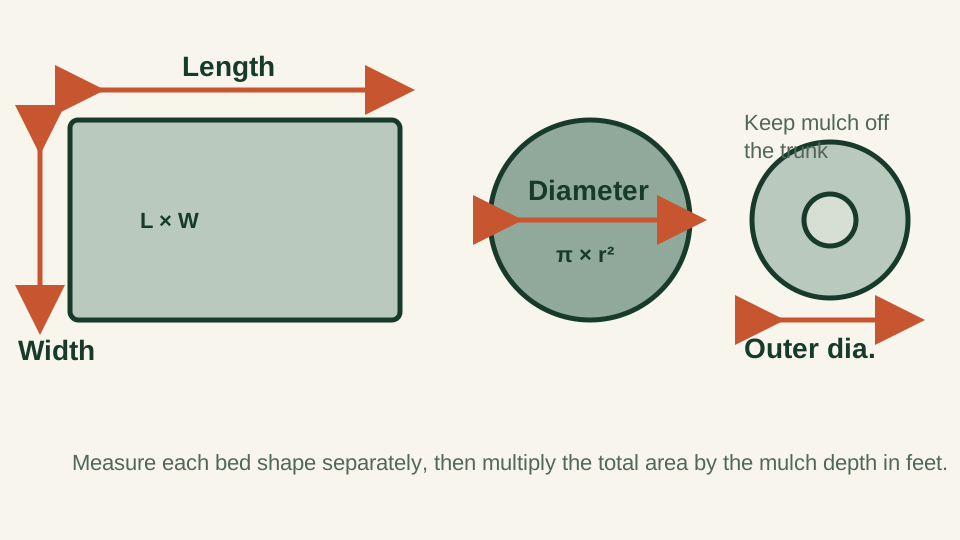
- Measure borders in metres; for curved beds, approximate with rectangles and add the areas, then use the total-area mode.
- A 5 cm (50 mm) layer is a common top-up depth; 7–10 cm suits new beds and serious weed suppression.
- Leave a gap around woody stems and crowns — mulch piled against them holds moisture where it does harm.
Local guidance
Notes for United Kingdom
- UK mulch is sold in litres, not cubic feet: 1 m³ = 1,000 litres = 20 bags of 50 L, which makes bag-versus-bulk comparisons easy.
- Bulk bags (builder's bags) are nominally around a cubic metre but actual fill varies by supplier — check the stated litres or m³ on the product.
- VAT at the standard 20% rate is normally included in retail bag prices; loose loads quoted by landscape suppliers may be ex-VAT.
Quick reference
Mulch depth quick reference (typical planning values)
| Application | Common depth |
|---|---|
| Annual top-up of borders | 3–5 cm |
| General beds and borders | 5 cm |
| New beds / weed suppression | 7–10 cm |
| Around trees and shrubs (clear of stems) | 5–8 cm |
Planning values only — over-mulching can smother roots and encourage rot at stems.
Good to know
Common mistakes to avoid
- Entering depth in millimetres into a centimetre field — 50 instead of 5 asks for ten times the mulch.
- Assuming a bulk bag is exactly 1 m³ — fills vary, so check the stated volume before comparing prices.
- Ignoring the 5% wastage allowance: bark settles noticeably in the first weeks.
- Mulching over dry soil or perennial weeds — the layer works best on moist, weeded ground (a gardening point the calculator can't fix).
Need help?
Frequently asked questions
How many 50 L bags are in a bulk bag?
If the bulk bag holds a full cubic metre (1,000 litres), it equals 20 bags of 50 L. Many bulk bags hold less — check the stated litres and divide by your bag size.
How much bark do I need for a 10 m² border at 5 cm?
10 × 0.05 = 0.5 m³. With 5% wastage that's 0.525 m³ = 525 litres, which is 11 bags of 50 L (525 ÷ 50 = 10.5, rounded up).
Is a 50 L bag the same as a 50 L bag of compost?
The volume is the same but coverage differs: bark chips sit looser than compost and settle differently. This calculator works purely on volume, so it applies to any mulch sold by the litre.
Keep planning
Related calculators
Transparency
About this calculator
- Written by:
- BuildMeasure Editorial Team
- Technically reviewed by:
- Pending independent technical reviewer (formula unit-tested; see methodology)
- Last reviewed:
- 2026-07-20
- Formula version:
- 1.1.0
- Region reviewed for:
- United Kingdom
- Spotted an error?
- Report a correction
Methodology
- Volume is computed as bed area × depth. You can enter the area directly or as length × width; either way all inputs are converted to SI units (metres) before any arithmetic to avoid unit drift.
- The wastage allowance is applied to the exact volume to cover settling and uneven spreading.
- Bag counts divide the total volume by the bag size you enter and round UP to whole bags, because you can't buy a fraction of a bag. The default bag size is a clearly-labelled common retail size (2 cubic feet in the US, 50 litres elsewhere) and is fully editable.
- Bulk order = allowance-adjusted volume rounded UP to the exact supplier increment you enter. Bulk-increment rounding is reported separately from the spreading allowance.
- Bag and bulk material totals use their independently rounded purchase quantities and only the prices and tax rate you enter. No current prices, delivery fee, or universal bulk increment is built in.
- The formula is covered by automated unit tests, including hand-calculated worked examples, and is versioned (see formula version on this page).
Sources & standards
- Unit definitions: Metric units throughout; 1 m³ = 1,000 litres.
- Bag sizes: 50 L is a common UK retail bag size, used as an editable default — 70 L and 100 L bags also exist; check your product.
This tool provides a material estimate and entered-price comparison for planning only. It is not a quotation. Bag sizes, loose volume, moisture, compaction, minimum loads, sale increments, delivery, access, and product quality vary. Confirm quantities, package volumes, bulk units, and all charges with the supplier before buying.