Landscaping
Soil Calculator UK — Topsoil in m³ & Bulk Bags
Enter inside bed dimensions in metres, unfilled depth in millimetres, and your supplier’s actual m³ or litre package sizes to estimate topsoil without guessing a tonnes-to-volume conversion.
Formula tested · Local units · No sign-up
Project inputs
Enter measurements
Use your preferred units. Results update automatically.
Show the calculation methodFormula, conversions, rounding, and assumptions+
One-bed volume (m³) = inside length (m) × inside width (m) × unfilled depth (m). Convert millimetres to metres by dividing by 1,000, then multiply by the number of identical beds.
Purchase volume = exact bed volume + the settling/handling allowance you enter. The calculator reports exact volume and allowance separately; it does not prescribe a blanket percentage.
Loose-bulk order = purchase volume rounded up to the supplier's entered sale increment, such as 0.25 or 0.5 m³. Confirm that the quote is genuinely volume-based before using this route.
Optional bag or bulk-bag quantity = purchase volume ÷ the exact package volume stated in litres or m³, rounded up once. One cubic metre is exactly 1,000 litres.
A tonne and a cubic metre are not interchangeable units. Soil mass per cubic metre changes with material composition, screening, moisture and settlement, so this calculator never invents a universal tonnes-to-bags or tonnes-to-m³ factor.
Loose and bagged material totals use only the current prices and VAT rate you enter. Delivery, small-load charges, pallet or bag handling, access and disposal remain separate quote lines.
Real-world example
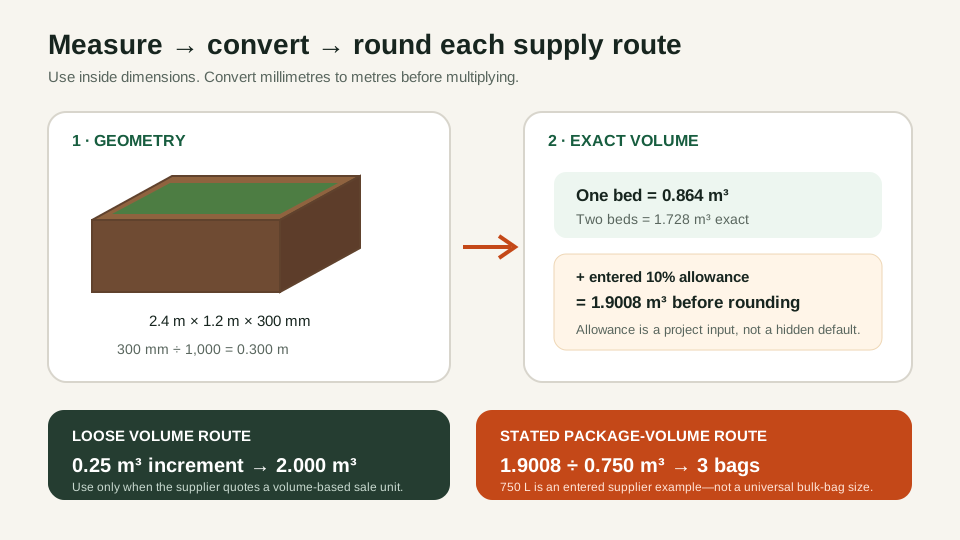
Two 2.4 × 1.2 m beds filled 300 mm deep
- Convert the depth: 300 mm ÷ 1,000 = 0.300 m.
- One bed holds 2.4 m × 1.2 m × 0.300 m = 0.864 m³.
- Two identical beds hold exactly 1.728 m³.
- A user-selected 10% settling/handling allowance adds 0.1728 m³, making 1.9008 m³ before purchasing-unit rounding.
- At an entered loose-bulk increment of 0.25 m³, round 1.9008 m³ up to a 2.000 m³ loose order. Increment rounding adds 0.0992 m³.
- If the selected supplier states 750 L (0.750 m³) per bulk bag, 1.9008 ÷ 0.750 = 2.53, so the alternative is 3 whole bulk bags containing a stated 2.250 m³ in total.
For these entered assumptions, compare a 2.000 m³ loose order with 3 × 750 L bulk bags. The 10% allowance, 0.25 m³ increment and 750 L package are editable example inputs, not universal UK supplier sizes.
Before you start
How to measure
- Measure each bed's inside length and width at the soil line in metres. Do not use the larger outside dimensions of sleepers, boards, brick or block walls.
- Measure only the empty depth that will receive the selected soil, preferably in millimetres. Deduct reliable existing fill, false bottoms, drainage structures or other occupied space rather than using the full wall height.
- The bed-count field assumes identical beds. Calculate different lengths, widths or fill depths separately and add their checked cubic-metre volumes.
- Choose the fill depth and soil specification for the plants and assembly rather than copying the worked example. RHS guidance says appropriate raised-bed depth depends on what will grow there and explains that deep beds can use lower layers that reduce the quantity of good soil needed.
- For loose delivery, ask the supplier for the quoted unit, minimum order, actual m³ increment, loose/dumped convention, vehicle and offload method. Do not type an order stated only in tonnes into an m³ field.
- For packaged soil, enter the exact volume printed or published for that product—such as litres per small bag or stated litres/m³ per bulk bag. The words “bulk bag”, “jumbo bag” and a bag weight do not establish one standard volume.
- Check delivery access before ordering. A pallet truck needs a suitable firm, level route; kerbside or tail-lift delivery may not put bulk bags beside the bed.
- Inspect the product specification and suitability separately from its quantity. RHS advises checking topsoil for unwanted roots, weeds, stones and contaminants; a volume result cannot certify soil quality.
Local guidance
Notes for United Kingdom
- This UK page defaults to metres for length, millimetres for depth, cubic metres for loose topsoil, litres for bag or bulk-bag volume, GBP and optional user-entered VAT.
- RHS lists topsoil as available in bags or bulk, distinguishes premium, general-purpose and economy grades, and advises inspection before buying. Quantity and product suitability remain separate decisions.
- A current Rolawn product page illustrates why volume must be entered rather than inferred: it describes standard and large bulk bags as approximately 500 L (0.5 m³) and 750 L (0.75 m³), while other UK suppliers sell different packages or loose loads.
- Rolawn's calculator uses length and width in metres and depth in millimetres, then reports calculated m³ and whole 500 L or 750 L bags. This calculator retains that useful unit workflow but lets you enter any supplier's stated volume.
- British Sugar TOPSOIL illustrates a different purchasing route: loose tipper loads or bulk bags with stated minimum quantities. Confirm the selected supplier's actual sale unit and minimum instead of assuming all UK topsoil is packaged alike.
- Where a specification calls for BS 3882 topsoil, verify the current product analysis and project requirement with the supplier. Mention of the standard does not mean every bag is suitable for every garden or planting use.
Quick reference
UK soil order stages and units
| Stage | Calculation or supplier input | Unit |
|---|---|---|
| Inside bed volume | length × width × (depth mm ÷ 1,000) × identical beds | m³ |
| Chosen allowance | exact m³ × entered percentage | m³ |
| Loose quantity before rounding | exact m³ + allowance m³ | m³ |
| Loose order | round up to entered supplier increment | m³ |
| Bag or bulk-bag order | purchase m³ ÷ exact stated package m³, rounded up | whole packages |
| Litre conversion | stated litres ÷ 1,000 | m³ per package |
| Weight-only quote | request product-specific volume or verified bulk density | do not assume tonnes = m³ |
Supplier examples of 500 L and 750 L show possible product sizes, not UK-wide standards. Always enter the selected product's current stated volume.
Good to know
Common mistakes to avoid
- Multiplying by a depth in millimetres without dividing by 1,000, which overstates cubic metres one thousandfold.
- Measuring outside the raised-bed frame or ordering for full wall height when existing fill occupies part of the bed.
- Assuming “one bulk bag” means the same volume across suppliers, or deriving package volume from a nominal kg/tonne label.
- Treating one tonne of topsoil as one cubic metre without a verified product-specific bulk density and moisture basis.
- Adding an allowance, then hiding the extra loose-increment or whole-bag remainder inside a second unexplained allowance.
- Comparing a loose £/m³ quote with a bulk-bag price before rounding both options to quantities the suppliers will actually sell.
- Forgetting to check whether VAT and delivery are included and whether the lorry or pallet truck can reach the unloading point.
- Using volume arithmetic as evidence that a soil grade, blend, contamination status or BS 3882 claim is suitable for the planting plan.
Need help?
Frequently asked questions
How do I calculate how much soil I need in the UK?
Multiply inside length in metres by inside width in metres by unfilled depth in metres. For a depth measured in millimetres, divide by 1,000 first. Multiply by identical bed count, add only your chosen allowance, then round to the actual m³ increment or litre package size offered by your supplier.
How much soil fills a 2.4 × 1.2 m raised bed?
At 300 mm unfilled depth, one bed holds exactly 2.4 × 1.2 × 0.300 = 0.864 m³ before allowance or supplier rounding. The depth must come from the planting and bed plan; 300 mm is only an example.
How many litres are in one cubic metre of soil?
One cubic metre is exactly 1,000 litres. A package explicitly stated as 750 L therefore represents 0.750 m³ by volume. Do not assume a package is 750 L merely because it is called a bulk bag.
How many bulk bags of topsoil do I need?
Divide the allowance-adjusted m³ by the selected supplier's stated m³ per bulk bag and round up. For example, 1.9008 m³ ÷ an explicitly stated 0.750 m³ bag = 2.53, so 3 bags. Use the actual product volume, not a generic bulk-bag assumption.
Is one tonne of topsoil the same as one cubic metre?
Not as a universal conversion. Tonnes measure mass and cubic metres measure volume. Composition, screening, moisture and settlement affect bulk density, so ask for the selected product's volume or verified density before converting a weight-only quote.
Does the soil calculator include VAT and delivery?
It includes VAT only when you enter a rate and applies it consistently to the two entered material prices. Delivery, minimum-load charges, pallets, bag handling, restricted access, equipment and labour are excluded and should stay as separate quote lines.
Keep planning
Related calculators
Transparency
About this calculator
- Written by:
- BuildMeasure Editorial Team
- Technically reviewed by:
- Pending independent UK horticultural reviewer (metric formula unit-tested; supplier claims source-linked)
- Last reviewed:
- 2026-07-23
- Formula version:
- 1.1.0
- Region reviewed for:
- United Kingdom
- Spotted an error?
- Report a correction
Methodology
- Formula version 1.1.0 retains the tested rectangular-prism calculation: inside length × inside width × unfilled depth × identical bed count.
- UK defaults convert metres and millimetres to an internal cubic-metre volume. One litre is 0.001 m³ exactly.
- Allowance, loose supplier-increment rounding and whole-package rounding remain separately reported quantities.
- A loose price entered per m³ is applied to the rounded loose m³. A package price is applied only after dividing by the exact entered package volume and rounding to whole packages.
- No tonnes-to-volume calculation exists. Product-specific supplier volume remains an input because topsoil bulk density is not universal.
- Automated tests cover UK input defaults, metric worked-example arithmetic, m³ and litre package rounding, GBP price comparison, publication, metadata, sources and region-specific diagram integrity.
Sources & standards
- Royal Horticultural Society — Topsoil: Buying Guide: UK horticultural guidance on bagged and bulk topsoil, uses and grades, buying checks and soil-quality considerations.
- Royal Horticultural Society — How to Make a Raised Bed: UK guidance on inside bed planning, plant-dependent depth, fill composition, deep-bed lower layers, drainage and allowing fill to settle.
- Rolawn — Beds & Borders Topsoil: Primary supplier example using metres, millimetres and m³, with explicitly stated 500 L and 750 L package variants and delivery constraints.
- British Sugar TOPSOIL: Primary UK producer information showing BS 3882:2015 products supplied through loose loads or bulk bags with supplier minimums.
- BIPM SI Brochure — Units of Measurement: Primary international SI definitions underlying metre, cubic metre and litre conversions.
Planning estimate for raised-bed soil volume and rounded supplier units only. It does not certify topsoil grade, BS 3882 conformity, composition, fertility, pH, drainage, contaminant safety, plant suitability, structural bed capacity, delivery access or supplier quality. Verify the inside dimensions, fill depth, allowance, exact package volume, loose sale unit, VAT basis, delivery method and selected soil specification with current project requirements and the supplier before ordering.