Landscaping
Topsoil Calculator — Cubic Yards for Raised Beds
Enter inside bed dimensions, unfilled soil depth, bed count, and supplier units to get exact volume, allowance, cubic-yard order quantity, and optional bag comparison.
Formula tested · Local units · No sign-up
Project inputs
Enter measurements
Use your preferred units. Results update automatically.
Show the calculation methodFormula, conversions, rounding, and assumptions+
One-bed volume = inside length × inside width × unfilled soil depth. Multiply by the number of identical beds; do not use outside frame dimensions or automatically fill the complete frame height.
Purchase volume = exact bed volume + the user-entered settling/handling allowance. Exact and allowance volumes are reported separately so settling is not hidden inside a rounded yard figure.
Bulk order = purchase volume rounded up to the supplier increment entered, such as 0.5 or 1 cubic yard. Increment rounding is a separate remainder after the allowance.
Optional bags = purchase volume ÷ exact bag volume, rounded up once. Bulk and bag material totals use only user-entered prices and tax; no current price or universal bag size is assumed.
One cubic yard equals 27 cubic feet. All dimensional inputs are converted before multiplying, so a depth entered in inches is not mistakenly treated as feet.
Real-world example
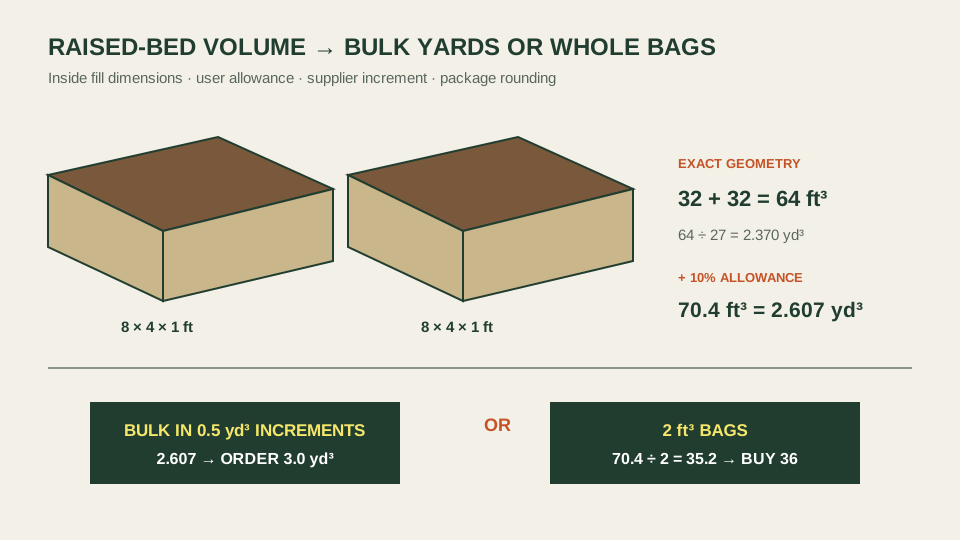
Two 8 × 4 ft beds filled 12 in deep
- Inside dimensions for each bed are 8 ft × 4 ft × 1 ft, so one bed holds 32 ft³.
- Two identical beds hold 64 ft³. Divide by 27 to get 2.370 yd³ exact volume.
- A user-selected 10% settling/handling allowance adds 6.4 ft³, making 70.4 ft³ or 2.607 yd³ before supplier rounding.
- The example bulk supplier increment is 0.5 yd³, so 2.607 yd³ rounds up to a 3.0 yd³ bulk order. Increment rounding adds 0.393 yd³ beyond the allowance-adjusted volume.
- At an editable 2 ft³ per bag, 70.4 ÷ 2 = 35.2, rounded to 36 whole bags. No price comparison is included until actual supplier prices are entered.
The example order is 3.0 yd³ in bulk or 36 two-cubic-foot bags. The 10% allowance, 0.5 yd³ increment, and 2 ft³ bag are demonstration inputs, not universal defaults.
Before you start
How to measure
- Measure inside length and width at the soil line. Subtract frame thickness, internal braces, false bottoms, reservoirs, or other features that reduce fill volume.
- Measure only the unfilled depth that will receive this soil mix. If existing material stays in the bed, subtract its reliable settled depth rather than ordering for full wall height.
- Calculate different-size beds separately or convert them into a checked combined volume; the bed-count input assumes identical dimensions.
- Choose allowance based on the actual mix, moisture, handling, settling expectation, and refill plan. Oregon State Extension notes that newly filled beds can sink over time as compost decomposes, but this calculator does not prescribe a percentage.
- Ask the supplier for the bulk order increment, minimum order, delivery unit, and whether quoted yards are loose/dumped volume. Enter the exact bag volume for a bag comparison.
- Select soil, compost, and amendments from reputable guidance and tested site conditions. Volume arithmetic does not determine a safe or suitable planting mix.
Local guidance
Notes for United States
- This page is published for US projects and defaults to feet/inches, cubic feet, cubic yards, whole bags, USD, and optional user-entered sales tax.
- University of Georgia Extension demonstrates raised-bed volume with length × width × height and converts cubic feet to cubic yards by dividing by 27.
- Oregon State Extension provides an independently checkable example: four 3 × 8 ft beds filled 6 in deep total 48 ft³, about 1.78 yd³; its published text rounds that planning example to about 1.7 yd³.
- Soil-mix recommendations vary with use and source. Enter the volume of the complete selected mix here; calculate component ratios separately when a trusted local recommendation specifies them.
Quick reference
Raised-bed soil order stages
| Stage | Formula or source | Shown separately because |
|---|---|---|
| Exact bed volume | Inside length × width × unfilled depth × bed count | It is pure geometry |
| Allowance | Exact volume × user percentage | Settling/handling is a project decision |
| Bulk order | Round purchase volume to supplier increment | Supplier sale units create a remainder |
| Bag order | Divide purchase volume by exact bag size and round up | Bags have a different packaging remainder |
| Entered-price comparison | Rounded units × user prices (+ entered tax) | Delivery and fees remain excluded |
| Soil mix selection | Trusted local guidance, tests, supplier data | Volume does not determine agronomic suitability |
Bulk-yard and bag totals can contain different leftover volumes, so compare both rounded quantities—not price per advertised unit alone.
Good to know
Common mistakes to avoid
- Using outside frame dimensions instead of the smaller inside fill dimensions.
- Entering a 12-inch depth as 12 feet or failing to convert inches before multiplying.
- Ordering for full frame height when existing soil, false bottoms, drainage material, or reservoirs already occupy part of the depth.
- Adding a settling allowance and then treating the supplier-increment remainder as another required allowance.
- Assuming every supplier sells half-yard increments or every bag contains 2 ft³.
- Comparing bulk and bag sticker prices without rounding each option to purchasable units or accounting for delivery and minimum-load fees.
- Using a volume calculator to choose a soil/compost ratio without considering plant needs, soil testing, drainage, quality, or contaminants.
Need help?
Frequently asked questions
How many cubic yards of soil fill a raised bed?
Multiply inside length × inside width × unfilled depth, convert the result to cubic feet, and divide by 27 for cubic yards. Multiply by identical bed count, then add only your chosen allowance and round to the supplier’s sale increment.
How much soil for an 8 × 4 × 1 ft raised bed?
The exact rectangular volume is 32 ft³, or about 1.185 yd³, before any allowance or supplier rounding. Two such beds are 64 ft³ or about 2.370 yd³.
How many 2 ft³ bags equal one cubic yard?
A cubic yard is 27 ft³, so 27 ÷ 2 = 13.5 bags by volume; whole-package purchasing would require 14 bags to meet or exceed one cubic yard. Use the exact printed bag size.
Does the calculator add settling automatically?
No. Enter an allowance only when appropriate to the selected mix and fill plan. The tool reports it separately, followed by the extra volume created by bulk-increment or bag rounding.
Is bulk topsoil always cheaper than bags?
No. Enter current prices to compare rounded material totals, then separately consider delivery, minimum orders, access, unloading, handling, mix quality, and leftover material. Those external costs are not inferred.
What soil mix should I use?
This calculator does not prescribe one. Use soil tests, plant needs, drainage, contaminant considerations, reputable extension guidance, and supplier information to select a suitable mix, then calculate its total volume here.
Keep planning
Related calculators
Measure with confidence
Planning guides for this project
Transparency
About this calculator
- Written by:
- BuildMeasure Editorial Team
- Technically reviewed by:
- Pending independent technical reviewer (formula unit-tested; see methodology)
- Last reviewed:
- 2026-07-20
- Formula version:
- 1.1.0
- Region reviewed for:
- United States
- Spotted an error?
- Report a correction
Methodology
- Length inputs are converted to metres before volume multiplication; volume outputs use exact shared cubic-foot/cubic-yard conversion definitions.
- One-bed volume = inside length × inside width × fill depth. Exact project volume = one-bed volume × whole bed count.
- Allowance volume = exact volume × user percentage. Purchase volume = exact + allowance.
- Bulk order uses guarded round-up to the user-entered supplier increment. Bags use guarded whole-package ceiling after dividing by exact bag volume.
- Bulk and bag prices are applied only to their independently rounded quantities. Entered tax affects both equally; delivery and other fees are excluded.
- Automated tests cover the worked example, multiple beds, unit conversion, allowance/increment separation, bag rounding, exact boundaries, price comparison, validation, publication scope, links, and diagram.
Sources & standards
- University of Georgia Extension — Raised Bed Soils: Extension explanation of length × width × height for raised-bed soil volume and cubic feet ÷ 27 for cubic yards.
- Oregon State University Extension — How to Use Compost in Gardens and Landscapes: Extension guidance on filling raised beds, a multi-bed cubic-yard example, bulk mix use, and expected settling over time.
- Penn State Extension — Soil Health in Raised Beds: Current extension guidance on raised-bed soil quality and reputable soil/compost sources, illustrating that mix selection is separate from volume arithmetic.
- NIST — SI Units: Length: Official exact length relationships used for dimensional and derived-volume conversion.
This calculator estimates raised-bed fill volume and rounded supplier units. It does not select or certify topsoil, compost, amendments, ratios, fertility, pH, drainage, contaminant safety, plant suitability, structural bed capacity, delivery access, or supplier quality. Confirm the mix, measurements, quantities, and site plan with appropriate tests, reputable local guidance, and the selected supplier.