Concrete & Masonry
Post Hole Concrete Calculator — Bags per Fence Post
Enter each round hole's diameter and concrete fill depth, subtract the actual post displacement, then convert the project volume into whole bags using the yield printed on your product.
Formula tested · Local units · No sign-up
Project inputs
Enter measurements
Use your preferred units. Results update automatically.
Show the calculation methodFormula, conversions, rounding, and assumptions+
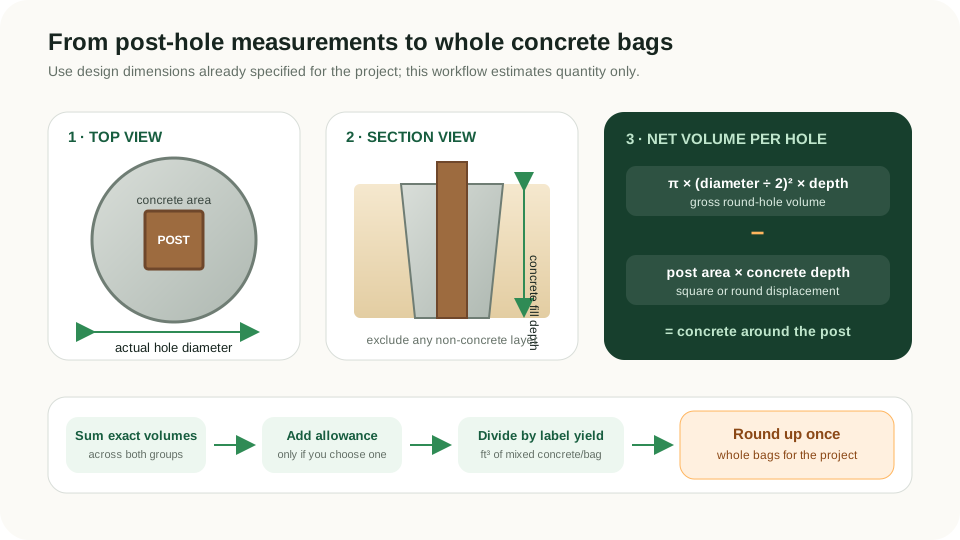
For each round hole, gross volume is π × (hole diameter ÷ 2)² × concrete fill depth. The calculator converts every length to metres before doing the arithmetic, then reports the result in cubic feet for a US bagged-concrete project.
Concrete does not occupy the post itself. A square post displaces post width² × fill depth; a round post displaces π × (post diameter ÷ 2)² × fill depth. Net concrete per hole is gross hole volume minus that displacement.
The standard-post and optional gate/corner-post groups are calculated separately and then added. Your chosen project allowance is applied to that combined net volume. No allowance is inserted automatically.
Required bags = project volume after allowance ÷ mixed-concrete yield per bag. The calculator rounds up once at the end so fractional bags are not ordered and identical holes are not each rounded prematurely.
Real-world example
Eight line posts plus two larger gate posts
- Eight line-post holes are 10 inches in diameter with 24 inches of concrete fill around actual 3.5-inch square posts. Their combined net concrete volume is 7.37 ft³.
- Two gate-post holes are 12 inches in diameter with 30 inches of concrete fill around actual 5.5-inch square posts. Their combined net volume is 2.88 ft³.
- The two groups total 10.24 ft³ before allowance. A user-selected 10% allowance makes the order volume 11.27 ft³.
- For a product whose current label states a 0.375 ft³ yield per bag, 11.27 ÷ 0.375 = 30.04 bags.
Round up once for the whole project: buy 31 bags. The 10% allowance and 0.375 ft³ yield are example inputs, not universal defaults—replace both with your project decision and exact product label.
Before you start
How to measure
- Use the hole diameter and depth specified by your approved plan, product instructions, or local authority. This calculator estimates quantity; it does not size a footing.
- Measure the actual round hole across the concrete-filled zone. If the hole flares or collapses, split it into sections or use a conservative measured diameter that reflects the excavated shape.
- Enter concrete fill depth, not automatically the full excavation depth. Exclude any separate gravel layer or planned unfilled space above the concrete.
- Measure the post itself. Nominal lumber names may differ from actual width; use one actual side for a square post or the actual diameter for a round post.
- Put identical line-post holes in the standard group. Use the second group for gate, corner, or end posts only when their hole diameter, fill depth, or post size differs.
- Read the mixed-concrete yield on the exact bag or current manufacturer data sheet. Enter volume per bag in ft³—not bag weight in pounds.
Local guidance
Notes for United States
- Footing diameter and depth can depend on loads, soil, frost conditions, the structure, permits, and local code. Confirm those design inputs before using this quantity result.
- Call 811 or submit a location request before digging so participating utilities can mark underground facilities. Follow the timing and excavation instructions supplied for your state.
- Bag weight is not bag yield. Fast-setting and standard concrete products of the same weight can state different mixed volumes, so the calculator requires the product-specific yield.
- Sales tax varies by state and locality. The optional cost result uses only the bag price and tax percentage you enter and is not a live market quote.
Quick reference
Inputs that change the concrete-bag count
| Input | Enter this | Why it matters |
|---|---|---|
| Hole diameter | Actual round-hole diameter | Radius is squared, so diameter errors have a large effect on volume. |
| Concrete fill depth | Only the depth receiving concrete | A base layer or unfilled top space should not be counted as concrete. |
| Post size | Actual width or diameter | The post volume is subtracted from the gross hole volume. |
| Hole count | Count of identical holes in that group | Standard and larger gate/corner holes can be totalled separately. |
| Allowance | Your project-specific percentage | Accounts for conditions you choose; the calculator does not assume one. |
| Yield per bag | Mixed volume printed on the exact product | This converts project volume into bags; pounds alone are not a volume. |
The table describes measurement inputs, not recommended footing dimensions or a universal allowance.
Good to know
Common mistakes to avoid
- Entering post diameter as the hole diameter. The hole is the outer cylinder; the post is a separate displacement that the calculator subtracts.
- Using nominal post size instead of measuring the actual post width or diameter.
- Entering the full excavation depth when part of the hole will contain a separate base layer or remain unfilled.
- Treating bag weight as yield. A 50 lb, 60 lb, or 80 lb label describes dry mass, not automatically the mixed cubic-foot volume.
- Rounding every hole up to a whole bag before adding the holes. Sum the exact volume first and round the final project bag count once.
- Averaging line-post and gate-post holes even though their measured dimensions differ. Use the two groups instead.
Need help?
Frequently asked questions
How many bags of concrete do I need per fence post?
There is no reliable fixed number. It depends on the round hole diameter, concrete fill depth, actual post displacement, and the mixed-volume yield stated for your bag. Enter those measurements for one hole and set the count to 1 for a per-post result.
Does the calculator subtract the fence post from the hole volume?
Yes. It subtracts a square prism for a square post or a cylinder for a round post across the concrete fill depth, then uses the remaining net volume for the bag calculation.
Should I enter the full hole depth or only the concrete depth?
Enter only the depth that will actually contain concrete. If your approved detail includes a separate base layer or an unfilled portion, do not count that portion as concrete.
Can I calculate larger gate and corner post holes separately?
Yes. Enter the repeated line-post holes in the standard group and complete the optional gate/corner group for a second diameter, depth, post size, and count. The calculator combines both exact volumes before rounding bags.
Where do I find concrete yield per bag?
Look for yield, mixed yield, or approximate yield in cubic feet on the product packaging or the manufacturer's current technical data sheet. Do not infer it only from bag weight.
Does this calculator tell me how deep or wide to dig?
No. It converts dimensions you already have into a quantity. Footing design can depend on the structure, loads, soil, frost conditions, manufacturer instructions, local code, and permits.
Why does the calculator round bags only once?
Concrete volume is additive. Summing the exact requirement for every hole before rounding avoids adding a separate rounding surplus to each post. If you divide the work into isolated pours, plan each pour's supply and staging separately.
Keep planning
Related calculators
Measure with confidence
Planning guides for this project
Transparency
About this calculator
- Written by:
- BuildMeasure Editorial Team
- Technically reviewed by:
- Pending independent technical reviewer (formula unit-tested; see methodology)
- Last reviewed:
- 2026-07-20
- Formula version:
- 1.0.0
- Region reviewed for:
- United States
- Spotted an error?
- Report a correction
Methodology
- All length inputs are converted to metres using the exact international definition 1 inch = 25.4 millimetres. Volumes are computed in cubic metres and converted to cubic feet for display.
- Round-hole volume uses πr²h. Square-post displacement uses s²h; round-post displacement uses πr²h. Automated tests cover both post shapes, mixed hole groups, fit validation, whole-project rounding, and optional cost arithmetic.
- The worked example's 0.375 ft³ yield is traceable to the cited QUIKRETE Fast-Setting Concrete Mix data sheet for its 50 lb package. It is an example product input, not a bag-weight conversion rule.
- Prices and tax are never supplied by BuildMeasure on this page. Optional cost is whole bags × the user-entered bag price, plus the user-entered tax rate.
Sources & standards
- NIST — SI Units: Length: Official reference for the exact inch-to-millimetre conversion used by the calculator.
- QUIKRETE Fast-Setting Concrete Mix data sheet: Manufacturer source for the worked example's stated 0.375 ft³ yield for a 50 lb package; users must check their own current product.
- 811 Before You Dig: National starting point for requesting underground utility marking before excavation in the United States.
Planning estimate only. Not structural, geotechnical, code, permit, excavation-safety, or product-use advice. Confirm the design dimensions, concrete product, yield, placement method, and quantities with the responsible professional, local authority, manufacturer, and supplier.