Concrete & Masonry
Concrete Bag Calculator — 40, 50, 60 & 80 lb
Enter a known concrete volume or rectangular pad dimensions, then compare up to three exact products using the mixed yield printed on each bag—not bag weight alone.
Formula tested · Local units · No sign-up
Project inputs
Enter measurements
Use your preferred units. Results update automatically.
Show the calculation methodFormula, conversions, rounding, and assumptions+
Known-volume mode converts cubic feet, cubic yards, cubic metres or litres through cubic metres internally. Rectangular mode converts length, width and confirmed thickness to metres, then calculates exact volume = length × width × thickness.
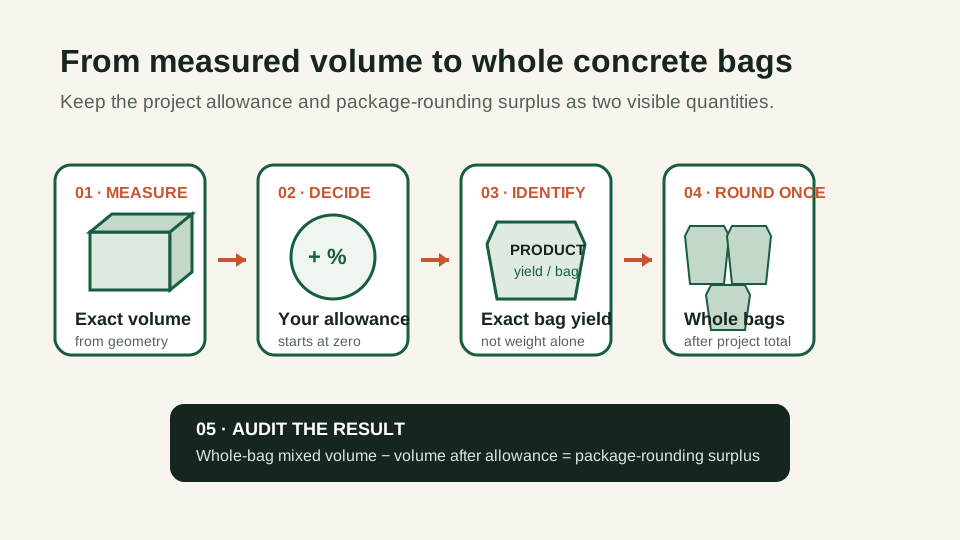
Allowance volume = exact geometric volume × your entered allowance percentage. Volume to cover = exact volume + allowance. The field starts at zero; no generic waste factor is silently added.
For each product, exact bags = volume to cover ÷ mixed-volume yield printed per bag. Bag weight is recorded in the product label for identification but never substituted for yield.
Whole bags to buy = ceiling(exact bags). Rounding happens once after the complete project volume and allowance are combined. A floating-point boundary guard prevents an exact whole-bag result from gaining an extra bag.
Mixed volume represented by whole bags = whole bags × entered yield. Volume added only by package rounding = whole-bag mixed volume − volume to cover. This is shown separately from the project allowance.
When a current shelf price is entered for a product, pre-tax material subtotal = whole bags × price per bag. The result deliberately excludes tax and all other project costs rather than guessing their basis.
Real-world example
3 × 3 ft equipment pad at 4 inches
- Exact rectangular volume = 3 ft × 3 ft × (4 ÷ 12) ft = 3.000 ft³.
- A user-entered 5% allowance adds 3.000 × 0.05 = 0.150 ft³, so the volume to cover is 3.150 ft³.
- For an exact product yield of 0.60 ft³ per bag, 3.150 ÷ 0.60 = 5.25 bags. Buy 6 whole bags; they represent 3.600 ft³, so package rounding adds 0.450 ft³.
- At 0.45 ft³ per bag, 3.150 ÷ 0.45 = exactly 7 bags, with no package-rounding surplus.
- At 0.30 ft³ per bag, 3.150 ÷ 0.30 = 10.50 bags. Buy 11; they represent 3.300 ft³, so package rounding adds 0.150 ft³.
The same pad needs 6, 7 or 11 bags for the three example yields. These are yield comparisons, not universal bag-weight rules—identify the exact product and replace every example yield with its current label or technical-sheet figure.
Before you start
How to measure
- Use known-volume mode when a slab, footing, pier or post-hole takeoff already gives the exact concrete volume. Do not re-enter its dimensions here and create a second, conflicting geometry calculation.
- Use rectangular mode only for one rectangular pad or slab with one confirmed thickness. Break irregular shapes and thickened edges into separate volumes in the concrete volume calculator, then bring the combined exact volume here.
- Thickness is a design input, not a calculator recommendation. Use the dimension from approved project documents or qualified guidance; this tool does not decide slab or footing thickness.
- Identify the exact concrete product and bag size you will buy. Check the current package or manufacturer technical data for mixed yield in ft³, litres or m³ per bag.
- If comparing products, enter each product's own yield and price. Do not copy one product's yield across 40, 50, 60 and 80 lb bags simply because the weights look proportional.
- Choose an allowance only for the actual project conditions you are planning for, such as uneven excavation or handling loss. Keep it at zero if no allowance decision has been made.
- Review the whole-bag count alongside the total number of bags that must be stored, lifted, mixed, placed and finished. For a large bag count, compare the workflow with a current ready-mix quote rather than using a universal crossover rule.
- Confirm product suitability, water amount, minimum placement thickness, temperatures, batch size, placement sequence, finishing and curing from the current manufacturer instructions.
Local guidance
Notes for United States
- This version is US-only because it uses the 40, 50, 60 and 80 lb bag language found on cited US products. It is not mechanically reused for Canadian or Australian metric bags.
- The calculator accepts litres and cubic metres when a US product publishes metric yield alongside ft³, but result summaries remain in cubic feet for comparison.
- No bag size, product, allowance or price is preselected. The example button demonstrates the arithmetic using clearly named sample yields and must be replaced before ordering.
Quick reference
Manufacturer examples: product name must stay attached to yield
| Exact product | Bag size | Approximate mixed yield | Use boundary from source |
|---|---|---|---|
| QUIKRETE Concrete Mix No. 1101 | 40 lb | 0.30 ft³ | Concrete work 2 in or thicker |
| QUIKRETE Concrete Mix No. 1101 | 60 lb | 0.45 ft³ | Concrete work 2 in or thicker |
| QUIKRETE Concrete Mix No. 1101 | 80 lb | 0.60 ft³ | Concrete work 2 in or thicker |
| SAKRETE 5000 Plus | 50 lb | 0.38 ft³ | Concrete work over 2 in thick |
| SAKRETE 5000 Plus | 60 lb | 0.45 ft³ | Concrete work over 2 in thick |
| SAKRETE 5000 Plus | 80 lb | 0.60 ft³ | Concrete work over 2 in thick |
Examples were checked against the cited manufacturer sources on the review date. Yields are approximate and product-specific; use the current label or technical data for the exact product in hand. A product application minimum is not structural thickness advice.
Good to know
Common mistakes to avoid
- Treating pounds of dry mix as cubic feet of mixed concrete. Weight and mixed volume are different quantities.
- Choosing a yield only from bag weight without keeping the manufacturer and product formulation attached to it.
- Adding a default 5% or 10% allowance without deciding whether the measured project needs it.
- Rounding each shape or section to whole bags before all project volumes are combined, which can inflate the order.
- Hiding project allowance and whole-bag surplus inside one padded number.
- Using area alone. Concrete quantity needs thickness to become volume.
- Using a standard concrete mix below its stated placement range because a different repair or topping product can be placed thinner.
- Assuming extra water produces valid extra yield. Follow the product's stated water range and do not overwater.
- Calling the entered-price subtotal a complete project cost when tax, delivery, mixer, reinforcement, base, labour and disposal are outside it.
- Selecting bagged concrete for a large continuous pour without planning storage, lifting, batching, placement time and finishing capacity.
Need help?
Frequently asked questions
How many 80 lb bags of concrete make one cubic yard?
At a product-specific yield of 0.60 ft³ per 80 lb bag, one cubic yard is 27 ÷ 0.60 = exactly 45 bags before any project allowance. Verify that 0.60 ft³ applies to the exact product you will buy.
How many 60 lb bags make one cubic yard?
At a cited yield of 0.45 ft³ per 60 lb bag, 27 ÷ 0.45 = exactly 60 bags before allowance. Specialty products can differ, so enter the current product yield.
How many 40 lb bags make one cubic yard?
At the cited QUIKRETE Concrete Mix yield of 0.30 ft³ per 40 lb bag, 27 ÷ 0.30 = 90 bags before allowance. That is a named-product example, not a universal rule for every 40 lb formulation.
Why does the calculator ask for yield if I know bag weight?
Bag weight describes dry material to handle; yield describes the mixed volume it produces. Lightweight, high-yield, rapid-set, repair and standard mixes can have different formulations, so weight alone is not enough.
Should I automatically add 10% waste?
No universal percentage fits every pour. Enter an allowance only after considering the measured excavation or forms, uneven substrate, handling and placement plan. The calculator starts at zero and shows your decision separately.
Does this decide whether bags or ready-mix are cheaper?
No. It can calculate bag subtotals from prices you enter. A fair ready-mix comparison also needs a current quote with supplier increment, minimum, delivery, short-load, pumping, waiting and tax terms; use the ready-mix cost calculator for that side.
Keep planning
Related calculators
Measure with confidence
Planning guides for this project
Transparency
About this calculator
- Written by:
- BuildMeasure Editorial Team
- Technically reviewed by:
- Pending independent concrete-product reviewer (formula unit-tested; manufacturer yields cited and user-entered)
- Last reviewed:
- 2026-07-30
- Formula version:
- 1.0.0
- Region reviewed for:
- United States
- Spotted an error?
- Report a correction
Methodology
- All geometry is converted to SI units before multiplication. Exact legal conversions are used when cubic feet, cubic yards, inches and feet are displayed.
- The formula accepts one known volume or one rectangular prism. Other geometry remains owned by the concrete volume, slab and post-hole calculators to prevent conflicting takeoffs.
- Allowance is multiplied once against exact volume. Each product divides the same volume-after-allowance by its own entered yield.
- Whole-bag rounding uses Math.ceil with a small floating-point boundary guard so an exact multiple does not gain one extra bag.
- Package-rounding surplus is never called wastage: it is the mixed volume represented by whole purchased bags minus the volume already containing the entered allowance.
- Prices are optional and always user-entered. The output is explicitly a pre-tax bag subtotal and suppresses cost lines when no price is supplied.
- Automated tests cover the hand-checked three-product example, exact whole-bag boundaries, cubic-yard and litre conversions, optional comparisons, cost from rounded bags, invalid inputs and US-only publication.
Sources & standards
- QUIKRETE Concrete Mix No. 1101 — Specification Data: Primary manufacturer data for the named standard mix, including approximate 0.30, 0.45 and 0.60 ft³ yields for 40, 60 and 80 lb bags and the 2-inch-or-thicker application range.
- SAKRETE 5000 Plus High Early Strength Concrete Mix: Primary manufacturer page listing the exact product's 50, 60 and 80 lb sizes, approximate 0.38, 0.45 and 0.60 ft³ yields, and over-2-inch application range.
- QUIKRETE Concrete Calculator: Manufacturer calculator confirming whole-bag round-up and that published yield calculations are approximate and exclude uneven substrate and waste.
- NIST — SI Units: Length: Primary US measurement reference for exact inch, foot and yard definitions used in volume conversions.
Planning estimate only. Not structural, mix-design, placement, safety, code or product-use advice. Confirm dimensions, concrete specification, yield, water, thickness range, temperatures, mixing capacity, placement sequence and purchase quantity with approved project documents, the current manufacturer instructions, supplier and responsible qualified professional.