Concrete planning guide
Concrete Bag Yields: 40, 50, 60, and 80 lb
Compare product-specific 40, 50, 60, and 80 lb concrete bag yields, convert cubic feet to whole bags, and check the exact product before ordering.
Published 2026-07-16 · Updated 2026-07-30 · BuildMeasure Editorial Team
Next step
Turn your measurements into a material estimate
Enter the recorded dimensions in the calculator. It shows the calculated amount, wastage allowance, and a supplier-ready suggested order.
Use the Concrete Bag CalculatorBag weight is not the same as yield
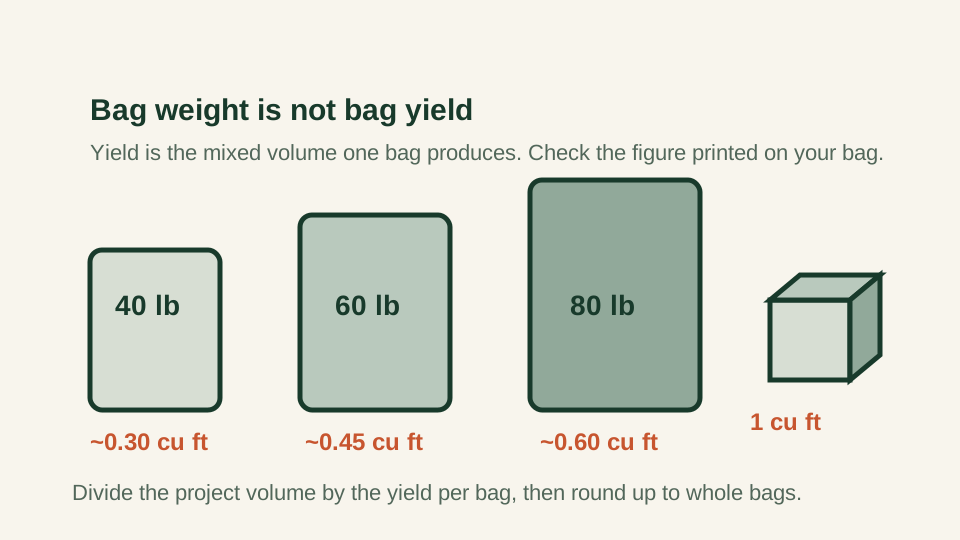
Dry bag weight and mixed concrete volume are different quantities. Yield depends on the exact product formulation as well as package size, so pounds alone cannot determine how much concrete one bag produces.
Check the current label or manufacturer technical sheet for the exact product. For QUIKRETE Concrete Mix No. 1101, cited approximate yields are 0.30 cu ft (40 lb), 0.45 cu ft (60 lb), and 0.60 cu ft (80 lb). SAKRETE 5000 Plus lists 0.38 cu ft for its 50 lb bag, alongside 0.45 and 0.60 cu ft for 60 and 80 lb sizes. Keep the product name attached to the figure.
Convert your volume to cubic yards, then to bags
A cubic yard is 27 cubic feet. To find how many bags you need, divide the volume in cubic feet by the yield per bag.
For a volume measured in inches, convert to cubic feet first by dividing by 1,728 (12 × 12 × 12). Then divide by the yield per bag.
| Bag weight | Yield per bag | Bags per cubic yard |
|---|---|---|
| QUIKRETE Concrete Mix — 40 lb | 0.30 cu ft | 90 bags |
| SAKRETE 5000 Plus — 50 lb | 0.38 cu ft | 72 bags after whole-bag rounding |
| Named standard/5000 products — 60 lb | 0.45 cu ft | 60 bags |
| Named standard/5000 products — 80 lb | 0.60 cu ft | 45 bags |
Product-specific manufacturer examples, not a universal bag-weight table. Exact yields are approximate; confirm the current source for the product in hand.
Choose bag size based on the project volume
A lower-weight bag reduces the dry load lifted at one time but may increase bag count and batching. A higher-weight bag can reduce bag count while increasing the load handled for each bag.
Choose only after checking the exact product, stated application range, how bags will be moved, and the number of whole bags that fit a consistent mixing batch.
Round the complete project result up to whole bags once. Plan how any package-rounding surplus will be placed or disposed of within the product's limited working time; it is not a reason to overwater or extend the mix.
Remember: always read the bag
Specialty formulations — quick-set, fiber-reinforced, or colored concrete — may have different yields than standard bags of the same weight. Confirm the yield printed on the product before you calculate bag count. One manufacturer's 60 lb bag may not match another's if the formulation differs.
- Calculate the volume you need in cubic feet.
- Read the yield printed on the bag.
- Divide volume (cu ft) by yield (cu ft per bag) to find the bag count.
- Round up to the nearest whole bag.
- For hand-mixing or small batches, consider the practical batch size from one bag.
- Check whether the store has the bag size in stock and in the specific product you chose.
Same project
Related measurement guides
Sources and limits
Check the project-specific details
- QUIKRETE Concrete Mix No. 1101 specification data — Primary manufacturer sheet for the named mix, its 40/60/80 lb yields, and 2-inch-or-thicker application range.
- SAKRETE 5000 Plus product data — Primary manufacturer page for product-specific 50/60/80 lb yields and application range.
- NIST unit conversion — Reference for cubic foot and cubic yard definitions.
Review status: Formulas and conversions covered by automated tests; measurement practice pending human trade review.
This guide supports planning only. It does not specify structural design, code compliance, or a supplier quotation.