Construction conversion reference
Construction Unit Conversion Guide: Imperial and Metric
Convert construction length, area, volume and mass units with exact factors, while keeping material density separate from unit conversion.
Published 2026-07-20 · Updated 2026-07-20 · BuildMeasure Editorial Team
Next step
Turn your measurements into a material estimate
Enter the recorded dimensions in the calculator. It shows the calculated amount, wastage allowance, and a supplier-ready suggested order.
Use the Concrete Volume CalculatorConvert the dimension, then apply the correct power
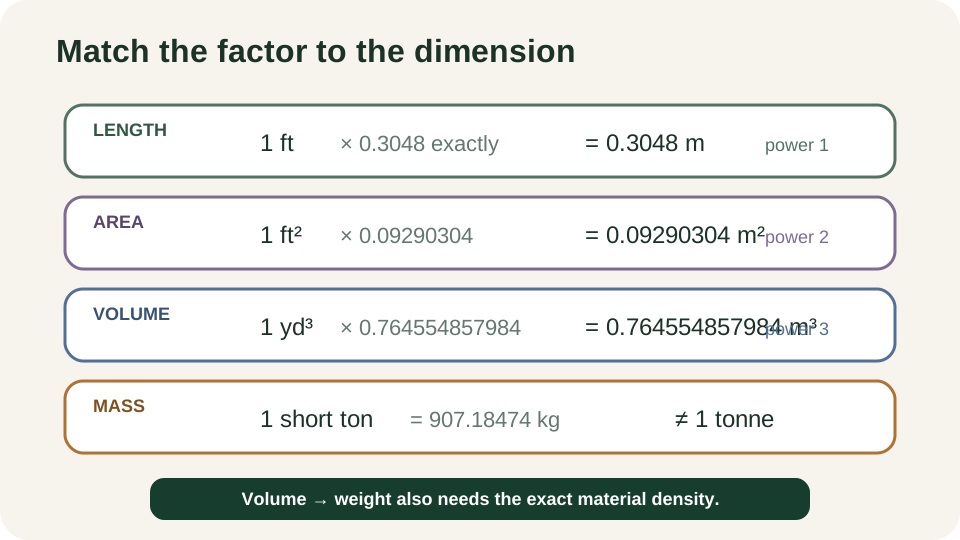
Length, area and volume do not use the same conversion factor. One foot is exactly 0.3048 metre, but one square foot is 0.3048² = 0.09290304 square metre and one cubic foot is 0.3048³ = 0.028316846592 cubic metre.
A common estimating error is to use a length factor on an area or volume. Write the unit beside every intermediate result so the exponent remains visible.
| From | To | Multiply by | Reverse factor |
|---|---|---|---|
| in | mm | 25.4 exactly | mm ÷ 25.4 |
| ft | m | 0.3048 exactly | m × 3.280839895 |
| ft² | m² | 0.09290304 exactly | m² × 10.763910417 |
| ft³ | m³ | 0.028316846592 exactly | m³ × 35.314666721 |
| yd³ | m³ | 0.764554857984 exactly | m³ × 1.307950619 |
| lb | kg | 0.45359237 exactly | kg × 2.204622622 |
| short ton (2,000 lb) | kg | 907.18474 exactly | kg ÷ 907.18474 |
| metric tonne | kg | 1,000 exactly | kg ÷ 1,000 |
Reverse factors are displayed to practical precision. The underlying BuildMeasure conversion functions retain the exact defined factors before display rounding.
Cubic yards to cubic metres: a concrete order example
To convert 2.5 yd³ to cubic metres, multiply by 0.764554857984: 2.5 × 0.764554857984 = 1.91138714496 m³, displayed as 1.911 m³. To convert 2 m³ to cubic yards, multiply by about 1.307950619: 2 × 1.307950619 = 2.616 yd³.
A converted exact volume is not automatically a supplier order. Apply the destination supplier's selling increment, minimum load, allowance and rounding rules after conversion, not before.
| Cubic yards | Cubic metres | Cubic metres | Cubic yards |
|---|---|---|---|
| 0.5 yd³ | 0.382 m³ | 0.5 m³ | 0.654 yd³ |
| 1 yd³ | 0.765 m³ | 1 m³ | 1.308 yd³ |
| 2 yd³ | 1.529 m³ | 2 m³ | 2.616 yd³ |
| 3 yd³ | 2.294 m³ | 3 m³ | 3.924 yd³ |
| 5 yd³ | 3.823 m³ | 5 m³ | 6.540 yd³ |
Table values are rounded for display. Use the calculator for the project quantity and supplier rounding.
Tons and tonnes are not the same — and neither converts from volume without density
A US short ton is 2,000 lb or exactly 907.18474 kg. A metric tonne is exactly 1,000 kg. Those are mass conversions. Converting cubic yards of gravel, soil or mulch into tons requires the bulk density of that exact material and moisture condition; there is no universal yards-to-tons factor.
Use the supplier density in the gravel calculator and keep the volume, density and resulting weight visible as separate lines. Do not use a concrete or gravel density for another material simply because the volumes share the same unit.
Conversion worksheet
Record the original value, its exponent, the exact factor and the unrounded result before formatting. Round only the displayed result unless a supplier rule explicitly requires purchase rounding.
| Original value + unit | Exact factor | Unrounded converted value | Displayed value | Supplier rounding / minimum |
|---|---|---|---|---|
Same project
Related measurement guides
Sources and limits
Check the project-specific details
- NIST — SI Units: Length — Official exact international foot and inch definitions from which the area and volume factors are derived.
- NIST Handbook 44, Appendix C — General Tables of Units of Measurement — Official US customary and SI unit relationships, including mass terminology and conversion references.
Review status: Measurement workflow and exact unit conversions checked editorially; project choices and material allowances pending human trade review.
This guide supports planning only. It does not specify structural design, code compliance, or a supplier quotation.