Gravel ordering reference
Gravel Cubic Yards to Tons: Ordering by Weight
Convert gravel cubic yards to tons using the density your supplier gives you: the exact NIST unit math, why density varies, and how to order by weight.
Published 2026-07-20 · Updated 2026-07-20 · BuildMeasure Editorial Team
Next step
Turn your measurements into a material estimate
Enter the recorded dimensions in the calculator. It shows the calculated amount, wastage allowance, and a supplier-ready suggested order.
Use the Gravel CalculatorSuppliers sell by weight; you measure by volume
You calculate a gravel project in volume — cubic yards or cubic feet — but most quarries and yards sell by weight, in US short tons. To turn one into the other you need the material's density: how much a given volume weighs. Density is the supplier's number, not a universal constant.
This reference explains the conversion so it works for any gravel job — a paver base, a French drain, a driveway, or a slab base — all of which end in the same question: how many tons do I order?
The conversion arithmetic
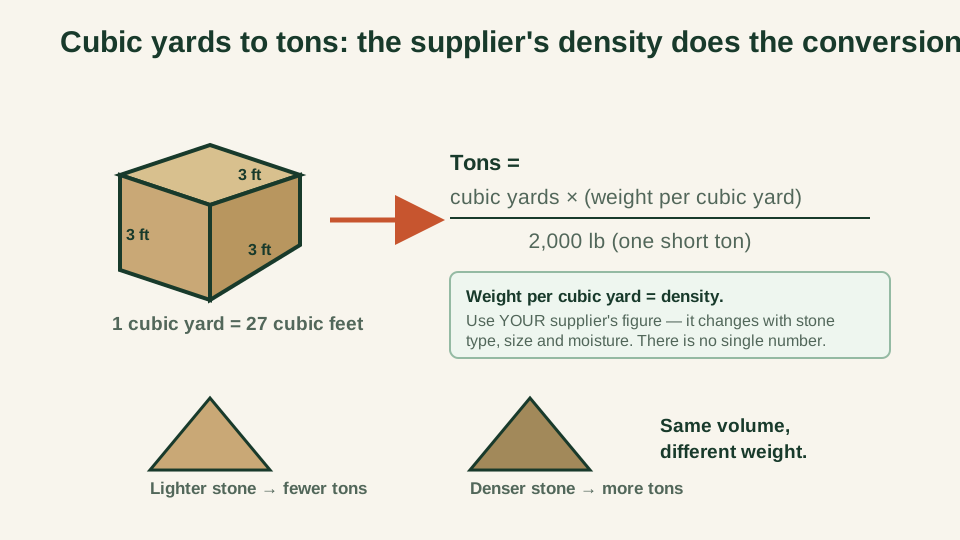
Two exact definitions from NIST do the work: 1 cubic yard = 27 cubic feet, and 1 US short ton = 2,000 pounds. Everything else is multiplication.
Tons = (cubic yards × weight per cubic yard in pounds) ÷ 2,000. If your density is in pounds per cubic foot instead, first multiply cubic yards by 27 to get cubic feet, then: tons = (cubic feet × pounds per cubic foot) ÷ 2,000.
- Cubic yards → cubic feet: × 27.
- Volume → pounds: × the density (lb per cubic yard, or lb per cubic foot).
- Pounds → short tons: ÷ 2,000.
Where density comes from — and why it varies
Density changes with stone type, particle size, and moisture. Pea gravel, No. 57 crushed stone, and crusher run are different gradations — standard size numbers under ASTM D448 / AASHTO M43 — and do not weigh the same per cubic yard. Damp stone weighs more than dry.
So there is no single 'tons per yard' figure to memorise. Ask your supplier for the material's weight per cubic yard (or per cubic foot), or for their coverage figures. The gravel calculator carries an editable density whose default is a clearly-labelled example — replace it with your supplier's number.
Convert whatever figure your supplier gives you
Suppliers state density in different ways. Use the row that matches what yours gives you.
| What the supplier gives you | How to convert to tons |
|---|---|
| Tons per cubic yard | tons = cubic yards × that figure |
| Pounds per cubic yard | tons = cubic yards × lb-per-yd³ ÷ 2,000 |
| Pounds per cubic foot | tons = cubic yards × 27 × lb-per-ft³ ÷ 2,000 |
| Coverage (sq ft per ton at a depth) | tons = area in sq ft ÷ that coverage |
Every figure in the left column is the supplier's, for the exact material. This page publishes no density of its own.
Same volume, different weight — worked example
Suppose a project comes to 3 cubic yards. The tonnage depends entirely on the density you were given.
If the supplier says 1.4 tons per cubic yard (about what the calculator's editable default works out to): 3 × 1.4 = 4.2 tons. If a denser stone is quoted at 1.5 tons per cubic yard: 3 × 1.5 = 4.5 tons. Same volume, different order.
Working from pounds per cubic foot instead: 3 cubic yards × 27 = 81 cubic feet; at a supplier figure of 105 pounds per cubic foot, 81 × 105 = 8,505 pounds ÷ 2,000 ≈ 4.25 tons.
Rounding, minimums, and tons vs tonnes
Quarries weigh the loaded truck, so your order is rounded to their increment; the calculator rounds up to the next quarter ton. Ask about delivery minimums and short-load fees, which can change the practical order size.
Watch the unit: a US short ton is 2,000 pounds, but a metric tonne is 1,000 kilograms (about 2,205 pounds). A how-to written for Canada, the UK, or Australia in 'tonnes' is not quoting the same unit as a US 'ton'.
Use the calculator on every gravel project
Because the conversion is the same everywhere, enter the volume from any gravel guide into the gravel calculator, set the density to your supplier's figure, and read off the tons and an editable cost estimate. The paver-base, French-drain, driveway, and slab-base guides all feed this one step.
Ordering checklist
Before you place a weight-based order:
- Total volume from your project, in cubic yards (or cubic feet).
- The material's density from the supplier (tons/yd³, lb/yd³, lb/ft³, or coverage).
- Density entered into the calculator, replacing the example default.
- Tons calculated and rounded up to the supplier's increment.
- Delivery minimum, short-load fee, and whether the quote is by ton or by tonne.
- Supplier price per ton entered for a cost estimate — no prices are built in.
Same project
Related measurement guides
Sources and limits
Check the project-specific details
- NIST Handbook 44 unit definitions — Exact definitions: 1 cubic yard = 27 cubic feet and 1 US short ton = 2,000 pounds, used in every conversion here.
- ASTM D448 / AASHTO M43 aggregate size numbers — Standard aggregate gradations (pea gravel, No. 57, crusher run, and others) weigh differently, so ask your supplier for the material's density.
Review status: Formulas and conversions covered by automated tests; measurement practice pending human trade review.
This guide supports planning only. It does not specify structural design, code compliance, or a supplier quotation.