Flooring planning guide
Flooring Pack Coverage and Rounding
Flooring is sold by the pack, not the square foot. How to go from measured area to waste allowance to whole packs, with the arithmetic shown.
Published 2026-07-16 · Updated 2026-07-16 · BuildMeasure Editorial Team
Next step
Turn your measurements into a material estimate
Enter the recorded dimensions in the calculator. It shows the calculated amount, wastage allowance, and a supplier-ready suggested order.
Use the Flooring CalculatorYou buy packs, not square feet
Laminate, engineered wood, luxury vinyl plank, and most solid hardwood are sold in packs, sometimes called cartons or boxes, and each pack states its coverage in square feet on the label, for example 19.6 sq ft or 23.8 sq ft per carton. The store will not split a pack, so your order is always a whole number of packs.
That means your measured area is the start of the calculation, not the end. Two separate adjustments sit between the tape measure and the order: the waste allowance, and whole-pack rounding. Keeping them separate is what makes the final number explainable.
Waste first, packs second
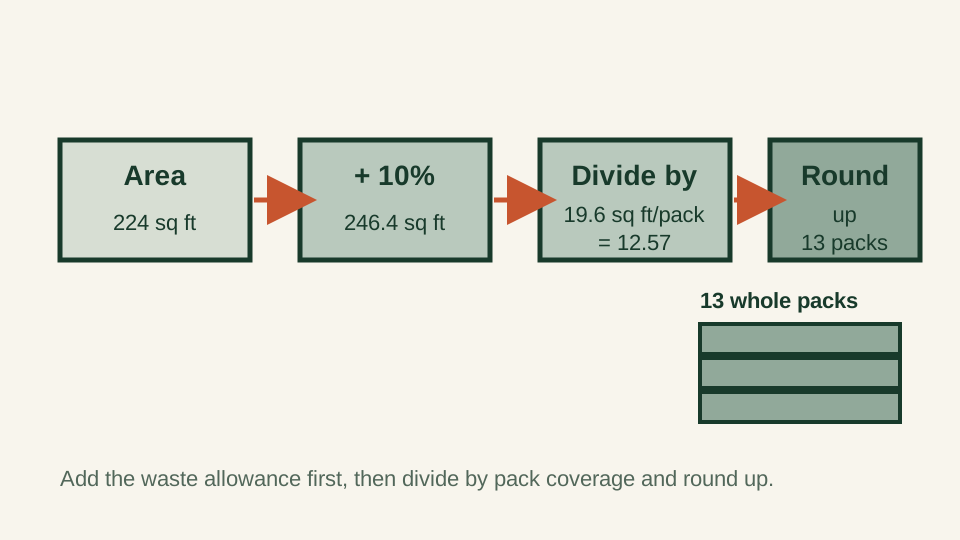
Apply the waste allowance to your measured area first, then divide by pack coverage, then round up. The order matters. If you round to packs first and add waste afterwards, you inflate a number that was already rounded up and lose track of what each step contributed.
The waste allowance covers end cuts at walls, boards trimmed around doorways, damaged boards, and offcuts too short to reuse. A 10 percent allowance is a commonly used planning figure for straight plank layouts; diagonal layouts and rooms with many doorways run higher. These are planning allowances, not guarantees, so confirm with your installer.
Whole-pack rounding is a purchasing step, not a waste step. Dividing the waste-adjusted area by the pack coverage almost never lands on a whole number, and the only direction you can round is up.
Worked example: 224 sq ft, 19.6 sq ft packs
Take the 224 sq ft L-shaped living area from the irregular-room worksheet, a straight plank layout with a 10 percent planning allowance, and flooring sold in packs that cover 19.6 sq ft each.
Each step below is a different quantity with a different job: the exact area is what the floor measures, the waste-adjusted area is what the job is expected to consume, and the pack count is what the store can actually sell you.
| Step | Calculation | Result |
|---|---|---|
| 1. Measured area | Sum of room sections | 224.0 sq ft |
| 2. Add 10% waste allowance | 224 × 1.10 | 246.4 sq ft |
| 3. Divide by pack coverage | 246.4 ÷ 19.6 | 12.57 packs |
| 4. Round up to whole packs | 12.57 → 13 | 13 packs |
| 5. Coverage ordered | 13 × 19.6 | 254.8 sq ft |
The 10% figure is a planning allowance commonly used for straight layouts, not a guarantee. Rounding 12.57 down to 12 packs would supply 235.2 sq ft against an expected consumption of 246.4 sq ft, roughly half a pack short.
Why an extra pack is often sensible
In the example, 13 packs supply 254.8 sq ft against an expected consumption of 246.4 sq ft, so the rounding itself already leaves 8.4 sq ft of headroom. Many buyers still add one more pack, 14 in total, and there is a practical reason beyond caution.
Flooring, like tile, is produced in batches, and color and texture are matched within a batch or dye lot. A pack bought two years later to repair a scratched board or a water-damaged corner may be visibly different from your floor even though the product name is identical. Boards from your original order are the only guaranteed match, so a spare pack stored flat in a dry closet is a repair kit you cannot buy later.
Leftover packs versus running short
The two ways to get this wrong are not symmetric. An unopened leftover pack has options: many retailers accept unopened cartons back within their return window, and if not, it becomes your repair stock. Its cost is bounded and known at the till.
Running short is worse in every direction. The job stalls with an unfinished strip of floor, you make an extra trip, and the packs you buy weeks later may come from a different batch that does not quite match the boards already laid. Whatever your flooring costs per pack, one pack of surplus is cheap insurance against finishing a floor with mismatched boards.
The flooring calculator applies exactly the steps above: enter your measured area, your chosen allowance, and the pack coverage printed on the label, and it reports the exact area, the waste-adjusted area, and the whole-pack order as three separate figures.
Same project
Related measurement guides
Sources and limits
Check the project-specific details
- National Wood Flooring Association — US industry association for wood flooring; its installation guidelines are the trade reference for layout and acclimation practice. Linked at the top level because guideline documents are member resources.
- Shaw Floors - How to guides — Manufacturer how-to library; individual product pages state per-carton coverage in square feet.
Review status: Formulas and conversions covered by automated tests; measurement practice pending human trade review.
This guide supports planning only. It does not specify structural design, code compliance, or a supplier quotation.