Site work planning guide
How Much Gravel for a French Drain
Measure the trench and clean-stone volume for a French drain using dimensions from a qualified plan, with pipe displacement subtracted explicitly.
Published 2026-07-20 · Updated 2026-07-20 · BuildMeasure Editorial Team
Next step
Turn your measurements into a material estimate
Enter the recorded dimensions in the calculator. It shows the calculated amount, wastage allowance, and a supplier-ready suggested order.
Use the Gravel CalculatorDimensions and materials come from a qualified plan
A French drain's size, depth, slope, pipe, stone, and fabric are drainage-design decisions. They must come from a qualified plan or professional for your site — this guide does not design a drain and recommends no dimension.
What this page does is arithmetic: once your plan fixes the trench size, it turns that into the trench volume and the volume of stone to order. If you do not have a plan, get one before you dig.
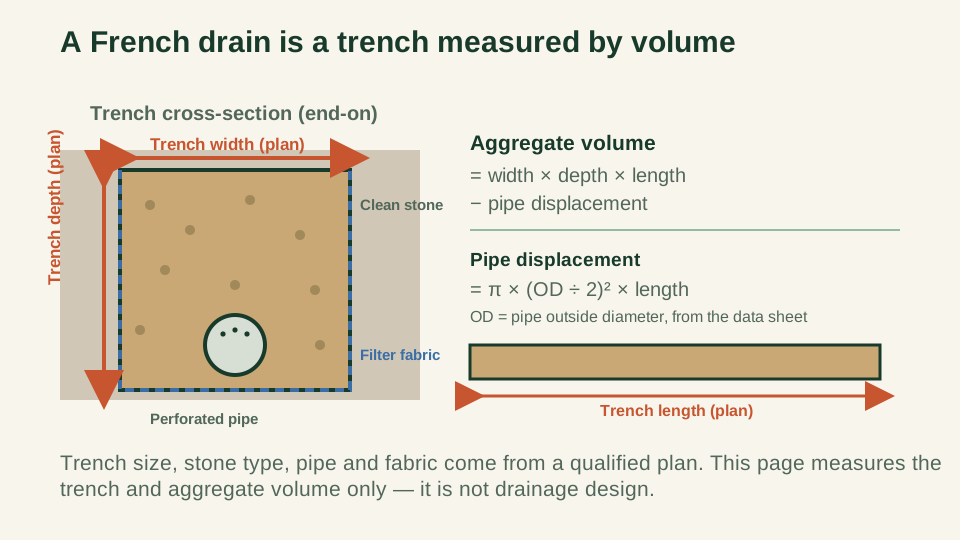
Trench volume = width × depth × length
A drainage trench is a long rectangular prism. Its volume is width × depth × length, with every measurement in the same unit. Convert width and depth from inches to feet (divide by 12) before multiplying, then divide by 27 for cubic yards.
Measure the trench you actually dig. If a run changes width or depth, or turns a corner, break it into straight segments, calculate each segment, and add them.
| Segment | Length (ft) | Width (ft) | Depth (ft) | Volume (cu ft) |
|---|---|---|---|---|
| Segment 1 | ||||
| Segment 2 | ||||
| Segment 3 | ||||
| Total |
Volume per segment = length × width × depth. Add the segments, then divide by 27 for cubic yards.
Subtract the pipe: aggregate volume = trench volume − pipe displacement
If the trench holds a drain pipe, the pipe occupies space that stone does not fill. Subtract the pipe's volume — its displacement — from the trench volume to get the stone volume: aggregate volume = trench volume − pipe displacement.
A round pipe displaces π × (OD ÷ 2)² × length, where OD is the pipe's actual outside diameter (not its nominal size) taken from the manufacturer's data sheet. Subtracting the pipe is optional: skip it and you simply order a little extra stone, which some installers prefer as a buffer.
| Input | Example value | Result |
|---|---|---|
| Pipe outside diameter (OD) | 4.5 in = 0.375 ft | radius 0.1875 ft |
| Cross-section area | π × 0.1875² | ≈ 0.110 sq ft |
| × trench length | 0.110 × 40 ft | ≈ 4.42 cu ft |
OD is an example only. Use your pipe's published outside diameter for the calculation.
Clean, open-graded stone: identity from your plan
French drains use a clean, open-graded stone so water can move through the voids. The specific size is your plan's choice; drainage plans often reference a standard aggregate size number such as No. 57, defined in ASTM D448 / AASHTO M43. Use the size your plan specifies and confirm it with the supplier.
Because it is open-graded, this stone is not compacted like a road base, so no compaction allowance is subtracted from the stone volume — though the calculator's wastage field still covers spillage and over-excavation if you want a buffer.
Order the stone by weight
Suppliers sell drainage stone by weight. Enter the stone volume in the gravel calculator with the supplier's density for that stone to convert cubic yards to tons, then enter the supplier's price for a cost estimate. Pipe and fabric are separate purchases and are not part of the stone weight.
See the cubic-yards-to-tons guide for how the density you enter drives the weight, and why it differs between stone types.
Worked example: 40 ft trench
Plan figures, shown to demonstrate the method: trench 40 ft long, 12 in (1.0 ft) wide, 18 in (1.5 ft) deep, with a pipe whose data sheet lists a 4.5-inch outside diameter.
Trench volume: 40 × 1.0 × 1.5 = 60 cubic feet.
Pipe displacement: π × (0.375 ÷ 2)² × 40 = π × 0.1875² × 40 ≈ 4.42 cubic feet.
Stone volume: 60 − 4.42 = 55.58 cubic feet ≈ 2.06 cubic yards. Convert to tons in the calculator with the supplier's stone density.
Field worksheet
Confirm every item against your plan before digging or ordering.
- Trench dimensions from your plan: length, width, and depth for each straight segment.
- Trench volume calculated per segment and summed (cu ft and cu yd).
- Pipe outside diameter from the manufacturer's data sheet, if a pipe is used.
- Pipe displacement calculated and subtracted, or left in as a buffer.
- Stone size and gradation as specified by your plan, confirmed with the supplier.
- Supplier density for the stone entered in the calculator to get tons.
- Filter fabric and pipe counted as separate purchases.
- Utility locates completed and the drainage design confirmed by a qualified professional.
Same project
Related measurement guides
Sources and limits
Check the project-specific details
- ASTM D448 / AASHTO M43 aggregate size numbers — Standard classification of open-graded coarse-aggregate sizes (for example No. 57 stone) your drainage plan may specify; use the gradation on your plan.
- NIST Handbook 44 unit definitions — Exact cubic-foot and cubic-yard definitions used in the trench-volume conversions.
Review status: Formulas and conversions covered by automated tests; measurement practice pending human trade review.
This guide supports planning only. It does not specify structural design, code compliance, or a supplier quotation.