Paint planning guide
How Much Paint Primer Do You Need? Coverage Planning
Find out how much paint primer you need by calculating coverage from the product label separately from the topcoat, then round each up to a container.
Published 2026-07-16 · Updated 2026-07-19 · BuildMeasure Editorial Team
Next step
Turn your measurements into a material estimate
Enter the recorded dimensions in the calculator. It shows the calculated amount, wastage allowance, and a supplier-ready suggested order.
Use the Paint CalculatorPrimer and topcoat are two separate calculations
How much primer you need depends on your primer's own label coverage and your paintable area, not on a fixed fraction of the topcoat. Calculate it as paintable area ÷ label coverage per coat, then round up to a whole container — the same steps as the worked example below.
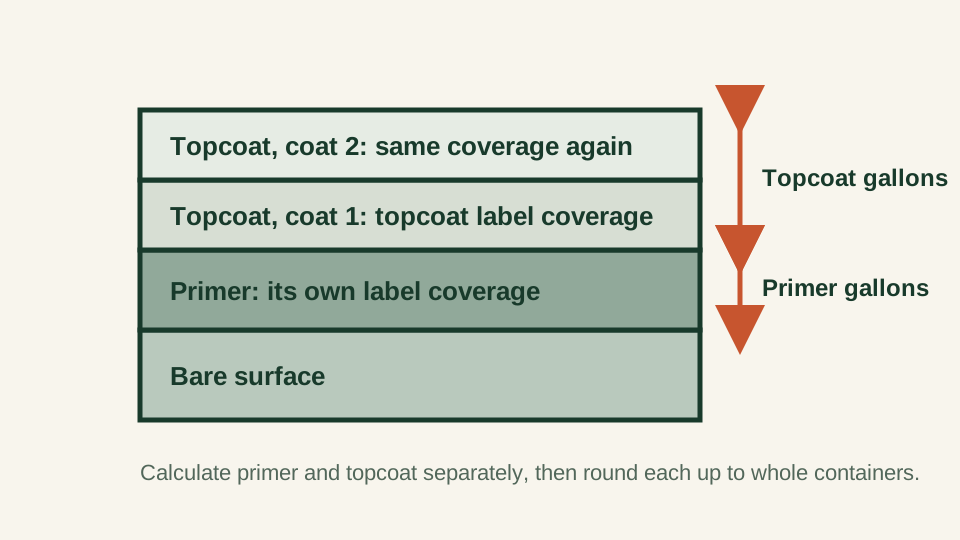
Primer is a different product with its own coverage figure, its own number of coats, and its own container rounding. Do not fold it into the topcoat estimate by adding an extra coat of paint; run the same area through two independent calculations.
The paintable area is usually the same for both, but the coverage rarely is. Take each product's coverage from its own label or technical data sheet. Manufacturer labels commonly print coverage in the 250–400 sq ft per gallon range, and the exact figure for your product is the one that matters.
When primer is usually part of the system
Manufacturers describe the situations where their topcoats need a primer underneath. Treat the list below as questions to confirm on the specific product data sheet, not as fixed rules, because requirements differ between product lines.
| Surface situation | Primer question to answer from the data sheet | Effect on quantity |
|---|---|---|
| Bare drywall or fresh joint compound | Does this topcoat require a drywall primer-sealer first? | Adds one full-area primer calculation before any topcoat |
| Water stains, smoke, or tannin bleed | Is a stain-blocking primer specified for this type of stain? | Adds primer at least over the stained areas, often the whole surface |
| Big color change, especially dark to light | Does the manufacturer recommend a tinted primer for this change? | One primer coat can replace an extra topcoat; quantities shift between products |
| Glossy or previously enamelled surfaces | Is a bonding primer required after cleaning and scuff-sanding? | Adds a full-area primer calculation and prep time |
| Sound, previously painted wall in a similar color | Does the data sheet allow topcoat directly over this surface? | Often no primer line at all; topcoat coats only |
Always confirm against the data sheet for the exact product you are buying, not the brand in general.
Coverage per coat and container rounding are different operations
Coverage per coat turns area into gallons: multiply the paintable area by the number of coats, then divide by the label coverage. That result is almost never a whole number.
Container rounding is a second, separate step: round the gallons up to the containers you can actually buy. Two coats needing 2.2 gallons means buying 3 gallons, or 2 gallons plus a quart if the product is sold in quarts. Round primer and topcoat up independently — a spare half gallon of primer cannot become topcoat.
Worked example: primer and topcoat for one room
Take a 15 ft × 12 ft room with 8 ft ceilings. Perimeter: 2 × (15 + 12) = 54 ft. Gross wall area: 54 × 8 = 432 sq ft. Deduct one unpainted 3 ft × 7 ft door (21 sq ft) and two 3 ft × 4 ft windows (24 sq ft): 432 − 45 = 387 sq ft of paintable wall.
Suppose the primer label states 300 sq ft per gallon and the plan is one primer coat: 387 ÷ 300 = 1.29 gallons, which rounds up to 2 gallons, or 1 gallon plus 2 quarts where quarts are sold.
Suppose the topcoat label states 350 sq ft per gallon and the plan is two coats: 387 × 2 = 774 sq ft of coverage needed, and 774 ÷ 350 = 2.21 gallons, which rounds up to 3 gallons. The coverage figures here are stand-ins for the example — replace them with the numbers printed on your actual products.
Self-priming paint claims: check the conditions
Paint-and-primer-in-one products do exist, but the claim comes with conditions printed in the data sheet — typically a sound, previously painted surface in a similar color. On bare drywall, stains, or glossy surfaces the same data sheet often still calls for a dedicated primer.
If a self-priming product qualifies for your surface, you are back to a single topcoat calculation. If it does not, plan both products separately as above. When in doubt, the product data sheet outranks the front of the can.
Same project
Related measurement guides
Sources and limits
Check the project-specific details
- Sherwin-Williams homeowner resources — Manufacturer starting point for product data sheets stating coverage and primer requirements.
- EPA lead information — Surface prep that disturbs old paint in pre-1978 homes may involve lead-based paint.
Review status: Formulas and conversions covered by automated tests; measurement practice pending human trade review.
This guide supports planning only. It does not specify structural design, code compliance, or a supplier quotation.