Materials estimating guide
How Much Screed Do I Need? (UK Volume, Depth and Bags)
How much screed do I need? Multiply floor area by depth: 10 m² at 50 mm is 0.5 m³. Minimum depths, screed over UFH and insulation, and 25 kg bags per m².
Published 2026-09-19 · Updated 2026-09-19 · BuildMeasure Editorial Team
Next step
Turn your measurements into a material estimate
Enter the recorded dimensions in the calculator. It shows the calculated amount, wastage allowance, and a supplier-ready suggested order.
Use the Concrete Volume Calculator for screed m³How much screed do I need? Floor area × depth
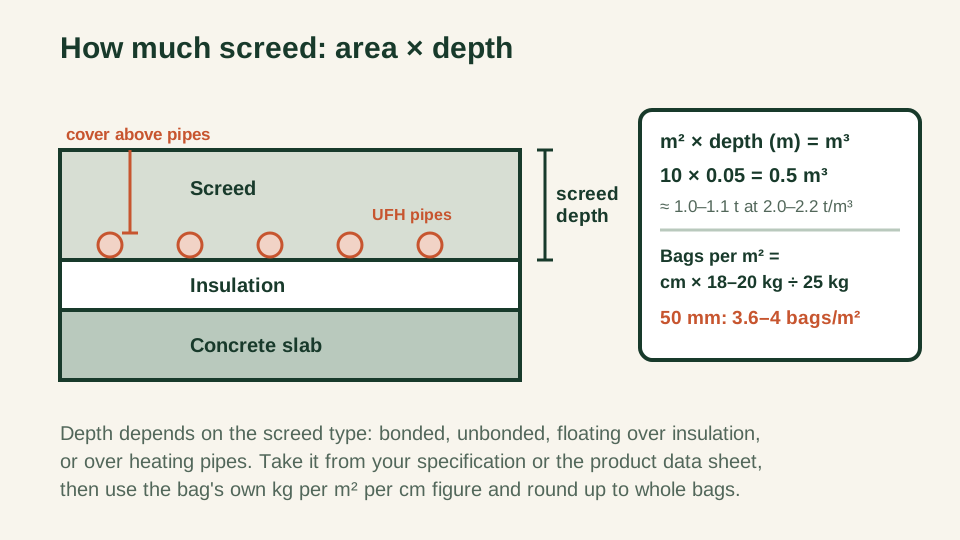
How much screed you need is the floor area in m² multiplied by the screed depth in metres. A 10 m² floor at 50 mm needs 10 × 0.05 = 0.5 m³, about 1.0–1.1 tonnes of wet screed. In 25 kg bags of a pre-bagged screed using 18–20 kg per m² per cm, that is 3.6–4 bags per m², or 36–40 bags for 10 m².
The depth is the decision that matters, and it depends on the screed type and what sits underneath: bonded to a slab, laid on a membrane, floating over insulation, or covering underfloor heating pipes. The figures below are published guidance, not a design. Your screed contractor, the UFH designer or the product's data sheet sets the depth for your floor.
Minimum screed depths by type (published guidance)
Traditional sand and cement screed follows BS 8204. The Concrete Society's summary gives bonded screeds an optimum 25–40 mm, unbonded screeds a minimum of 50 mm, and floating screeds more than 65 mm for lightly loaded floors and 75 mm for more heavily loaded floors. Liquid (flowing) screeds can be laid thinner: the figures below come from the manufacturers' own data.
| Screed type | Bonded | Unbonded (on membrane) | Floating over insulation | Over underfloor heating |
|---|---|---|---|---|
| Sand and cement (BS 8204-1 summaries) | 25–40 mm | 50 mm minimum | 65 mm light/domestic, 75 mm heavier | 75 mm minimum, 65 mm domestic |
| Cementitious liquid (Cemfloor Complete) | 20 mm | 30 mm | 35 mm domestic, 40 mm commercial | 25 mm above the pipes |
| Anhydrite liquid (Gyvlon) | 25 mm | 30 mm | 35 mm domestic, 40 mm commercial | 25 mm cover over the pipes |
Sources: Concrete Society and Designing Buildings summaries of BS 8204; SMET's summary of BS 8204-1 heated screeds; Cemfloor Complete technical data sheet; Gyvlon FAQ. These are minimums from published guidance — the specified depth may be greater, and some proprietary systems allow less.
Volume, weight and 25 kg bags by area and depth
Once you know the depth, volume is area × depth. To estimate weight, liquid screeds are published at a fresh density of about 2,100–2,200 kg/m³ (Cemfloor Complete) and around 80 kg/m² at 40 mm (Gypsol), which is 2,000 kg/m³, so 2.0–2.2 tonnes per m³ is a sensible planning range.
For pre-bagged screed, use the consumption printed by the manufacturer. Mapei's Topcem Pronto, a ready-to-use screed in 25 kg bags, states 18–20 kg per m² per cm of thickness depending on compaction. Bags = area × depth in cm × 18 to 20 ÷ 25, rounded up.
| Floor area | Depth | Volume | Weight at 2.0–2.2 t/m³ | 25 kg bags |
|---|---|---|---|---|
| 1 m² | 50 mm | 0.05 m³ | 100–110 kg | 3.6–4 bags |
| 5 m² | 40 mm | 0.20 m³ | 400–440 kg | 15–16 bags |
| 10 m² | 50 mm | 0.50 m³ | 1.00–1.10 t | 36–40 bags |
| 10 m² | 65 mm | 0.65 m³ | 1.30–1.43 t | 47–52 bags |
| 10 m² | 75 mm | 0.75 m³ | 1.50–1.65 t | 54–60 bags |
| 20 m² | 75 mm | 1.50 m³ | 3.00–3.30 t | 108–120 bags |
Volume = area × depth in metres. Bags = area × depth in cm × 18 (low) or 20 (high) ÷ 25, rounded up to whole bags; the 1 m² row is left unrounded to show bags per m². Before any allowance for an uneven base. Other products have different consumption — use your bag's figure.
Worked example: a 4.0 m × 3.5 m room with underfloor heating
Floor area = 4.0 × 3.5 = 14 m². Suppose the UFH designer specifies a 75 mm floating sand and cement screed over insulation. Volume = 14 × 0.075 = 1.05 m³, about 1.05 × 2.0 = 2.10 to 1.05 × 2.2 = 2.31 tonnes. In 25 kg bags at 18–20 kg/m² per cm: 14 × 7.5 × 18 = 1,890 kg ÷ 25 = 75.6, so 76 bags; 14 × 7.5 × 20 = 2,100 kg ÷ 25 = 84 bags. Add 10% for an uneven base: 84 × 1.1 = 92.4, so plan 93 bags.
Ninety-odd bags is more than two tonnes to carry in and mix, so at this size many people order semi-dry screed by the m³ (some volumetric trucks carry screed) or use a liquid screed contractor. For comparison, an anhydrite liquid screed over, say, 16 mm pipes with the 25 mm minimum cover needs at least 16 + 25 = 41 mm, which is above the 35 mm domestic floating minimum. At 41 mm the volume is 14 × 0.041 = 0.574 m³ — roughly half the sand and cement figure. The pipe diameter is an example; take yours from the heating system, and the contractor sets the final depth.
Sand and cement ratio, or liquid screed?
Tarmac describes a traditional cementitious screed as typically 1:3 or 1:4.5 cement to sharp sand. Designing Buildings gives the same 1:3 to 1:4.5 range. Follow the ratio on your specification or cement bag rather than a rule of thumb, because a leaner mix is weaker and harder to finish well.
Liquid screeds are either cement-based (such as Cemfloor) or calcium-sulphate anhydrite (such as Gyvlon and Gypsol). They self-compact around UFH pipes and can be laid thinner, which reduces the volume. Tarmac notes that flowing anhydrite screeds are often used over underfloor heating because of their thinner section. They are usually pumped by a specialist contractor, priced by the m³ or m².
- Sand and cement: DIY-friendly, mixed on site or bought pre-bagged; thicker minimums; longer drying.
- Cementitious liquid: pumped or mixed from bags; bonded from 20 mm and floating from 35 mm (Cemfloor Complete data).
- Anhydrite liquid: pumped by a contractor; bonded from 25 mm and floating from 35 mm (Gyvlon); is usually sanded a few days after laying (Gyvlon).
Before you order: screed checklist
Check these so the volume matches the floor you are actually laying.
- Floor area measured in metres, split into rectangles for L-shaped rooms and added together.
- Screed type decided: bonded, unbonded, floating over insulation, or over underfloor heating.
- Depth taken from the specification, UFH designer or product data sheet — not guessed.
- Depth measured at several points where the base is uneven; use the average for volume and the deepest point for the check.
- Volume = area × depth in metres, with an allowance for level variations.
- Bags worked out from the product's own kg per m² per mm or cm figure, rounded up to whole bags.
Common questions
Short answers to the screed questions people search for most.
- How much screed per m²? — 1 m² × depth. At 50 mm that is 0.05 m³, about 100–110 kg, or 3.6–4 × 25 kg bags of a screed using 18–20 kg/m² per cm.
- How much screed on top of underfloor heating? — Published guidance for liquid screeds is a minimum of 25 mm above the pipes (Cemfloor Complete, Gyvlon); sand and cement heated screeds are summarised at 65 mm domestic or 75 mm total. Your UFH designer confirms the depth.
- How much screed over insulation? — A floating sand and cement screed is summarised at more than 65 mm for lightly loaded floors and 75 mm for heavier loads; liquid screeds are published at 35 mm domestic and 40 mm commercial.
- What is the sand and cement ratio for screed? — Typically 1:3 or 1:4.5 cement to sharp sand (Tarmac). Follow the ratio in your specification.
- How many bags of screed per m²? — Depth in cm × the bag's kg per m² per cm ÷ 25. At 65 mm and 18–20 kg/m² per cm that is 4.7–5.2 bags per m².
Same project
Related measurement guides
Sources and limits
Check the project-specific details
- The Concrete Society — Screeds: general — Summary of BS 8204 screed thicknesses: bonded 25–40 mm, unbonded minimum 50 mm, floating greater than 65 mm for lightly loaded and 75 mm for heavily loaded floors.
- Designing Buildings — Screed — Reference summary giving 1:3 to 1:4.5 cement to sand, bonded 25–40 mm, unbonded around 50 mm, floating 65/75 mm, and thinner calcium sulphate options.
- SMET — Trouble-free screeding with underfloor heating — Summarises BS 8204-1 for heated cementitious levelling screeds (75 mm minimum, or 65 mm for domestic) and BS 8204-7 for self-smoothing screeds (40 mm commercial, 35 mm domestic).
- Tarmac — Floor screed — Manufacturer page stating a cementitious screed is typically a 1:3 or 1:4.5 ratio of cement to sharp sand, and that anhydrite flowing screeds are often used over underfloor heating.
- Cemfloor Complete technical data sheet — Manufacturer data: 25 kg bags; minimum thickness bonded 20 mm, unbonded 30 mm, floating 35 mm domestic / 40 mm commercial, 25 mm above UFH pipes; fresh density 2,100–2,200 kg/m³.
- Gyvlon — Frequently asked questions — Anhydrite screed manufacturer minimum depths: bonded 25 mm, unbonded 30 mm, over insulation 35 mm domestic and 40 mm commercial, and a 25 mm minimum over underfloor heating.
- LKAB Minerals — Gypsol anhydrite screed — Anhydrite binder screed stating about 80 kg/m² at 40 mm (equivalent to 2,000 kg/m³), used here for the weight range.
- Flooring Materials — Mapei Topcem Pronto 25 kg — UK stockist listing for Mapei's ready-to-use screed in 25 kg bags, quoting coverage of 18–20 kg/m² per cm of thickness depending on compaction.
Review status: Formulas and worked examples checked by hand; measurement practice pending human trade review.
This guide supports planning only. It does not specify structural design, code compliance, or a supplier quotation.