Landscaping
Sod Calculator — Pallets Needed from Square Feet
Measure the lawn, subtract hardscape and beds, enter the selected supplier’s pallet coverage, and get net area, allowance, exact pallets, whole pallets, and spare coverage.
Formula tested · Local units · No sign-up
Project inputs
Enter measurements
Use your preferred units. Results update automatically.
Show the calculation methodFormula, conversions, rounding, and assumptions+
Net sod area = gross measured lawn area − measured house, driveway, bed, and other non-sod surfaces. For irregular sites, total simple measured sections before entering known-area mode.
Coverage to purchase = net area + the cutting/handling allowance you choose. The calculator shows the allowance in square feet and does not insert a hidden percentage.
Exact pallets = coverage to purchase ÷ supplier-stated coverage per pallet. The purchase quantity rounds up once to a whole pallet, then reports the coverage remaining after that rounding.
Pallet coverage is an input rather than a site default because coverage can differ by grass, producer, piece or roll dimensions, and sale unit. A typical value in one extension reference is not a universal product specification.
Real-world example
4,000 ft² lawn with 500 ft² pallets
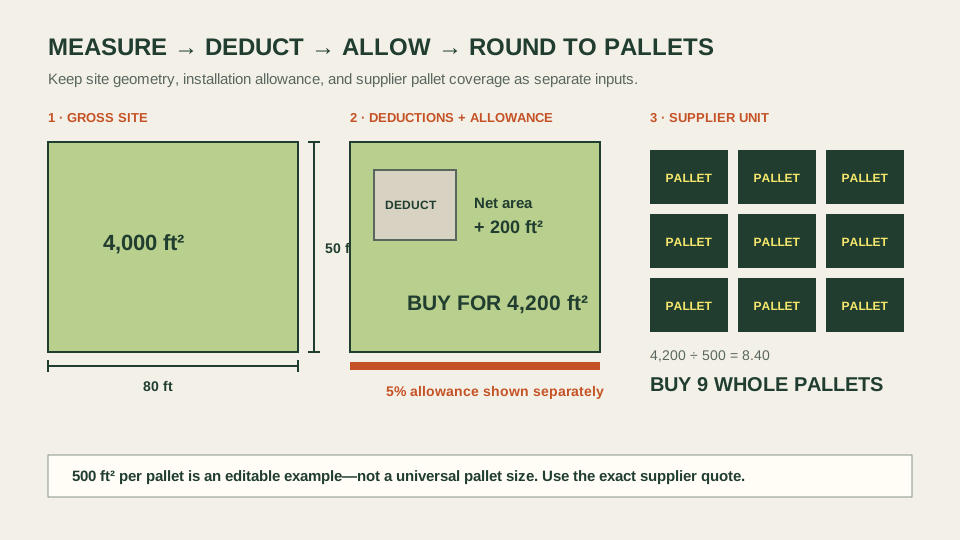
- An 80 ft × 50 ft rectangle has a gross measured area of 4,000 ft². The example includes no hardscape or bed deductions.
- A user-selected 5% cutting/handling allowance is 200 ft², so the coverage to purchase is 4,200 ft².
- The example supplier coverage is 500 ft² per pallet: 4,200 ÷ 500 = 8.40 pallets.
- Round up once to a purchasable unit: buy 9 pallets. Nine example pallets cover 4,500 ft².
- Whole-pallet rounding leaves 300 ft² beyond the allowance-adjusted purchase area. No price, tax, delivery, or pallet deposit is assumed.
The example needs 9 whole pallets. The 500 ft² coverage and 5% allowance are editable demonstration inputs; use the exact supplier coverage and a project-specific allowance.
Before you start
How to measure
- Sketch the site and break it into rectangles, triangles, circles, or measured irregular sections. Label every dimension and keep the section areas so the total can be checked.
- Measure the gross site first. Measure the house footprint, driveway, walks, beds, patios, and other surfaces that will not receive sod separately and subtract them once.
- Use known-area mode when a survey, takeoff, mapping tool, or section worksheet already provides the gross square footage. Keep the source and date with the estimate.
- Choose an allowance that reflects the actual layout, curves, edges, handling, and installation plan. The calculator does not prescribe or silently add one.
- Ask the selected supplier for square feet per delivered pallet for the exact grass and cut. If the quote gives piece dimensions and count instead, confirm the supplier’s stated pallet coverage rather than multiplying nominal dimensions without checking gaps or sale-unit conventions.
- Confirm delivery access, pallet placement, preparation completion, irrigation readiness, and installation timing before accepting fresh sod.
Local guidance
Notes for United States
- This page is published for US projects and defaults to feet, square feet, whole pallets, USD, and optional user-entered sales tax.
- University of Georgia Extension examples show that typical pallet coverage can differ among turf types. That is why this calculator requires the selected supplier’s coverage instead of hard-coding one value.
- Penn State Extension recommends measuring the total site and subtracting structures and other areas where turf will not be established. Its lawn-establishment guidance also describes sod as rectangular strips delivered on pallets.
- Fresh sod is time-sensitive. University extension guidance emphasizes prompt laying, staggered seams, prepared soil, close-fitting pieces, soil contact, and appropriate watering; coordinate exact instructions for the turf and local conditions.
Quick reference
Sod pallet order worksheet
| Quantity | How to obtain it | How it is used |
|---|---|---|
| Gross lawn area | Measured sections or approved takeoff | Starting square footage |
| Non-sod deductions | Measured hardscape, structures, and beds | Subtracted once from gross area |
| Cutting/handling allowance | User’s layout and installation decision | Shown separately and added to net area |
| Coverage per pallet | Exact supplier quote or product sheet | Divides purchase area into pallet units |
| Whole pallets | Calculator ceiling after division | Purchasable order quantity |
| Price and tax | Current supplier quote and local rate | Optional user-entered material estimate |
Do not reuse a pallet-coverage number from another turf type, producer, or region without supplier confirmation.
Good to know
Common mistakes to avoid
- Using lot size as lawn size without subtracting the house, driveway, beds, patios, and other non-sod surfaces.
- Measuring an irregular lawn as one rough rectangle instead of summing smaller, checkable shapes.
- Treating 450 or 500 ft² as a universal pallet even though supplier coverage can differ.
- Applying an allowance to gross area before deductions, which also adds sod for surfaces that will not be covered.
- Rounding each small section to pallets separately instead of combining compatible areas and rounding the order once.
- Confusing allowance area with spare coverage created by whole-pallet rounding; both are shown separately.
- Ordering before confirming fresh-harvest timing, unloading access, pallet placement, site preparation, and irrigation readiness.
Need help?
Frequently asked questions
How many square feet are in a pallet of sod?
There is no single coverage value safe for every order. Coverage varies by turf, producer, cut dimensions, and sale unit. Enter the square-foot coverage printed on the selected quote or product sheet; extension examples of 450 or 500 ft² are context, not universal defaults.
How many pallets do I need for 4,000 square feet?
It depends on deductions, allowance, and the supplier’s pallet coverage. With no deductions, a user-selected 5% allowance, and 500 ft² per pallet, the purchase area is 4,200 ft² and the result rounds from 8.4 to 9 pallets.
Should I subtract the house, driveway, and garden beds?
Yes, when they are measured surfaces that will not receive sod. Enter them as deductions from the gross lawn site. Do not subtract the same surface again if your known-area input is already a net turf area.
Does the calculator add a waste percentage automatically?
No. Enter the cutting/handling allowance appropriate to the project. The calculator reports that square footage separately, then shows any additional coverage left by rounding to whole pallets.
Can I buy partial pallets?
Supplier policies vary. This page rounds the main order to whole pallets because the target query is pallet purchasing. Ask whether loose pieces, rolls, or partial pallets are available and compare the supplier’s exact units before changing the order.
Does the estimate include delivery or preparation?
No. Optional cost includes only whole pallets, the price entered, and any tax entered. Delivery, pallet deposits, grading, soil testing, amendments, equipment, labor, irrigation, and disposal remain separate planning items.
Keep planning
Related calculators
Transparency
About this calculator
- Written by:
- BuildMeasure Editorial Team
- Technically reviewed by:
- Pending independent technical reviewer (formula unit-tested; see methodology)
- Last reviewed:
- 2026-07-20
- Formula version:
- 1.0.0
- Region reviewed for:
- United States
- Spotted an error?
- Report a correction
Methodology
- Length and area inputs are converted to exact SI units before arithmetic, then displayed in US square feet using exact conversion definitions.
- Rectangle mode multiplies converted length × width. Known-area mode accepts a measured area directly. Deductions are converted independently and must be smaller than gross area.
- Net area = gross area − deductions. Allowance area = net area × user-entered percentage. Purchase area = net area + allowance area.
- Exact pallets = purchase area ÷ user-entered pallet coverage. Whole pallets use guarded ceiling arithmetic so an exact multiple is not increased by one.
- Spare coverage = whole pallets × pallet coverage − purchase area. It is not merged with the user-entered cutting allowance.
- Optional cost = whole pallets × user-entered pallet price, plus user-entered tax. No live price, delivery fee, or deposit is embedded.
- Automated tests cover the worked example, deductions-before-allowance order, exact and fractional pallet boundaries, unit conversion, spare coverage, cost/tax, validation, publication scope, and diagram presence.
Sources & standards
- Penn State Extension — Lawn Establishment: University guidance on measuring the site, subtracting structures and non-turf areas, sod delivery form, prompt use, staggered installation, and site preparation.
- University of Georgia Extension — Tips for Planting Sod in the Winter, Part Two: Extension example showing that stated pallet coverage can differ among turf types, supporting a supplier-entered rather than universal pallet default.
- University of Georgia Extension — Soil Preparation Essential for Sod Success: Extension preparation and installation workflow covering soil testing, debris, amendments, leveling, tight staggered pieces, rolling, and watering.
- University of Minnesota Extension — Seeding and Sodding Home Lawns: Reviewed extension guidance on fresh sod timing, staggered seams, slopes, soil contact, watering, and establishment checks.
- NIST — SI Units: Length: Official exact foot/metre relationship used to convert lengths and square areas in the shared unit library.
This calculator estimates sod quantity from measured area and supplier-stated coverage. It does not select a turfgrass, assess site suitability, replace soil testing or preparation guidance, schedule harvest or irrigation, or guarantee establishment. Confirm the order, delivery, and installation requirements with the supplier and relevant local professionals.