Concrete planning guide
How to Measure an Irregular Concrete Slab
Measure L-shaped, T-shaped, and other irregular slabs by decomposing them into rectangles, then calculating each section separately.
Published 2026-07-16 · Updated 2026-07-16 · BuildMeasure Editorial Team
Next step
Turn your measurements into a material estimate
Enter the recorded dimensions in the calculator. It shows the calculated amount, wastage allowance, and a supplier-ready suggested order.
Use the Concrete Slab CalculatorDo not estimate irregular shapes by eye
An L-shaped or T-shaped slab looks simple, but eyeballing its volume is a common source of shortages and waste. The volume of an irregular outline depends on how you measure the internal jogs and missing corners.
Decompose the shape into simple rectangles. This makes the math transparent, the measurements repeatable, and the order quantity defensible.
The rectangle decomposition method
Irregular slabs are made of rectangles. An L is two rectangles. A T is three. A complex five-sided slab is a rectangle with a notch cut out, or two overlapping rectangles.
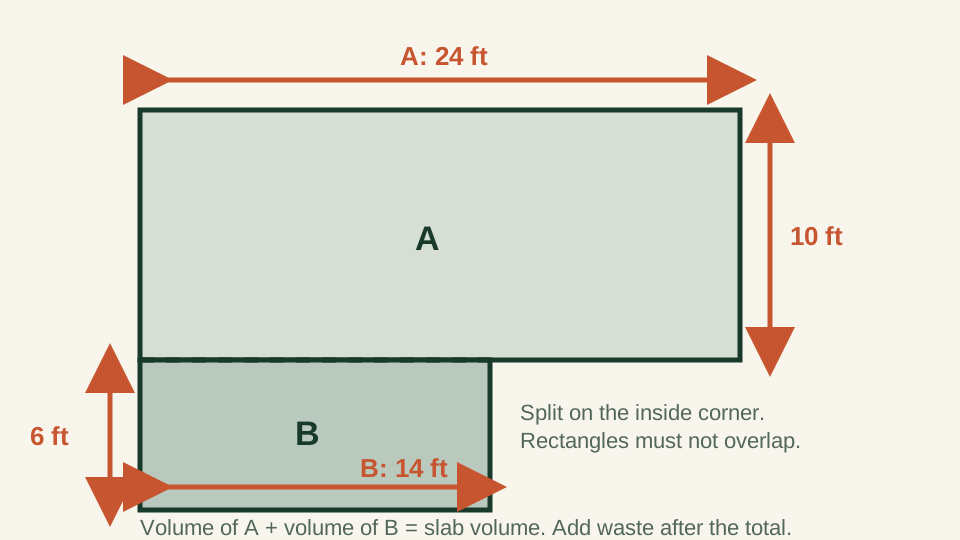
Draw the slab outline on paper or a sketch board. Divide it with straight lines so that each piece is a simple rectangle. Label each rectangle (A, B, C, etc.). Measure the length, width, and thickness of each rectangle. Multiply and add.
There is often more than one way to split a shape — split it the way that uses the fewest rectangles and keeps the geometry clear.
Worked example: an L-shaped deck foundation
The slab is L-shaped: a long arm on the east side and a short arm on the north. Sketch it. Split it into two rectangles: Rectangle A (the long arm) and Rectangle B (the short arm), being careful not to double-count the corner.
Rectangle A (east): 20 ft long, 12 ft wide, 4 inches thick. Volume: 20 × 12 × (4 ÷ 12) = 80 cu ft.
Rectangle B (north extension): 16 ft long, 6 ft wide, 4 inches thick. Volume: 16 × 6 × (4 ÷ 12) = 32 cu ft.
Total: 80 + 32 = 112 cu ft = 4.15 cu yd (plus 10% waste = 4.57 cu yd, which rounds up to 4.75 or 5.0 cu yd depending on the supplier's increment, before checking their minimum).
| Rectangle | Length (ft) | Width (ft) | Thickness (in) | Volume (cu ft) |
|---|---|---|---|---|
| A (east arm) | 20 | 12 | 4 | 80 |
| B (north extension) | 16 | 6 | 4 | 32 |
| C (if needed) | — | — | — | — |
| Total | — | — | — | 112 |
Volume per row is length × width × (thickness ÷ 12). Add all rows. Convert to cubic yards by dividing by 27. Add waste allowance and round up.
Handle thickness variations
If the slab has a thickened edge (common for slabs-on-grade), measure that edge as a separate rectangle: a narrow strip around the perimeter with its own width and thickness.
If the thickness varies across the slab (sloped drainage, for example), split the slab so each rectangle has one consistent thickness.
Field measurement checklist
Before ordering, sketch the slab shape and label each rectangle. Walk the site with a tape measure and record every dimension below.
- Sketch the slab outline roughly to scale, or photograph it with a tape measure for scale.
- Draw decomposition lines to split the outline into rectangles; label each (A, B, C, etc.).
- For each rectangle: length and width in feet, measured along the inside of the forms.
- Thickness in inches at multiple points (the deepest point if the base is uneven).
- Any thickened edges or special sections; measure them as separate rectangles.
- Total outline perimeter, as a sanity check on your overall measurements.
- Photos of the formed-up slab from above and at least one corner for reference.
Same project
Related measurement guides
Sources and limits
Check the project-specific details
- NIST unit conversion reference — Reference for exact foot and yard definitions used in decomposition calculations.
- American Concrete Institute design guides — General information on concrete slab design and placement.
Review status: Formulas and conversions covered by automated tests; measurement practice pending human trade review.
This guide supports planning only. It does not specify structural design, code compliance, or a supplier quotation.